
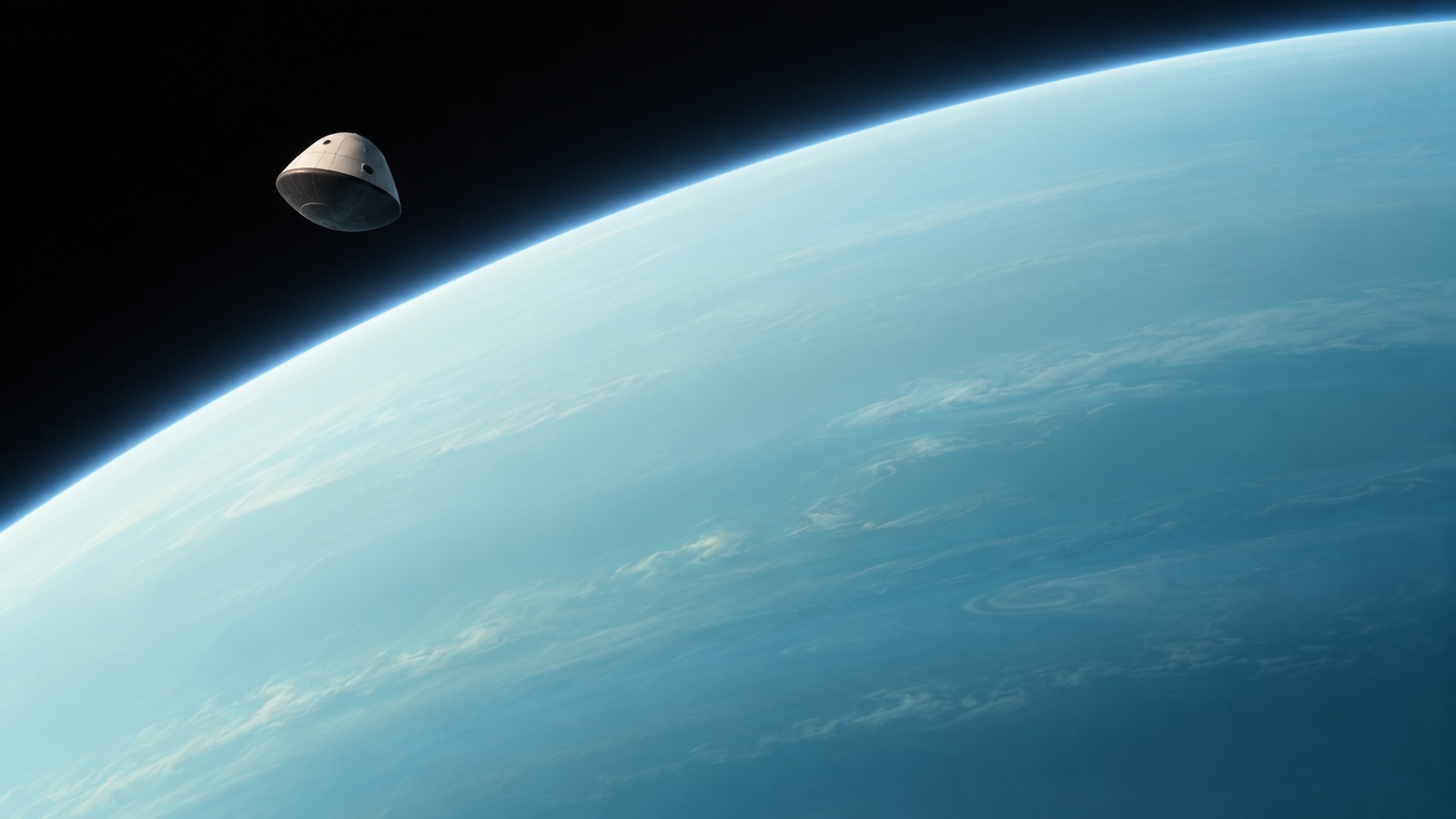
A Fall Would Begin in Cold Air and End Before the Deep Interior
Falling into Uranus would not mean landing on a blue ice sheet. You would enter a hydrogen-rich atmosphere, encounter clouds and increasing pressure, and move toward hot, compressed material whose detailed arrangement remains uncertain. To follow that sequence, imagine a sealed probe released above the visible clouds with thermal protection and a working radio, rather than an unprotected person arriving at interplanetary speed. This slow-entry starting assumption removes one source of immediate heating but does not make the descent safe. We can describe the upper conditions and the forces acting on the probe; deeper layers must remain explicitly model-dependent. The resulting journey has recognizable stages—cold air, obscured views, increasing drag and hull stress—without inventing a measured route to the center.
No Probe Has Supplied a Uranian Descent Record
Voyager 2 flew past Uranus in January 1986, returning measurements of the planet, rings, moons, and surrounding environment. It did not enter the atmosphere. Remote observations from Earth and space telescopes have expanded the record since then, while scientists continue to reanalyze the flyby data. NASA’s Uranus encounter history describes that achievement. A narrated fall must not turn the flyby into a direct pressure-by-pressure exploration of the interior.
This limited record does not leave scientists with no information. Spectra constrain atmospheric constituents, occultations investigate vertical structure, and gravity and magnetic measurements constrain hidden properties. Material physics and numerical models connect those signals to possible interiors. The important distinction is how the information was obtained. Some statements describe measured upper-atmosphere behavior, while others describe a distribution consistent with indirect constraints.
Our probe begins with information gathered remotely rather than a previously surveyed landing corridor. Instruments would measure the local pressure, temperature and composition as it moved, turning the journey itself into the first direct profile along that path. The radio record would be a sequence of atmospheric samples, not a continuous photograph of every layer. An accompanying orbiter could provide the larger weather context and receive the transmissions. We would learn most from matching each sensor reading to the probe’s changing location and motion. Voyager’s flyby supplies the planetary framework; the hypothetical entry supplies the local measurements that framework still lacks.
The first visible change might be the loss of the clean blue disk seen from space. A probe approaching the atmosphere would see a local cloud and haze environment expand across its view rather than watch a miniature globe beneath its feet. Once suspended particles reduced visibility, nearby scattering could hide more distant structures. Pressure and temperature sensors would then become better guides than the window. A descent narrative can follow those changing signals without requiring a photograph of each deeper region. Where the modeled interior begins, we should describe possible material behavior rather than add unobserved scenery.
The Pale Appearance Is Not the Physical Medium
Uranus’s blue-green appearance results from how its atmosphere scatters and absorbs sunlight. Methane contributes to absorption at red wavelengths, while haze and clouds also matter. That color is not a picture of an exposed water ocean. It cannot establish whether a particular deep region is liquid, solid, or a mixture. A view from far away identifies an optical outcome, while a descending instrument would need to measure the local material.
Nor does a relatively smooth visible disk establish gentle weather. Features can have low visible contrast and become clearer at other wavelengths. Observing geometry and season affect the portrait as well. An object entering the atmosphere encounters gas motion regardless of whether a distant photograph shows a dramatic storm. Surface-like smoothness is therefore a poor guide to the mechanical loads or local visibility a vehicle would experience.
The Upper Air Is Cold and Biologically Unsuitable
Near the one-bar atmospheric reference, NASA’s fact sheet gives a representative temperature around 76 kelvins, approximately minus 197 degrees Celsius. Its 0.1-bar value is colder, about 53 kelvins. Neither is a universal temperature throughout the planet: the probe would carry a thermometer precisely because conditions change along the route. Hydrogen and helium dominate the external gas, so a person could not breathe it even where the pressure resembled terrestrial sea-level pressure. The protected capsule needs heating, oxygen and isolation before the deeper pressure problem becomes the main obstacle.
Cloud Chemistry Adds Information Without Creating a Floor
Scientists have identified hydrogen sulfide above Uranus’s clouds through spectral observations. The familiar rotten-egg association helps name the compound but is a poor way to frame a human visit. A person cannot safely stand there smelling the air. NASA’s hydrogen-sulfide report explains why the detection instead matters to atmospheric chemistry and the planet’s elemental inventory.
Predicted condensation levels can be represented in atmospheric models, but not every proposed cloud layer has the same observational support. Methane, sulfur-bearing species, and deeper compounds require appropriate temperatures, pressures, and chemical assumptions. A cutaway may arrange them in neat bands to aid comprehension. It should not imply that a traveler would encounter uniformly sharp color changes at known depths around the entire globe.
Cloud particles are suspended within the surrounding fluid. Meeting a cloud therefore does not mean colliding with a continuous icy slab. Its opacity could limit a camera’s view while the vehicle continues moving through gas. That is a different event from finding a landing surface. Measurements of particle populations and gas conditions would be useful precisely because a camera portrait alone cannot specify the environment.
Arrival Speed Determines an Early Heating Problem
A vehicle entering from interplanetary space carries substantial motion relative to the atmosphere. Drag converts part of that motion into heat and slows the vehicle. The heating associated with fast entry is different from the ambient temperature of the surrounding gas. A very cold atmosphere can therefore produce a severe heating event when encountered at high speed. The trajectory and engineering design must be specified before assigning a thermal load to a hypothetical probe.
If our probe is released slowly relative to the local atmosphere, the initial heating from motion is smaller than for a fast interplanetary arrival. It accelerates under gravity while aerodynamic resistance grows with its speed and the surrounding density. A high-speed spacecraft would need to shed far more kinetic energy, making its heat shield central to the early encounter. A parachute could be useful only after the vehicle reached conditions in which deploying it was mechanically feasible. These are different ways to enter the same atmosphere. The slow-release scenario lets us follow the later pressure and fluid forces; it does not describe a practical shortcut for getting a spacecraft there.
The design also affects what data can be returned. A heat shield, parachute, sensors, and communication system each operate within limits. Their suitability cannot be inferred from the planet’s name alone. A probe designed for another giant planet is not automatically ready for Uranus without adapting to a particular mission profile. Understanding the environment involves both planetary physics and the practical boundaries of the measurement system.
The NASA Uranus facts describes a planet whose gases and fluids become increasingly demanding below its visible atmosphere. That general progression supports the conclusion that a human fall is unsurvivable. It does not supply a universal depth where every spacecraft fails. The difference between a secure qualitative conclusion and an invented precise threshold is central to an honest survival explanation.
Pressure Is the Better Guide to the Sampled Path
A pressure gauge gives the descent a tangible sequence: the probe passes from thin gas into levels with progressively more material overhead. The one-bar reference is a useful benchmark, not a floor. Below it, a sealed hull must resist an increasing difference between interior and exterior pressure unless its own operating design allows that pressure to rise. Leaks, deformation and instrument limits become part of the vehicle’s story. Researchers would pair those readings with temperature and composition to identify the environment being sampled. Depth alone would be a poorer guide because the atmosphere’s density and geometry determine how pressure changes along the path.
Increasing Density Changes the Meaning of Falling
As the external fluid becomes denser, the probe’s motion can change markedly. Drag transfers energy from the moving vehicle into the surrounding material, while buoyancy depends on the mass of fluid displaced. A light, intact object need not follow the same path as a dense object whose hull collapses; a changing shape alters both forces. This is why the later journey cannot be modeled as endless acceleration through a vacuum. Instruments recording motion would help connect a pressure reading with the physical descent rate. The same increasing density that slows a vehicle also brings it into a more demanding pressure environment.
Imagining an indestructible object removes those engineering limits but creates a different question. It still requires specified density, heat behavior, and buoyancy rules before its movement can be calculated. It might not follow the path of a real sensor package. An indestructible observer also says nothing about human survival. Fictional protection can be a useful mathematical simplification only when it is identified explicitly and its consequences are kept separate from the real encounter.
Ice-Giant Composition Does Not Mean Freezer Conditions
In planetary terminology, water, ammonia, and methane belong to a conventional group of volatile materials often called ices. Deep inside a planet, they can be hot, compressed, mixed, or in unusual phases. The label survives as a compositional convention even when the material is not ordinary frozen ice. Uranus therefore cannot be understood as an enormous snowball hidden under gas. Its classification and its present internal states answer different questions.
The proportions of volatile and rocky material, and how those materials are distributed, remain subjects of modeling. Gravitational compression affects density, so a measured bulk density cannot uniquely identify one mixture. Thermal assumptions and rotation also enter the interpretation. A broad enriched interior is a useful introductory picture without being a verified map of every constituent. The uncertainties become especially important when an animation supplies a crisp core boundary.
Deep electrically conducting material is relevant to Uranus’s unusual magnetic field. Different possible conducting regions and flow patterns can influence the field geometry. That is evidence to investigate, not a view of an interior ocean available to a descending camera. Magnetic observations and atmospheric entry measurements would answer different parts of the puzzle. Neither should be presented as a substitute for all the other needed constraints.
Laboratory experiments explore how candidate materials behave at high pressures and temperatures. They test physical possibilities used in interior models. A phase observed in a laboratory is not automatically confirmed at a particular Uranian depth or in the same abundance. Keeping mixture, pressure, and temperature assumptions visible prevents an intriguing experimental result from becoming a complete travel itinerary.
A Cold Exterior Does Not Establish Zero Internal Heat
Older summaries often said Uranus released essentially no internal heat. NASA and Oxford researchers reported a revised energy-budget analysis in 2025 indicating that it emits about fifteen percent more energy than it receives from the Sun. The NASA report explains the roles of seasonal reflectivity, haze, and modeling in the revision. The excess remains much smaller than Neptune’s. That comparison concerns emitted energy, not permission to assume the entire Uranian interior is cold.
Internal temperature and the rate at which heat escapes are related but distinct. A planet can contain substantial energy while transporting it outward inefficiently through parts of its structure. Scientists therefore investigate both the heat inventory and the barriers or pathways governing its release. A descending vehicle would encounter local conditions along its route. A global radiative budget alone cannot predict each sensor reading it would obtain.
A Useful Probe Would Investigate a Limited Interval
An atmospheric probe could directly measure a selected portion of Uranus’s pressure, temperature, composition, and cloud structure. Its isotope and abundance measurements could constrain formation models, while its motion could supply information about local density and winds. The operating interval would end when communication or equipment reached its limits. That finite record would still be valuable. Scientific success does not require a vehicle to reach the center or survive indefinitely.
A broader orbital investigation could complement the local descent with repeated gravity, magnetic, and atmospheric observations. The entry site would need context because one region may not represent every latitude or season. The main gain would be replacing selected inferred properties with direct measurements and testing competing models. This is why a future mission is more informative than a confidently illustrated imaginary fall.
Follow the protected probe from its starting position and the sequence is clear enough to be compelling: cold hydrogen-rich air, a changing cloud view, increasing atmospheric resistance and a growing load on the hull. Sensors could keep returning a useful local profile after the camera lost its distant view. Eventually the real vehicle’s materials or radio link would set the end of the encounter; no known floor provides a landing. Beyond that finite record lie hotter, compressed mixtures whose arrangement must be investigated through several kinds of measurement. An unprotected person could not begin this journey, but a carefully designed instrument could turn part of it into new planetary knowledge.


