
Visible Does Not Always Mean Easily Recognizable
Yes, Uranus can be seen from Earth, and under excellent conditions some observers can detect it without optical aid. That possibility needs several qualifications: a dark clear sky, suitable vision, the correct field, and confidence that the faint point is actually the planet. Binoculars make detection easier, while a telescope can reveal a tiny disk rather than the detailed world shown in spacecraft and space-telescope images. The most satisfying first observation is therefore a verified identification, not a promise of rings and dramatic clouds. Understanding brightness, angular size, opposition, and local sky conditions helps match the goal to the equipment. It also makes the naked-eye challenge more useful: a careful observer can separate seeing a faint object from knowing which object was seen.
The Naked-Eye Claim Comes With a Real Threshold
Uranus commonly appears around sixth magnitude, reaching roughly magnitude 5.7 near favorable oppositions. Lower magnitude numbers indicate brighter objects. This puts it within the possible unaided reach of some observers under dark, transparent skies, but it is not an easy bright-planet target like Jupiter. Light pollution, haze, moonlight, vision, and experience can all determine whether it is detectable. NASA’s Night Sky Network Uranus guide presents the challenge with an explicit dark-sky qualification rather than a guarantee that everyone can see it from any location.
Brightness and Recognition Are Different Achievements
A barely visible point can be detected without its identity being secure. Uranus shares the sky with numerous stars, and naked-eye vision does not resolve its small planetary disk. Its color is also not a reliable unaided identification test near the threshold. The first requirement is a correct location among surrounding reference stars. Knowing where to look reduces the search area, but it does not justify declaring any flicker in that area a planet.
A useful way to approach the challenge is to identify Uranus through optics first and then examine the same field without them. This connects a difficult faint-point observation to a stronger positional confirmation. It does not make naked-eye success compulsory. An observer who cannot repeat the unaided detection can still have made a successful binocular observation. Recording the method honestly is more informative than stretching a borderline impression into a claim of effortless visibility.
The distinction has historical resonance. Uranus had been recorded as a star before its planetary nature was recognized. William Herschel’s 1781 observations and subsequent work established the different interpretation. NASA’s discovery explainer discusses the movement and orbital evidence involved. Modern observers know in advance what the object is, but they still need evidence to distinguish it from a neighboring stellar point.
Opposition Improves the Opportunity, Not Every Condition
For an outer planet, opposition places it approximately opposite the Sun in our sky. It becomes available through much of the night, with a favorable combination of distance and illumination. Uranus is usually at its brightest and largest apparent size around that part of its cycle. A session need not occur on the exact opposition date to be worthwhile. The weeks around it often offer a broad observing window.
Opposition does not guarantee clear skies, high altitude from every location, or excellent atmospheric stability. The planet’s declination and the observer’s latitude influence how high it rises. The Moon may also brighten the field, while local obstructions can restrict the hours available. A current position and rise–set calculation is therefore more useful than treating one calendar date as a universal best night. The physical event and the practical local opportunity should be planned together.
The Best Hour Depends on Your Own Sky
Uranus is generally easier to examine when well above the horizon. A higher position reduces the amount of terrestrial atmosphere along the line of sight, often improving transparency and limiting atmospheric distortion. Its highest daily altitude occurs around meridian transit, with the timing changing across the observing season. That event is not the same as opposition. One describes a local daily sky position; the other describes the planet’s relationship to the Sun as seen from Earth.
Choose a location that avoids looking directly over nearby roofs, vents, or other sources of disturbed warm air. Those local effects can blur a tiny disk even when the broader sky appears clear. For a naked-eye challenge, direct lamps also damage the conditions by brightening the surroundings and affecting visual adaptation. A transparent rural sky may matter more than an expensive optical accessory. Practical site selection addresses an actual limitation rather than merely making the session look more professional.
Local weather predictions distinguish clear sky from steady air imperfectly. High transparency helps with faint-point detection, while steady seeing helps reveal the small telescopic disk. These conditions can diverge: a very dark clear night can still have turbulent seeing. The observing goal should determine which limitation matters most. A binocular identification and a high-power disk assessment need not succeed equally well during the same session.
Make a session plan with an astronomy app or chart that lets you enter your location and date. As a worked planning example, NASA’s 2026 calendar lists Uranus’s opposition on November 25. Choose a nearby clear night, select Uranus and inspect the altitude through the evening rather than assuming opposition means directly overhead. Note the time when it is highest from your site, then check the Moon and weather before committing to that window. Record the chosen local time and time zone with the chart. In another year, update the opposition date and field instead of reusing this example as a permanent instruction.
A Chart Must Match the Actual Observing Field
Start with a chart broad enough to identify a recognizable region, then use a more detailed field to locate the predicted point. The magnitudes shown should be appropriate to what the eyes or optics can reach. Too many faint chart stars can overwhelm a small binocular field, while too few can remove the patterns needed for confirmation. The aim is a match among position, orientation, and scale. A list of coordinates is useful only when the observer can connect it to the view.
Binoculars Provide a Strong First Step
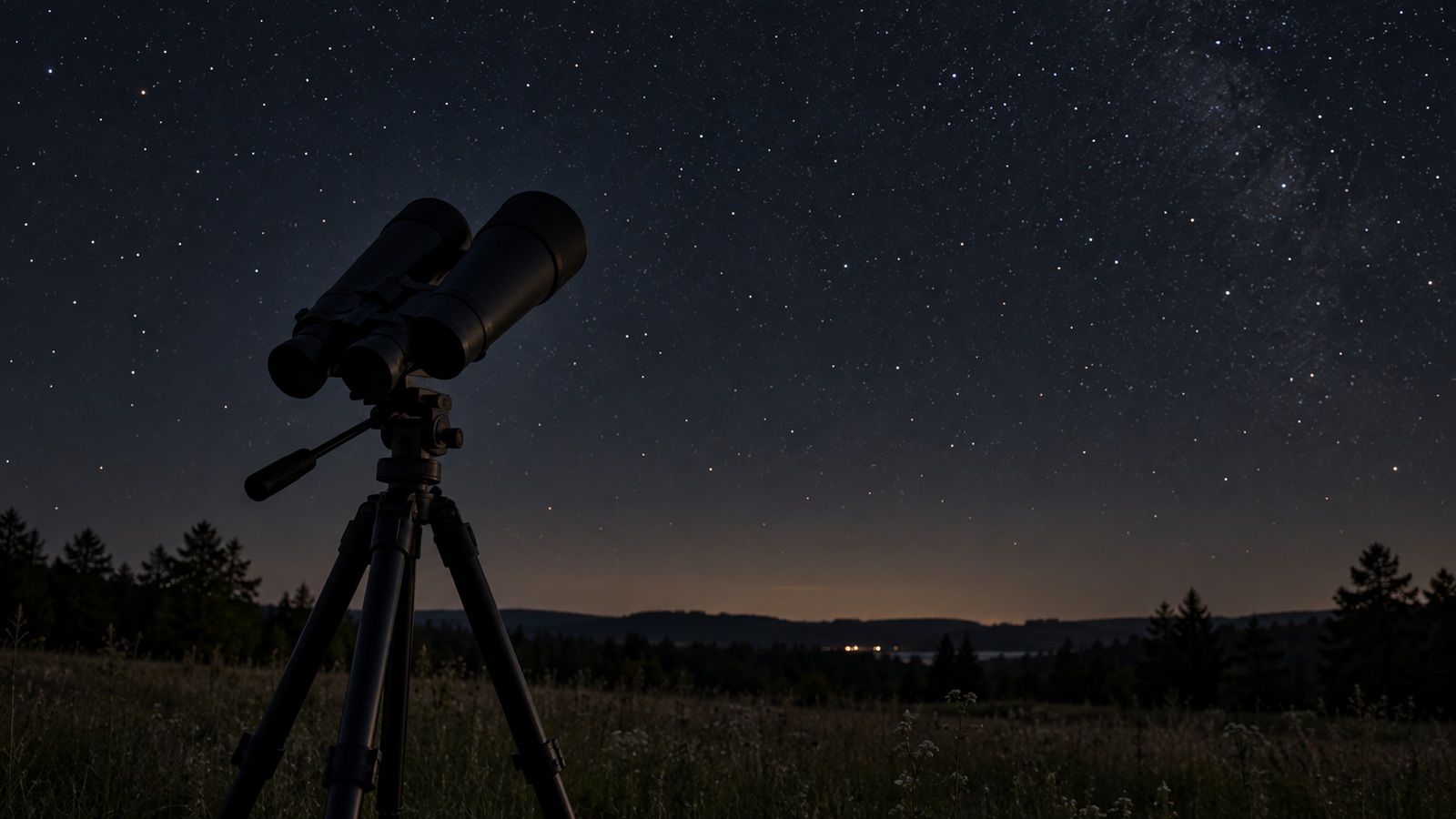
Begin with binoculars you can hold steadily, such as a supported 10×50 pair if one is already available. The first number is magnification and the second the objective diameter in millimeters; their wide field helps match a chart before a telescope narrows the view. Focus on a bright star, then return to the planned region and locate a recognizable triangle or line of field stars. Use two or three charted stars to establish orientation before identifying the faint point at Uranus’s position. Bracing your arms or using a mount can make the comparison much easier. This is a starting method, not a promise that every light-polluted site or observer will produce the same view.
Repeated comparisons with the chart help avoid selecting a brighter unrelated star simply because it is easier to notice. Check more than one surrounding pattern and retain the predicted position within that network. Binocular optics may also have orientation conventions different from the chart display. Understanding the view is part of the identification. Confidence comes from several consistent relationships rather than from a pale tint alone.
After optical confirmation, an unaided attempt can become a separate observing exercise. Give your eyes time away from bright screens and lights, and assess whether the same point can be detected consistently. Avoid repeatedly checking a bright display between glimpses. If averted vision helps detect something, use positional confirmation carefully because peripheral vision has limited spatial precision. A faint impression gains value when it can be repeated and anchored to the verified field.
The result should be recorded in stages rather than collapsed into one statement. A binocular position match may be secure even when the unaided attempt remains doubtful. Conversely, an experienced observer can report a repeatable unaided detection without claiming any resolved disk. This separation gives a later session a concrete next goal. It also prevents memory from upgrading a brief uncertain glimpse after a dramatic photograph is viewed at home. The observing record is strongest when its confidence is attached to the method actually used, not to what the observer knows the planet must look like up close.
A Telescope Can Reveal a Small Disk
Uranus’s apparent diameter is only a few arcseconds, commonly around 3.8 arcseconds near opposition. That is tiny beside the planets whose broad disks dominate beginner observing guides. With suitable optics, magnification, focus, and stable air, the image can look like a small pale blue-green disk. NASA’s observational fact sheet records the scale. Its measured angular size explains why a physically large planet can still demand a careful telescopic view.
For a telescope, start with the widest useful eyepiece to recover the same chart pattern, center the candidate, and then raise the power gradually. A 1,000-millimeter focal-length telescope with a 10-millimeter eyepiece gives 100× magnification; a 5-millimeter eyepiece gives 200×. Those calculations describe the setup, not guaranteed resolving performance. Focus using a nearby star and compare its appearance with the candidate’s tiny disk, allowing time for the instrument to settle to outdoor temperature. If both blur or boil, lower the power rather than force the view. A larger image is helpful only while it retains the detail needed to distinguish a planet from an unfocused star.
Most First Views Will Not Show a Weather Map
A small amateur view usually offers little or no secure atmospheric detail. Subtle bands, polar brightening, or clouds are much harder targets than the basic disk and depend on equipment, conditions, technique, and wavelength. Space-telescope products may emphasize infrared features that do not correspond to naked-eye appearance. ESA’s Webb Uranian-system image identifies the instrument and infrared context. Its dramatic presentation should inspire questions rather than establish an eyepiece promise.
Rings and Moons Require Different Goals
Uranus’s rings are faint and difficult; they are not a routine visual reward in a beginner telescope. Their appearance in advanced observatory images reflects sensitivity, wavelength selection, exposure, and processing. A first session should not be judged unsuccessful because no ring ellipse appears. The planet itself is already a distant-world identification. Asking the rings to behave like Saturn’s bright system overlooks their different physical and observational properties.
Some larger amateur instruments and specialized imaging setups can investigate selected Uranian moons under suitable circumstances. That requires current positions, sufficient sensitivity, and careful separation from field stars. It is a different project from detecting Uranus in binoculars. A generic claim that a telescope shows the planet does not promise its complete satellite system. Observing goals become more useful when each is given its own evidence requirement.
Imaging also differs from immediate visual observing. Stacked frames can improve signal and reveal information that is not obvious in an individual view, but processing can create artifacts if calibration, alignment, or sharpening is mishandled. A claimed feature should recur in independent data and agree with plausible orientation and motion. The final image’s scale and color may be deliberately altered. Those choices need disclosure if the image is used to describe what a person could see directly.
Finish the session with a small observing record: local time, equipment and magnification, a sketch of the matched stars, and whether the candidate appeared as a point or a disk. Return on another suitable night with a chart for that date and compare its predicted position within the field. This turns a first glimpse into a repeatable identification instead of making pale color carry the whole argument. Rings and faint moons can wait until the basic disk-and-field observation is secure. The small scale of the view is part of its interest: you have used ordinary optical equipment and a chart to identify a world far beyond Saturn.
Repeat the Position Check on Another Night
Uranus changes position relative to the stellar background over time. A sketch or recorded field from a later suitable night can help confirm the identification when compared with a current prediction. The change may be subtle over short intervals, so choose a timescale on which it is expected to be distinguishable. Telescope tracking or Earth’s daily sky rotation is not the same as the planet moving among stars. The confirmation must compare celestial positions rather than where the object sits on an untracked eyepiece edge.
Record the date, approximate time, site, observing method, and the reference field. Add a short description of transparency, seeing, and confidence. Those details let you distinguish a repeatable detection from a remembered impression. Uranus can be a naked-eye challenge, a straightforward binocular target, or a tiny telescopic disk depending on conditions. The best session uses a current location, realistic expectations, and a clear standard of confirmation. That combination turns the answer “yes” into an observation you can actually trust.


