
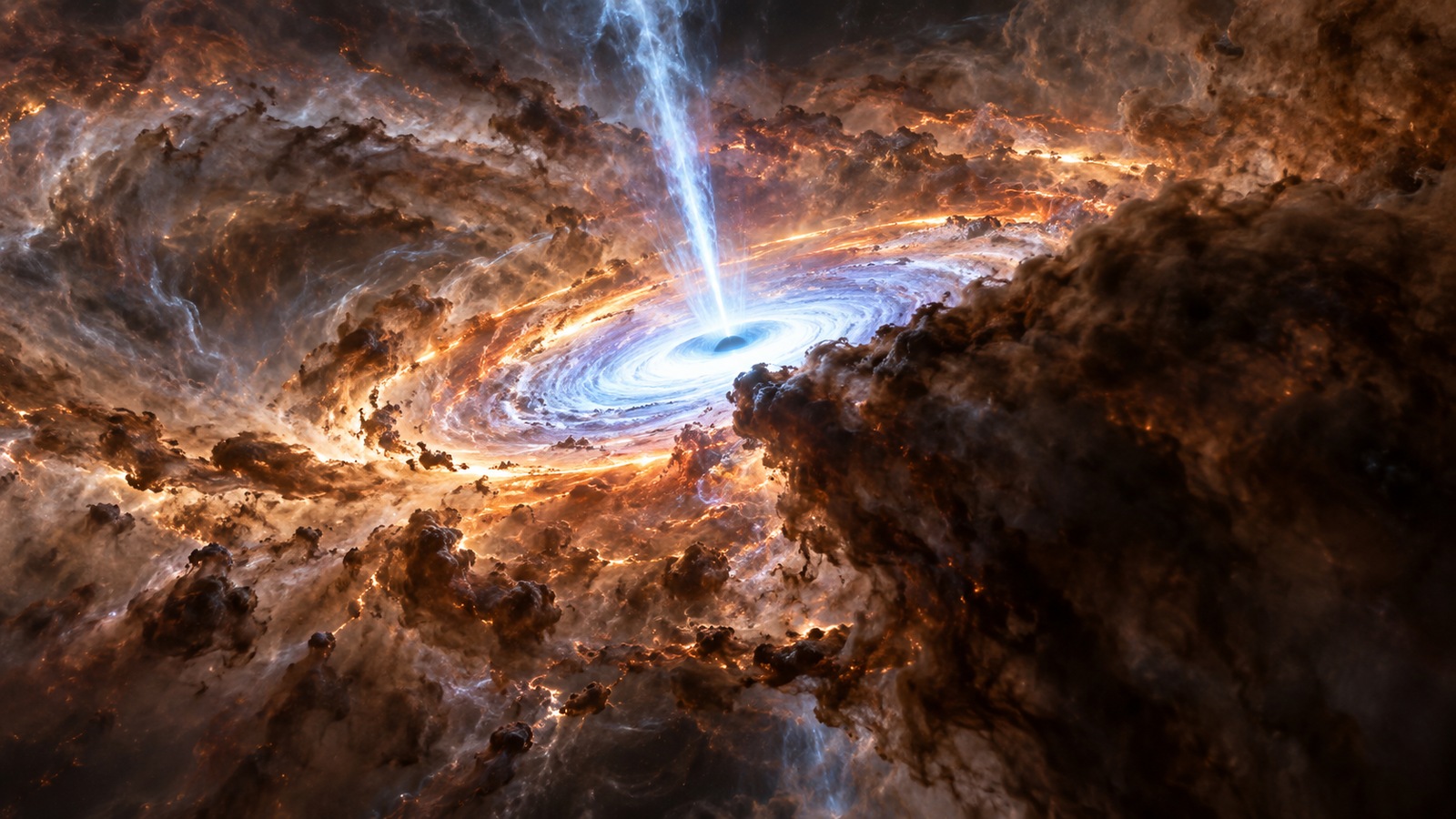
A Dark Center Can Power a Brilliant Surrounding System
A supermassive black hole does not glow like a star, yet its neighborhood can outshine the combined starlight of a galaxy. The apparent contradiction disappears when we identify where the energy is released. Gas moves through an accretion flow outside the event horizon, heating and radiating as it loses orbital energy. Magnetic fields can help organize both that inflow and powerful outward jets, while rotation supplies another potential energy reservoir. The engine therefore includes much more than the dark central boundary. It depends on available material, the state of the flow, and the fields threading the surrounding plasma. Understanding its operation also raises a historical question: how did a comparatively small beginning become a black hole containing millions or billions of solar masses, sometimes surprisingly early in cosmic history?
The Engine Is an Accreting System
Supermassive describes a mass scale, not a guarantee of brightness. A black hole at that scale can remain relatively quiet if little matter reaches its immediate surroundings. A luminous active galactic nucleus, or AGN, contains an energetic accretion system that produces radiation across several wavelength ranges. The black hole’s mass influences the physical scales, but the fuel supply and how efficiently the flow radiates also matter. Comparing a bright quasar with a quiet nucleus therefore requires more than comparing their central masses.
The engine converts energy in the surrounding flow rather than operating through nuclear fusion on a black surface. A standard thin-disk model around a nonrotating black hole gives a radiative-efficiency benchmark of about 5.7 percent of supplied rest-mass energy, as discussed in research on relativistic accretion-disk models. For comparison, converting four hydrogen nuclei into helium releases approximately 0.7 percent of their initial mass as energy, a benchmark described in NASA’s accretion-energy discussion. These refer to specific processes and assumptions, not the fraction of an entire star converted into light. Spin, magnetic stresses, and the state of the flow change actual accretion output.
Gas Must Rearrange Its Motion before It Moves Inward
Imagine gas orbiting at a large radius with substantial sideways motion. Gravity bends its trajectory, but that motion prevents a direct radial plunge; the gas carries angular momentum, the quantity describing its rotational motion about the center. To enter tighter orbits it must transfer angular momentum outward, for example through magnetic stresses and turbulence in the surrounding flow. The more tightly bound orbit has lower total orbital energy, so the change releases binding energy that can heat the plasma and ultimately become radiation. A disk is therefore an active transport system rather than a stack of permanent rings. The central issue is how the orbiting material exchanges motion and energy while moving inward.
As matter reaches tighter orbits, it can release energy associated with its gravitationally bound motion. That energy may emerge as radiation, remain in hot plasma, or contribute to outflows, depending on the flow’s state. The radiated amount cannot be inferred merely from the mass present in a distant reservoir. It matters how much reaches the inner region and on what timescale. A large dusty environment can surround a nucleus that is not currently producing a large luminous output. The bottleneck is the functioning inflow, not simply the existence of nearby gas.
Many introductory pictures show a thin, smooth accretion disk. Such a model is useful in an appropriate regime, but actual flows can be thicker, turbulent, variable, and partly obscured. Different accretion states can distribute energy differently between radiation and moving matter. NASA’s research on realistic supermassive-black-hole accretion structures demonstrates why simulations examine the disk’s dynamics rather than treat the illustrated shape as a universal object. A diagram supplies an organizing idea; the physical model must explain the measured spectrum and variability.
The energy accounting also includes material that does not enter the horizon. Disk winds can carry matter and angular momentum away, while some gas may remain at larger radii. The mass supplied to the broad environment, the mass moving through an inner disk, and the mass ultimately added to the black hole are therefore different quantities. Following those distinctions is necessary for reconstructing growth. An engine can radiate strongly without swallowing every parcel in its surroundings, and a feeding rate at one radius need not equal the final black-hole growth rate.
Brightness Can Push Back on the Fuel
Radiation interacts with surrounding matter and can oppose inward motion. The Eddington luminosity gives a characteristic balance between outward radiation force and inward gravity under simplified assumptions, notably concerning geometry and opacity. It is not an absolute rule that every complicated accretion flow must obey identically at every moment. Thick structures, anisotropic emission, and radiation trapped in an inflow can alter the situation. The benchmark remains valuable because it connects mass, luminosity, and growth timescales, while its assumptions must be stated before it becomes a verdict on an observed source.
Magnetic Fields Can Help Launch Relativistic Jets
Some active nuclei produce narrow jets whose plasma moves at speeds close to light’s speed. These outflows begin in the environment around the black hole, not by ejecting previously swallowed matter back through the horizon. Magnetic fields can channel energy and help accelerate and collimate the flow. The jet’s energy, geometry, and particle content remain subjects of research. A source can be highly luminous without displaying the same prominent jet as a radio galaxy, so jets are an important possible engine output rather than a compulsory feature of every accreting supermassive black hole.
A rotating black hole provides a reservoir of rotational energy. The Blandford-Znajek process describes a way magnetic fields and surrounding plasma can extract energy from that rotation. This does not permit an ordinary interior signal to escape, and it should not be pictured as matter drilling through a dark surface. The process involves an electromagnetic system tied to the rotating spacetime. A study implementing Blandford-Znajek jets illustrates how spin and magnetic conditions enter a modeled engine rather than being decorative labels attached to a generic beam.
Launching, accelerating, and maintaining a jet are related but distinct problems. The outflow must emerge from the inner region, acquire its observed speed, and remain sufficiently organized as it encounters surrounding material. Different observations probe different stages. A radio image of a distant lobe is not a direct close-up of the launching mechanism, while a compact emission measurement may miss the older large-scale structures. Connecting these scales requires a physical model and timing information. The engine is investigated through its products, without assuming that every bright jet feature shows the same process.
Dust and Viewing Direction Change the Appearance
Gas and dust around an active nucleus can obscure the central radiation and reradiate absorbed energy at longer wavelengths. Viewing direction changes which components are exposed, especially when a jet points more nearly toward the observer. These effects help explain why related engines can enter different observational categories. Orientation is not the only source of difference, however; fuel state, mass, magnetic conditions, and surrounding material also vary. A unified picture organizes several appearances without claiming that every active nucleus is an identical machine seen from a different angle.
Variability Provides a Clock for the Inner Environment
An active nucleus can brighten and fade across multiple timescales. Changes carry information about the emitting regions, because a physical region cannot respond coherently to a new signal faster than relevant communication and transport allow. Time delays between changes in one component and responses elsewhere can constrain size and geometry. This is the basis of reverberation approaches, which use variability as a probe rather than regard it as unwanted noise. The interpretation must account for what actually drives the change and which material responds.
Spectra add velocity and temperature information to that timing evidence. Broad emission lines can trace fast-moving gas outside the horizon, while X-ray measurements investigate energetic conditions near the inner flow. Infrared observations can reveal dust that hides or reprocesses central light. No single wavelength provides a complete mechanical inspection. Together, these measurements can constrain an engine’s parts and their relationships, but model assumptions remain important. A spectrum that implies fast motion does not itself provide a resolved photograph of the moving cloud or identify every source of acceleration.
The First Seeds Remain an Open Historical Problem
Present-day supermassive black holes must have grown from earlier beginnings, often called seeds. Possible pathways include remnants of the first massive stars, more massive objects produced through dense stellar-system evolution, and collapse of large gas concentrations under suitable conditions. Each pathway offers different initial masses and environmental requirements. A seed is not an observed baby version of every mature black hole. It is part of an origin model whose consequences must be compared with populations of young and old systems.
Starting mass matters because growth takes time. A light seed needs more sustained accretion or different growth conditions to reach an enormous mass quickly. A heavy seed begins with an advantage but needs a physically plausible formation route. NASA’s discussion of primeval black-hole searches outlines these competing beginnings. The scientific goal is not to pick the most dramatic origin story. It is to identify which pathways can produce the measured populations within the available cosmic time and their plausible surroundings.
Early luminous sources provide especially important tests because their light shows engines already operating when the universe was much younger. Mass estimates, selection effects, and source classification must be examined carefully before declaring a particular growth pathway impossible. A bright sample favors objects that were feeding conspicuously, potentially missing quiet seeds and less luminous stages. Researchers therefore compare individual sources with population models and observational limits. A surprising quasar can sharpen the problem without revealing its entire ancestry or proving that every black hole followed the same history.
Accretion and Mergers Build Different Parts of the Biography
Gas accretion can add mass over extended intervals, while mergers combine black holes that already exist. The relative importance of those channels changes with environment and history. A merger also emits gravitational waves, so the final mass is not simply a bookkeeping sum without energy loss. Likewise, a luminous accretion episode converts some available energy into radiation rather than retaining everything in the final object. A credible growth account tracks these physical transfers. It cannot be reconstructed solely by counting how many smaller black holes fit into the present mass.
NASA’s overview of massive-black-hole growth describes the unresolved seed question alongside accretion and mergers. Those processes connect the engine’s present operation with its accumulated mass. However, a current luminous state is one chapter rather than a complete biography. An engine may switch between active and weak phases, and the fraction of time spent accreting efficiently matters to its history. Population studies provide essential context when one spectacular nucleus dominates public attention.
A Quiet Black Hole Still Contains the Potential Engine
The Milky Way’s Sagittarius A* is a nearby example of a supermassive black hole with relatively weak overall activity compared with a bright quasar. That contrast does not imply a different fundamental species of central object. It highlights the importance of the surrounding flow and energy release. Studying a quiet environment and a strongly feeding one helps isolate which properties belong to the black hole itself and which belong to the engine state. The mass can persist through changes in the available fuel and emitted power.
Black-hole engines are therefore not perpetual cosmic suction devices. Their output depends on material reaching appropriate regions and on the plasma converting energy through particular channels. Radiation, winds, and jets can be powerful, but a source need not display all of them equally. Measuring the engine requires tracing where photons and moving matter originate, how obscuration affects them, and which models connect those observations with mass and spin. The dark horizon is central to the system without being the place from which ordinary observed light escapes.
The phrase engines of cosmic darkness captures this unusual partnership. A region that traps outward signals can sit inside a surrounding machine that releases extraordinary energy into the universe. Explaining that machine demands accretion physics, magnetic fields, radiation, and a growth history that remains partly unresolved. Its most compelling mysteries concern how those pieces work together and how the earliest beginnings became mature central objects. The result is a physical engine with measurable products and specific unanswered questions, rather than a dark object credited with every dramatic event in its galaxy.


