A Falling Observer Can Cross a Boundary That No Report Can Cross Back
Beyond an event horizon, general relativity predicts an interior in which an ordinary outward signal cannot reach distant space. To understand that answer, imagine following one observer into a large, nonrotating black hole. Give the traveler a clock and a lamp, and temporarily set aside surrounding gas and radiation so that the geometry can be examined clearly. This is an idealized journey, not a proposed safe expedition. The observer can cross the horizon in a finite time on their own clock, continue experiencing nearby events, and still lose every route for reporting those events to colleagues outside. Following the same traveler from approach to crossing to the classical endpoint makes the distinction concrete. It also shows exactly where the simplest model stops providing a complete physical answer.
Before Crossing, Separate the Traveler from the Received Picture
Our traveler falls freely toward the black hole while a distant colleague receives regularly transmitted flashes. Each flash is a message from a particular event along the approach. As emission occurs nearer the horizon, the distant receiver obtains increasingly delayed, redshifted signals. The lamp is not becoming intrinsically lazy, and the traveler’s clock has not stopped working. Comparing an emitted event with its received signal involves both the clock’s motion and the light’s path through curved spacetime.
This explains why the two observers give different accounts without contradicting each other. The falling clock records a finite interval to crossing, while an exterior description based on the usual Schwarzschild time coordinate places the crossing at an indefinitely late coordinate time. The received picture fades rather than maintaining a sharp, permanently visible astronaut at the boundary. NASA’s black-hole FAQ distinguishes these perspectives. An image arriving at the receiver is evidence about the event that emitted it; it is not an instantaneous view of everything the traveler is currently doing.
The Horizon Is Not a Material Floor
In this model, there is no shell for the traveler to strike at the horizon. A freely falling observer continues along a path through spacetime, with the wristwatch advancing normally in their immediate surroundings. Physicists call the time measured by that traveling clock proper time. It is different from a time label selected to describe events across a much larger region. Andrew Hamilton’s Schwarzschild geometry explanation makes this distinction explicit.
The location of the boundary depends on the black hole’s mass. For a nonrotating model, its radius is about three kilometers per solar mass: a ten-solar-mass example has a horizon radius of roughly thirty kilometers, whereas a four-million-solar-mass example has one around twelve million kilometers. These are illustrative model calculations, not measurements of the interior of a particular object. They show why the word horizon does not imply a fixed physical size or the density of an ordinary solid surface. The calculation follows the Schwarzschild-radius relation described in NASA’s black-hole mathematics guide.
A useful local experiment would be to shine the lamp across the cabin as the traveler crosses. Light still passes between nearby points according to ordinary local physics; the horizon does not make the lamp go dark by definition. What changes is the destination that a signal can eventually reach. The traveler need not notice a sudden impact, flash, or clock stoppage precisely at crossing. Recognizing the global boundary is a different task from measuring the conditions in a small freely falling laboratory.
A Gentle Crossing Does Not Guarantee Survival
The danger from tides depends on the difference in gravitational influence across an extended body. An object can be stretched lengthwise and compressed sideways even while each small part is falling freely. At the horizon of a sufficiently large black hole, those differences can be modest compared with the corresponding horizon-scale stresses of a much smaller one. They become destructive farther along the inward journey. NASA’s account of tidal disruption explains this distinction between overall gravitational influence and its variation across an object. Our quiet surroundings assumption removes another major hazard: actual accreting gas can expose an approaching traveler to intense radiation before the horizon is reached.
Compare two objects falling side by side: a small freely floating instrument and a long, loosely bound chain. Their centers can follow similar paths while the chain experiences a much larger difference between the accelerations of its ends. Its material strength and length therefore affect when it breaks. The same distinction applies to a person and a microscopic detector, so there is no single destruction radius independent of the traveler. A statement that an object can cross the horizon intact must specify both the black-hole model and the object’s physical properties. It says nothing about surviving all the way to the endpoint.
Inside, the Lamp Works but the Outward Future Has Changed
After crossing, our observer can still send light toward a nearby companion or examine a nearby instrument. Incoming light from the exterior can also reach the interior; the horizon does not seal it against all incoming influences. It prevents ordinary signals emitted inside from returning to distant space. The same boundary therefore permits inward communication while forbidding the report our traveler would most like to send outward. Darkness and absence of local activity are not the definition of a black hole.
The simplest interior has a stronger restriction than an unusually difficult uphill climb. Within the Schwarzschild horizon, every future-directed physical path proceeds toward smaller circumferential radius. That radius describes the size of spherical surfaces around the center, rather than a distance a pilot can choose to hold fixed by switching on an engine. A rocket changes the traveler’s local motion, but it cannot create a future-directed escape route that the spacetime lacks. Moving faster through the cabin and returning to the exterior are different claims.
One way to picture this is to replace the question “Which way should I steer?” with “Which events can come next?” Outside, future events can include moving farther away, remaining on a suitable orbit, or falling inward. Inside this nonrotating model, a future at a larger radius is no longer an available outcome for an ordinary traveler or light pulse. Hamilton’s journey through the Schwarzschild geometry follows those causal directions. This statement concerns the geometry of the model, not a claim that light locally slows below its usual speed.
The Interior Journey Has a Finite Classical Endpoint
The observer’s clock continues measuring elapsed time after crossing, but the classical inward journey does not last forever. In the ideal nonrotating solution, a falling observer encounters the future singular boundary in finite proper time. That endpoint cannot be avoided by choosing an ordinary circular orbit inside the horizon. The traveler also does not obtain an unlimited opportunity to watch every future event in the outside universe. Which exterior signals arrive depends on their emission events and the particular infalling path.
A singular boundary is where the classical geometry fails to provide a satisfactory complete physical account. It is not a photographed little ball whose measured density is infinite. Curvature becomes unbounded in the mathematical solution, telling us that continuing the classical calculation to its endpoint is inadequate. The distinction matters: a well-defined prediction for horizon crossing and much of the subsequent fall can coexist with an unresolved endpoint. Hamilton’s general-relativity lecture text treats infalling trajectories and the classical interior within the theory’s mathematical framework.
A Simulated Journey Gives These Statements a Physical Scale
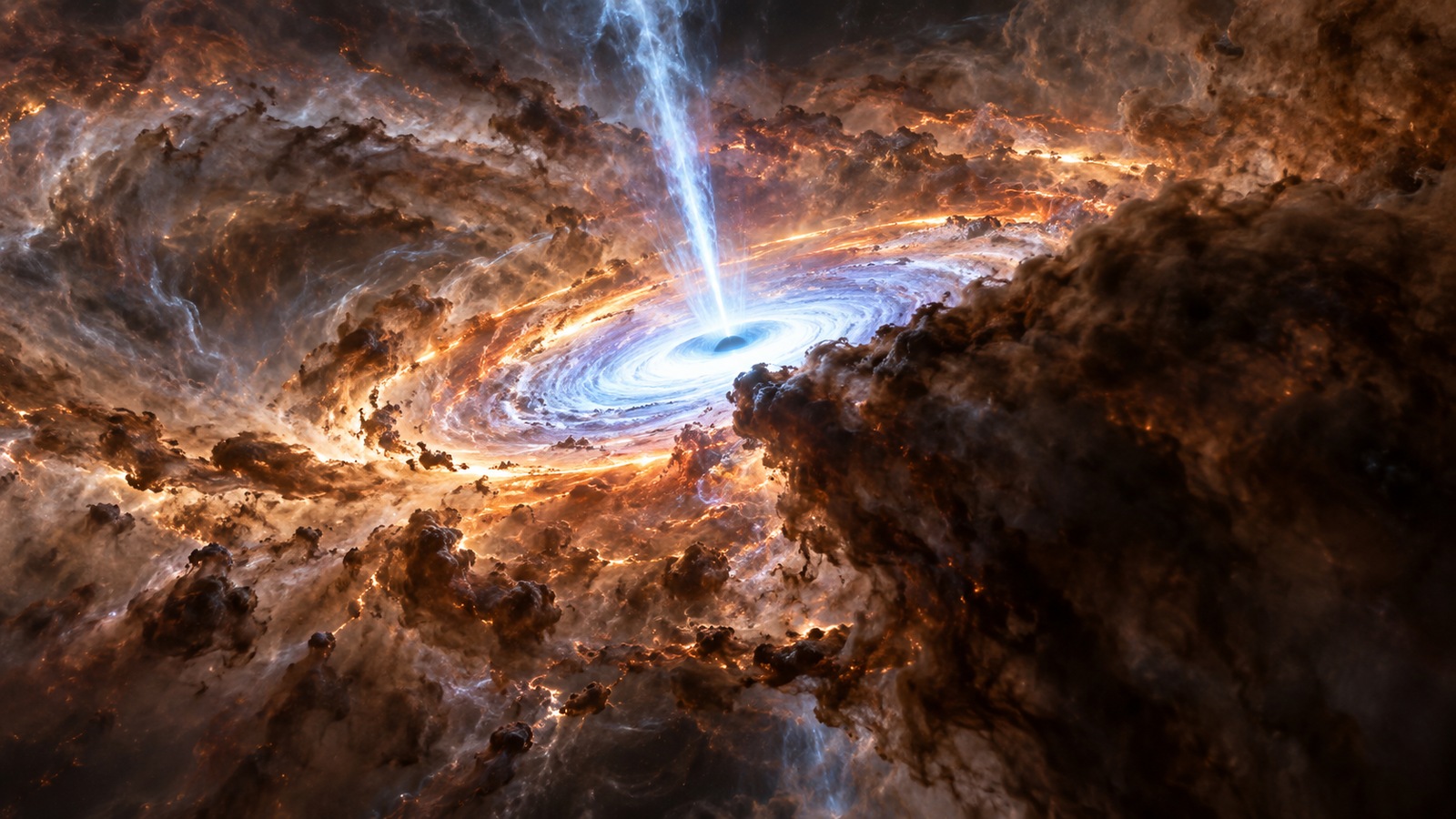
NASA’s 2024 black-hole visualization follows a simulated camera toward a black hole with 4.3 million solar masses. Surrounding emission is distorted into unusual views as the camera approaches, then the camera crosses the horizon and proceeds toward destructive tidal stresses. The scene is generated from a specified relativistic model, with a disk and background stars serving as visual references. Its reported travel intervals belong to that camera’s selected trajectory; they are not a universal countdown for every black hole. The example shows why mass, starting conditions, and path must accompany any numerical story about falling inside.
Rotation Changes the Model, Not the Need for a Physical Explanation
Our journey used the nonrotating Schwarzschild solution to keep the causal sequence clear. Rotating black holes are described by a different classical solution, called Kerr, and rotation changes both orbital behavior and the ideal interior. Outside the horizon, frame dragging alters how matter can move relative to distant space. The ergoregion, where remaining stationary relative to that distant reference is impossible, is distinct from the event horizon. Confusing the two would turn an exterior rotational effect into a false claim about escaping after crossing.
The ideal Kerr extension includes an inner horizon, but that mathematical structure is sensitive to incoming disturbances. Studies such as Hamilton and Polhemus’s analysis of rotating interiors investigate rapidly growing internal effects associated with infalling streams. A diagram of an exactly idealized extension therefore does not establish a stable passage to another universe. This is one specific limitation of applying that solution to a realistically formed, disturbed object. It does not require treating every exterior prediction of relativity as equally uncertain.
For our traveler, changing to a rotating model means recalculating the journey rather than adding a convenient exit to the previous one. The geometry, motion, and internal evolution depend on the physical assumptions being used. A drawing with a tunnel-like continuation is not enough to establish that an extended spacecraft could survive and traverse it. Rotation is an important part of astrophysical black-hole physics, but it does not supply an observationally demonstrated interior travel route.
The difference already matters before crossing. Two otherwise similar exterior trajectories, one moving with the rotation and another against it, need not have the same orbital properties. That is why a rotating object’s environment cannot be modeled simply by taking our spherical journey and turning the picture sideways. Calculations must include the spin and the observer’s motion when predicting which light reaches the camera and when. However, the familiar image of a spinning solid planet remains an imperfect analogy: a black hole has no crust to ride, and local motion is defined through the surrounding spacetime. The model changes the actual predictions rather than merely the visual presentation.
Outside Observations and Quantum Questions Answer Different Things
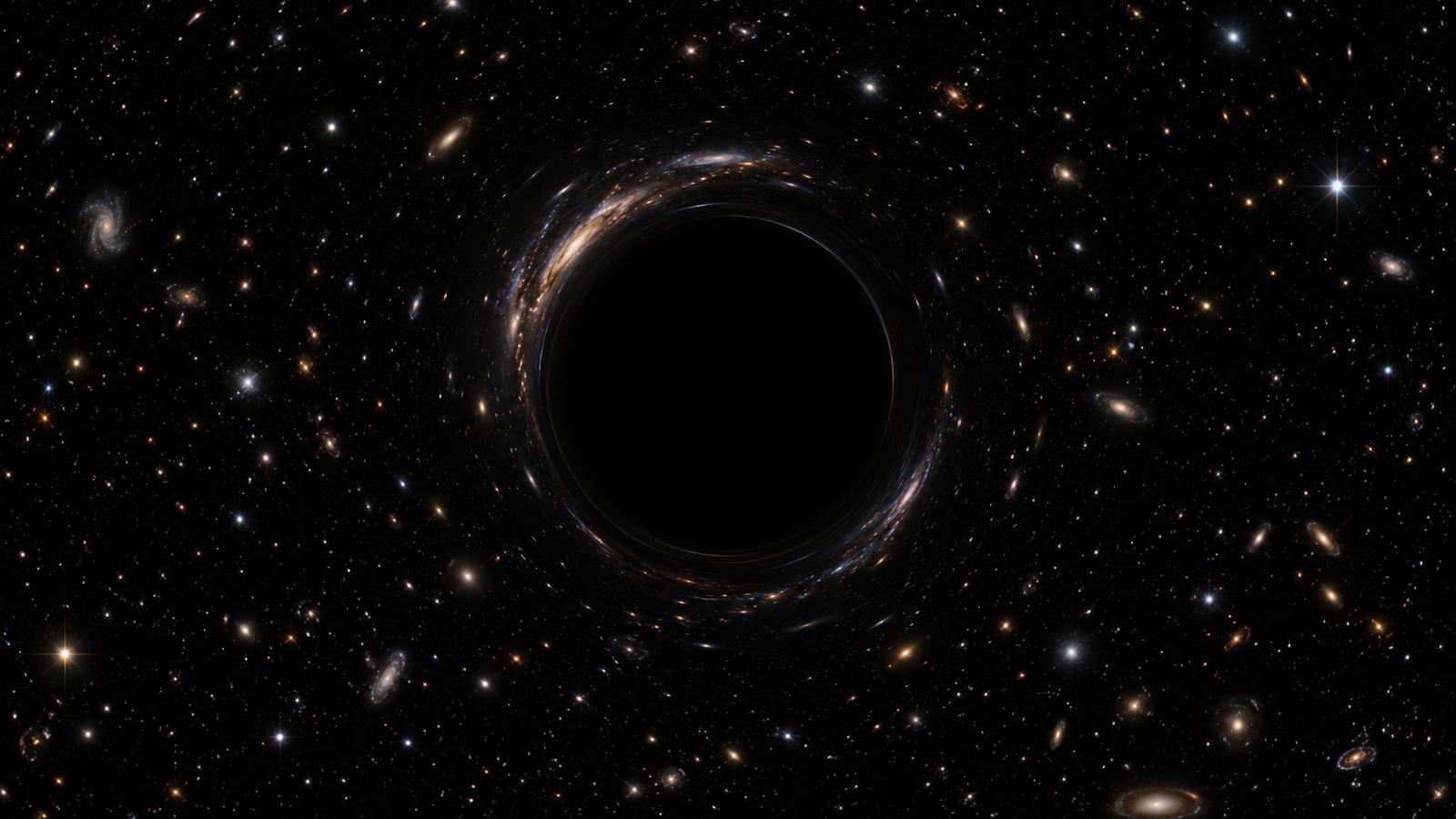
Stellar orbits, accretion light, shadows, and merger signals test the gravitational field and processes available to observers outside. They support black holes as physical objects without showing the interior directly. NASA’s explanation of black-hole evidence describes these indirect routes. A shadow measures how light is redirected or captured around the object; it is not a photograph taken beneath a material lid. Our imaginary traveler could collect local data after crossing, but the defining causal restriction prevents sending that new record back out.
Quantum theory adds another question through the prediction of Hawking radiation and black-hole evaporation. That emission is distinct from the bright accretion disk and has not been detected as Hawking radiation from an astrophysical black hole. The associated information problem concerns whether a complete description preserves the correlations required by quantum evolution, rather than whether a radio message can escape. Work reviewed in The Entropy of Hawking Radiation addresses that theoretical problem. It does not identify a directly observed destination behind the horizon or make the ordinary outbound lamp signal possible.
What the Traveler’s Journey Actually Answers
Beyond the horizon of our idealized nonrotating black hole lies an interior where the clock still runs, nearby physical processes still occur, and every ordinary future-directed route moves toward the classical endpoint. The crossing itself need not be the moment of destruction, while tides and actual surrounding material determine separate dangers. No message sent after crossing returns to distant colleagues. At the singular regime, the classical account requires a more complete theory. Following one traveler keeps those answers connected: the horizon is a boundary of communication, the interior is a predicted physical evolution, and the unresolved endpoint is a precise limitation rather than evidence for a promised hidden world.