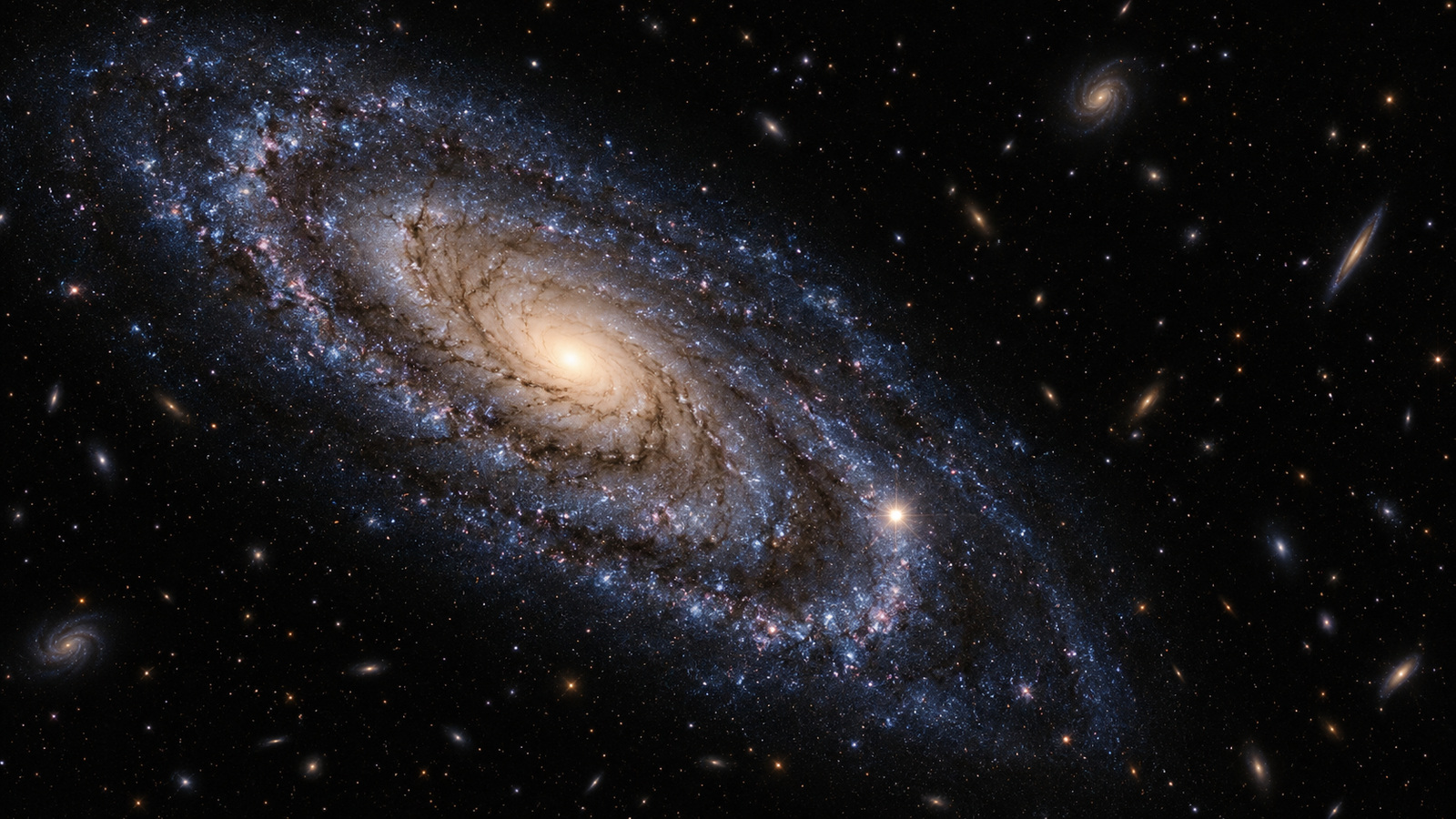
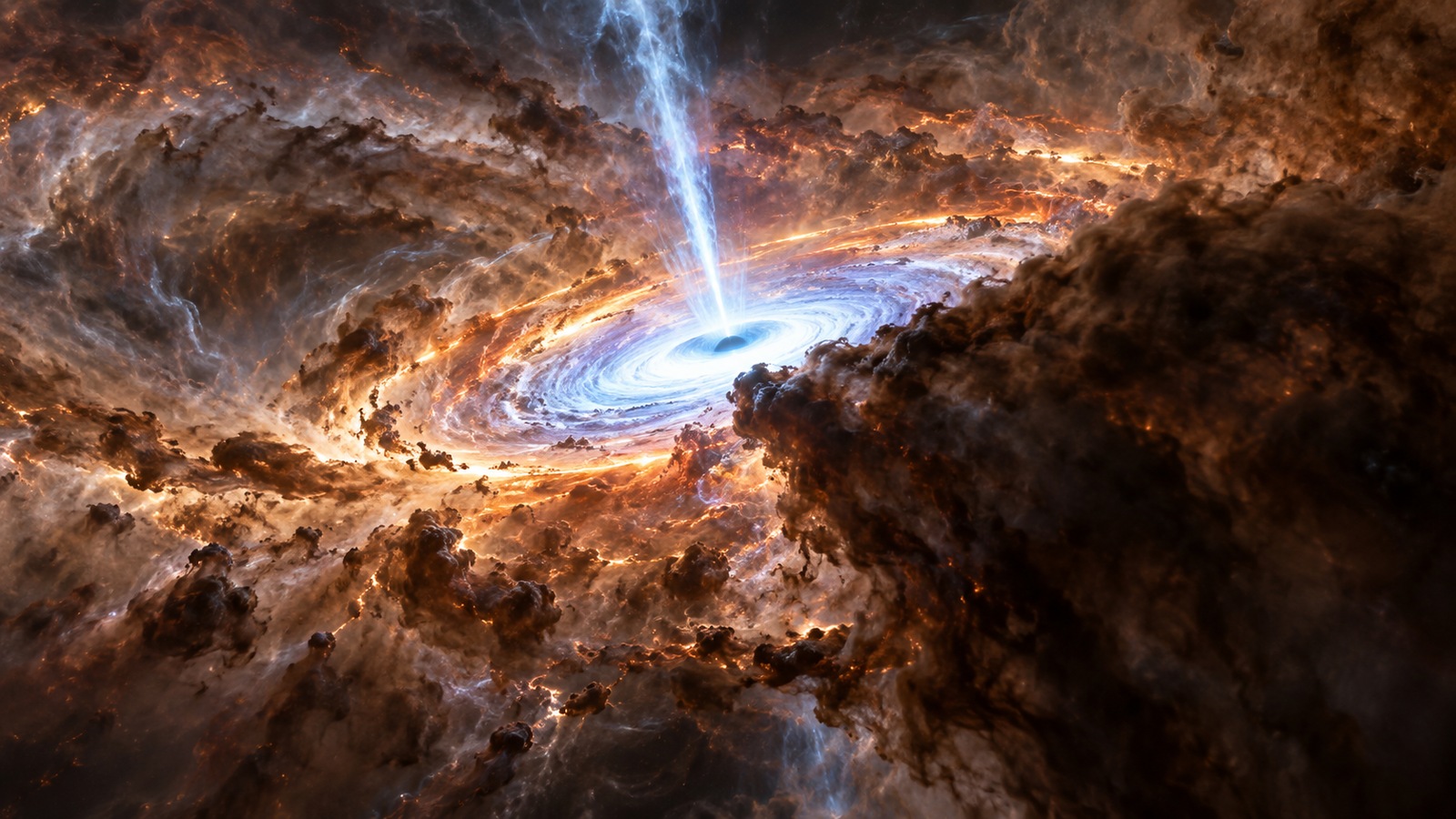
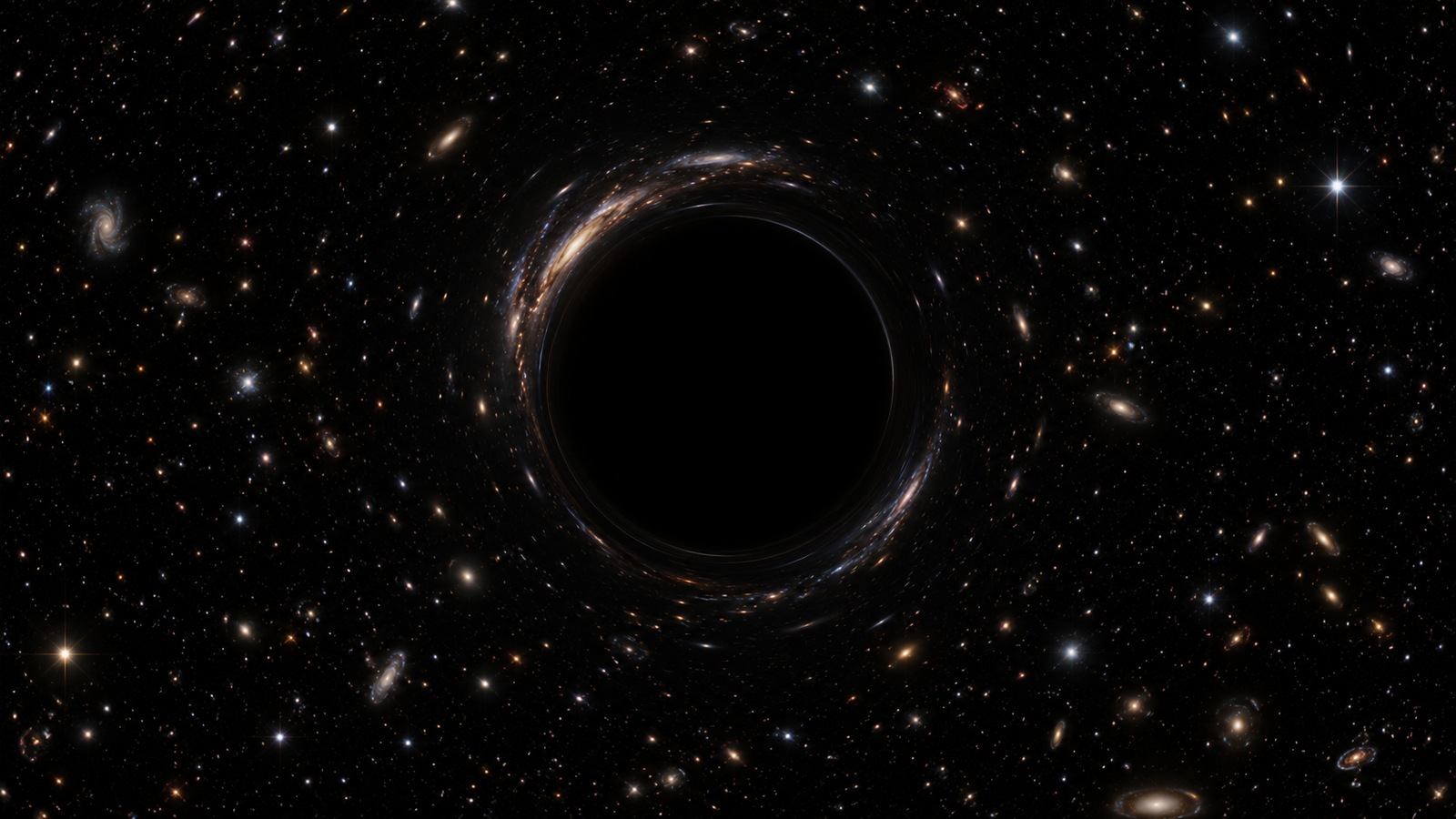
The idea of parallel universes has fascinated science fiction fans and physicists alike for decades. But one question pushes the imagination further than most: Are there parallel universes made entirely of darkness? In cosmology, the term darkness often refers to exotic, invisible components such as dark matter (materia obscura) and dark energy (energia obscura), both of which shape the cosmic structure of the universe despite being impossible to see directly. As researchers continue to explore the nature of these mysterious components, new scientific theories suggest that entire universes composed of dark material—universes that operate under different physical rules—may be possible within the grander frameworks of quantum mechanics, string theory, and multiverse cosmology. While these ideas remain theoretical, they offer a thrilling glimpse into realms that might exist alongside our own, forever hidden and yet profoundly influential.
1. The Cosmic Mystery of Darkness
When scientists talk about “darkness,” they do not mean evil, shadows, or the absence of light in a poetic sense. Instead, they are referring to measurable but invisible components of the cosmos. Dark matter, which interacts gravitationally but not electromagnetically, holds galaxies together even though we cannot touch or see it. Dark energy, a mysterious force causing the expansion of the universe to accelerate, dominates the energy budget of the cosmos.
These components make up roughly 95 percent of everything that exists. The visible universe—stars, planets, gas clouds, even our own bodies—accounts for just five percent of cosmic content. This astonishing imbalance raises an intriguing question: if the overwhelming majority of the universe is made from dark material, could there be universes made exclusively of it?
Theoretical physicists are increasingly entertaining this idea. Since dark matter and dark energy behave differently from ordinary matter, it is conceivable that they could form structures, rules, and realities unlike anything we understand. These dark components might even operate within their own “sectors” or “realms,” coexisting with but invisible to ours.
2. The Multiverse: A Landscape of Possibilities
The idea of parallel universes is not new, but modern cosmology provides mathematical frameworks that make the concept scientifically plausible. These frameworks, collectively referred to as multiverse theories, describe a cosmos where countless universes may exist.
One popular conception is the Level I multiverse, proposed by cosmologist Max Tegmark, which suggests that if the universe is infinite, then distant cosmic regions may repeat patterns—including worlds nearly identical to ours. This version does not fundamentally change the type of matter involved; it is simply a spatial extension of our own universe.
More exotic versions offer greater creative possibilities. The Level II multiverse suggests that separate cosmic bubbles form with different physical constants, meaning the laws of physics might vary from universe to universe. In one bubble, stars burn in recognizable patterns; in another, particles might not form at all. In this framework, a universe composed purely of dark matter or governed by alternative forms of matter is not just possible—it is mathematically permissible.
Beyond these lies the Level III multiverse, derived from quantum mechanics. This interpretation proposes that every quantum event creates branching outcomes, forming a vast tree of alternate realities. Although these universes share the same fundamental physical laws, they could contain unique distributions of matter, including variations in dark components.
The most speculative is the Level IV multiverse, in which universes follow entirely different mathematical structures. Here, the idea of universes made of “darkness” becomes even more compelling, as these universes may contain substances, dimensions, or forces we cannot perceive.
3. Dark Matter: The Invisible Architect
To understand whether a universe could be built from darkness, we must examine what makes dark matter so unusual. Dark matter does not emit, absorb, or reflect electromagnetic radiation. In other words, it does not interact with light. Scientists infer its presence by observing gravitational effects—galaxies spin too quickly to be held together by visible matter alone, so an invisible mass must be supplying additional gravity.
The leading candidates for dark matter particles include WIMPs (Weakly Interacting Massive Particles) and axions, both hypothesized but never directly detected. Another possibility is that dark matter involves an entire shadow realm made of its own types of particles, forces, and interactions. Some physicists call this the dark sector, a hypothetical framework in which dark matter is not a single substance but potentially a complex world with its own rules.
If the dark sector contains equivalents to atoms, molecules, or even dark radiation, then it could, in theory, support structures—maybe even “dark galaxies” or “dark stars”—completely invisible to us. These structures would not interact with visible matter except through gravity. They could overlap our universe without us ever detecting them.
4. Dark Energy: The Force That Defies Gravity
Dark energy complicates the picture even further. Unlike dark matter, dark energy does not clump or form structures. Instead, it acts as a uniform pressure that accelerates the expansion of the universe. If dark energy dominates everything, the universe becomes a smooth, ever-expanding realm with no galaxies, stars, or planets.
But what if another universe has different ratios of dark energy to dark matter? In our universe, dark energy accounts for about 68 percent of the total energy. If that percentage were higher, matter might never clump into galaxies. If lower, the universe might collapse under its own gravity.
In a universe made mostly—or entirely—of dark energy, reality might be unrecognizable. There would be no matter, no light, and no distinguishable structures. The idea of “darkness” here does not imply shadows but rather a smooth, featureless void that expands eternally. Such a universe would be empty but still physically meaningful within multiverse frameworks.
5. Could There Be Entire Universes Made of Darkness?
Considering the potential complexity of the dark sector, the answer may be yes. A universe composed exclusively of dark matter or dark energy—or both—could theoretically exist under the laws of physics as we currently understand them. A dark-matter-only universe might feature invisible analogues to galaxies and stars made of particles that never interact with light. These structures could be vast and intricate, governed by forces we cannot detect. A dark-energy-dominated universe might be a smooth, ever-expanding sea without structure or form. Some theories extend this idea further by proposing a mirror universe, a counterpart to ours made from mirror particles. These particles mimic ordinary matter but have reversed properties. According to these theories, mirror universes might exist alongside ours, interacting only minimally, perhaps through gravity or weak forces. If such universes exist, they would be entirely undetectable with current technology. They could overlap our cosmic location without being observable. They might be separated by dimensions, quantum boundaries, or energetic barriers. They might even influence our universe subtly, contributing to unexplained cosmic behaviors.
6. String Theory and Extra Dimensions
String theory provides another path toward understanding parallel universes. It proposes that particles are tiny vibrating strings, and their vibrational patterns determine particle types. String theory also requires multiple dimensions—sometimes as many as ten or eleven.
If extra dimensions exist, they could host their own forms of matter, potentially including substances invisible to our three-dimensional view. This opens the possibility that dark universes occupy higher-dimensional spaces. Their interaction with our universe would be limited to gravitational effects, which aligns perfectly with what we observe about dark matter.
Furthermore, string theory’s concept of brane worlds suggests that our universe might lie on a membrane floating in a higher-dimensional expanse. Other membranes could float parallel to ours, each holding a different universe. Some branes might contain light and matter like ours; others might contain only dark material. Collisions between branes might even explain cosmic events such as the Big Bang.
If true, a dark universe could be physically close—in a higher-dimensional sense—but perpetually inaccessible.
7. The Shadow Universe Hypothesis
The shadow universe hypothesis proposes that dark matter is not merely a single particle type but an entire sector with its own forces and interactions. In this model, the dark sector includes analogues of electromagnetism, atoms, and possibly chemistry—but all composed of dark material.
In this scenario, dark matter in our universe might interact with dark matter in the shadow universe. These interactions may be invisible to us because they do not emit light or conventional signals. However, gravitational effects could reveal the presence of dark structures.
If the shadow universe is extensive and structured, it might contain:
- Dark galaxies
- Dark stars
- Dark planet-like structures
- Dark gas clouds
- Dark black holes
These objects would overlap with our universe spatially but remain invisible. The shadow universe could even contain complex dynamics or systems, though there is currently no evidence of dark life or dark biology.
This idea might sound fantastical, but leading physicists treat the dark sector as a serious possibility. Experiments such as those at the Large Hadron Collider continue to search for signs of hidden forces connected to dark matter.
8. The Darkness We Cannot See: Implications for Physics
If parallel universes of darkness exist, they could help solve several major physics mysteries. One key problem is the hierarchy problem, which asks why gravity is so much weaker than other forces. If gravity spreads across multiple universes or dimensions, its weakness might be a natural consequence rather than a puzzle. Another issue is the cosmic coincidence problem, which questions why the densities of dark energy and matter are comparable today. Parallel universes with varying mixtures of dark components might help explain why ours has the conditions needed for galaxies, life, and structure. Finally, dark universes might even help clarify the nature of time. In some multiverse theories, time behaves differently depending on the quantity and behavior of matter. A universe dominated by dark energy might experience time in a fundamentally different way.
9. Could Dark Universes Interact with Ours?
Current physics suggests that if other universes exist, they likely interact very weakly with ours. However, there are scenarios where interaction might occur. The most likely mechanism is gravity. Because gravity may propagate across dimensions, dark universes might tug subtly on our cosmic structures. Some researchers propose that unexplained gravitational anomalies could hint at dark parallel structures overlapping ours.
Another possibility is cosmic collisions. If brane worlds collide, they could create bursts of energy, potentially causing Big Bang-like events. These collisions might leave traces in the cosmic microwave background radiation.
There are also speculative ideas involving quantum entanglement, where particles in different universes share linked states. This idea remains theoretical, but it highlights the profound mysteries surrounding quantum mechanics. Despite these possibilities, actual detection of a dark universe remains far beyond our current observational abilities. For now, interactions remain theoretical rather than observed.
10. Could Life Exist in a Dark Universe?
This question pushes the boundary of imagination, but science allows for speculation. If dark matter can form structures similar to atoms and molecules, then in principle, it could support more complicated chemistry-like interactions.
However, without electromagnetic interaction—the basis of ordinary chemistry and biology—dark life might be fundamentally different. Dark life could be bound by forces unknown to us, operating at energies or scales unlike anything in the visible universe.
Some scientists argue that a dark universe might be too featureless or too chaotic to produce any kind of stable life. Others counter that we cannot rule out the possibility of exotic, non-visible life cycles impossible to conceptualize with human experience. Even if dark life exists, we would not be able to interact with it directly. It would pass through visible matter like ghosts, unnoticed and intangible.
11. Philosophical Implications: What Darkness Tells Us About Reality
Thinking about universes made of darkness forces us to confront profound philosophical questions. If 95 percent of our universe is invisible, what does this say about the nature of reality? Are we merely inhabitants of a visible “bubble” floating in a vast sea of unseen forces?
The idea of dark universes also challenges the concept of uniqueness. If countless universes exist with radically different compositions, then our universe is just one among many possible realities. This humbles our understanding of cosmic significance while deepening our sense of wonder.
The possibility of dark universes also intersects with human imagination. Throughout history, myths and legends have described hidden realms, shadow worlds, or spiritual dimensions. While scientific and mythological ideas differ, both arise from the human desire to explore the unknown.
12. The Future of Dark Universe Research
While we cannot observe parallel universes directly, new technologies continue to push the boundaries of what we can study. Projects like the James Webb Space Telescope, Euclid Observatory, and future gravitational-wave detectors may reveal deeper insights into dark matter and dark energy. Laboratory experiments aim to detect dark matter particles or create conditions where they might interact with visible matter. If scientists discover new forces or particles associated with the dark sector, the idea of dark universes may transition from speculation to evidence-based theory. Quantum computing may also play a role in simulating alternate universes. By modeling exotic particle interactions and quantum behavior, researchers may uncover mathematical patterns that support the existence of dark parallel realms. Ultimately, discovering a dark universe would revolutionize physics, shifting our understanding of reality itself. It would represent one of the most significant discoveries in human history.
13.The Hidden Realms Beyond the Horizon
Are there parallel universes made of darkness? The honest answer is that we do not yet know, but the scientific frameworks surrounding dark matter, dark energy, extra dimensions, brane worlds, and multiverse theory make the idea intriguingly possible.
Our universe is already dominated by invisible components. If dark sectors include complex interactions, entire universes composed of dark materials could exist. These universes might overlap ours, exist in distant quantum branches, float on parallel membranes, or emerge from alternate mathematical structures.
Whether these dark universes hold galaxies, stars, or even exotic forms of life remains unknown. But their possibility expands our imagination and pushes science toward deeper cosmic truths. Parallel universes of darkness remind us that reality is larger and more mysterious than we can currently comprehend—and that exploration, whether scientific or philosophical, is an endless frontier.
In the end, the question of dark universes is not just about physics. It is about wonder. It invites us to look into the void not with fear but with curiosity, seeking to understand the hidden architecture of existence. And perhaps one day, with better instruments and deeper theories, humanity will glimpse the first signs of a universe made entirely of darkness.