A Hot Planet With Places That Stay Cold
Mercury sits closest to the Sun, yet its surface can be both fiercely hot and intensely cold. Sunlit ground may approach 430 degrees Celsius, while long nighttime exposure can bring temperatures near minus 180 degrees Celsius. Those familiar extremes are not one global thermostat reading; they describe different locations and conditions. With no substantial atmosphere to transport heat, illuminated rock and shaded terrain follow sharply different energy budgets. The planet also rotates slowly relative to the changing Sun, leaving long intervals for heating and cooling. Near the poles, some deep crater floors never receive direct sunlight and can preserve water ice. Understanding that apparent contradiction requires looking at illumination, radiation, surface material, and time rather than imagining that proximity to the Sun makes every place uniformly scorching.
Sunlight Starts a Local Energy Budget
A patch of ground warms when absorbed energy exceeds the energy it loses. Mercury receives much stronger sunlight than Earth because it is closer to the Sun, but only the illuminated surface directly benefits from that input. The angle of incidence matters: sunlight striking nearly perpendicular to the ground concentrates energy more effectively than the same beam spread across a sloping area. Reflectivity determines how much is absorbed rather than returned to space. These conditions vary across the planet even at the same instant.
Temperature also responds to the surface’s ability to emit infrared radiation and conduct heat into underlying material. A bright surface does not necessarily behave thermally like a dark one, and a rock outcrop can differ from loose regolith. The energy budget is therefore a physical accounting problem rather than a label applied to the whole planet. A maximum temperature reported for favorable heating conditions should not be read as the temperature of every sunlit location. Latitude, local time, and terrain supply necessary context.
Vacuum Does Not Prevent Cooling
Heat can leave a surface through radiation even when there is almost no surrounding gas. Mercury’s nighttime ground emits infrared energy to space while direct solar input is absent. Cooling does not require cold air blowing over the landscape. The sparse exosphere also cannot provide the substantial atmospheric insulation or redistribution familiar from Earth. This distinction is important because everyday experience often associates cooling mainly with air or water touching an object.
Why the Day-Night Contrast Is So Large
Earth’s atmosphere and oceans move and store energy, moderating many surface contrasts. Mercury lacks those large mobile reservoirs, so one region can radiate heat while another receives intense sunlight without efficient atmospheric exchange between them. Heat conducted through rock travels far less effectively across an entire planet than circulating air and ocean water. The heated dayside does not simply share its warmth with the nightside. Local surfaces consequently develop a wide range of temperatures.
The commonly quoted values near 430 and minus 180 degrees Celsius describe striking endpoints rather than the complete distribution. A dawn location, a high-latitude slope, and an equatorial afternoon plain need not sit near either extreme. Topography can create sharp contrasts between adjacent illuminated and shaded surfaces. Subsurface material also changes temperature more slowly than the exposed skin. Thinking in terms of a temperature map is more faithful than picturing two uniform hemispheres with one number each.
NASA’s Mercury facts connect the familiar daytime and nighttime extremes with the absence of a substantial heat-retaining atmosphere. That overview provides the basic physical setting, but real thermal models add illumination geometry and surface properties. The same broad explanation can produce different local curves as those inputs change. A useful model predicts how temperature evolves at a specified place instead of simply reproducing the planet’s hottest headline number. Location and time are part of the measurement.
A Rotation Period Is Not the Solar Day
Mercury rotates relative to the distant stars in about fifty-nine Earth days and orbits the Sun in about eighty-eight. Its rotation and orbital periods occupy a three-to-two resonance: it turns three times for every two orbital circuits. The Sun’s return to the same local meridian takes about 176 Earth days, substantially longer than one spin. Confusing those periods leads to misleading statements about how long a surface location experiences the full day-night cycle. The solar day is determined by rotation combined with orbital motion.
This long cycle allows prolonged heating and cooling, although Mercury’s eccentric orbit complicates the Sun’s apparent movement. Around parts of the orbit, the varying orbital angular speed can produce unusual apparent solar behavior for some locations. Not every place follows a simple terrestrial-style sunrise-to-sunset progression at a constant rate. A long solar day is nevertheless the essential beginner-level reason to avoid imagining a quick daily thermal reset. The surface has time to respond strongly to changing illumination.
Distance Changes During the Orbit
Mercury’s orbit is appreciably eccentric, so its distance from the Sun changes through the year. Solar energy arriving per unit area increases as distance decreases, adding variation beyond the ordinary angle and day-night effects. The strongest heating depends on the combination of orbital position, local time, and geography. An average orbital distance is useful for describing the planet but cannot specify every thermal circumstance. A calculation for the nearest part of the orbit should not be silently generalized to all seasons and longitudes.
Polar Shadows Provide a Different Environment
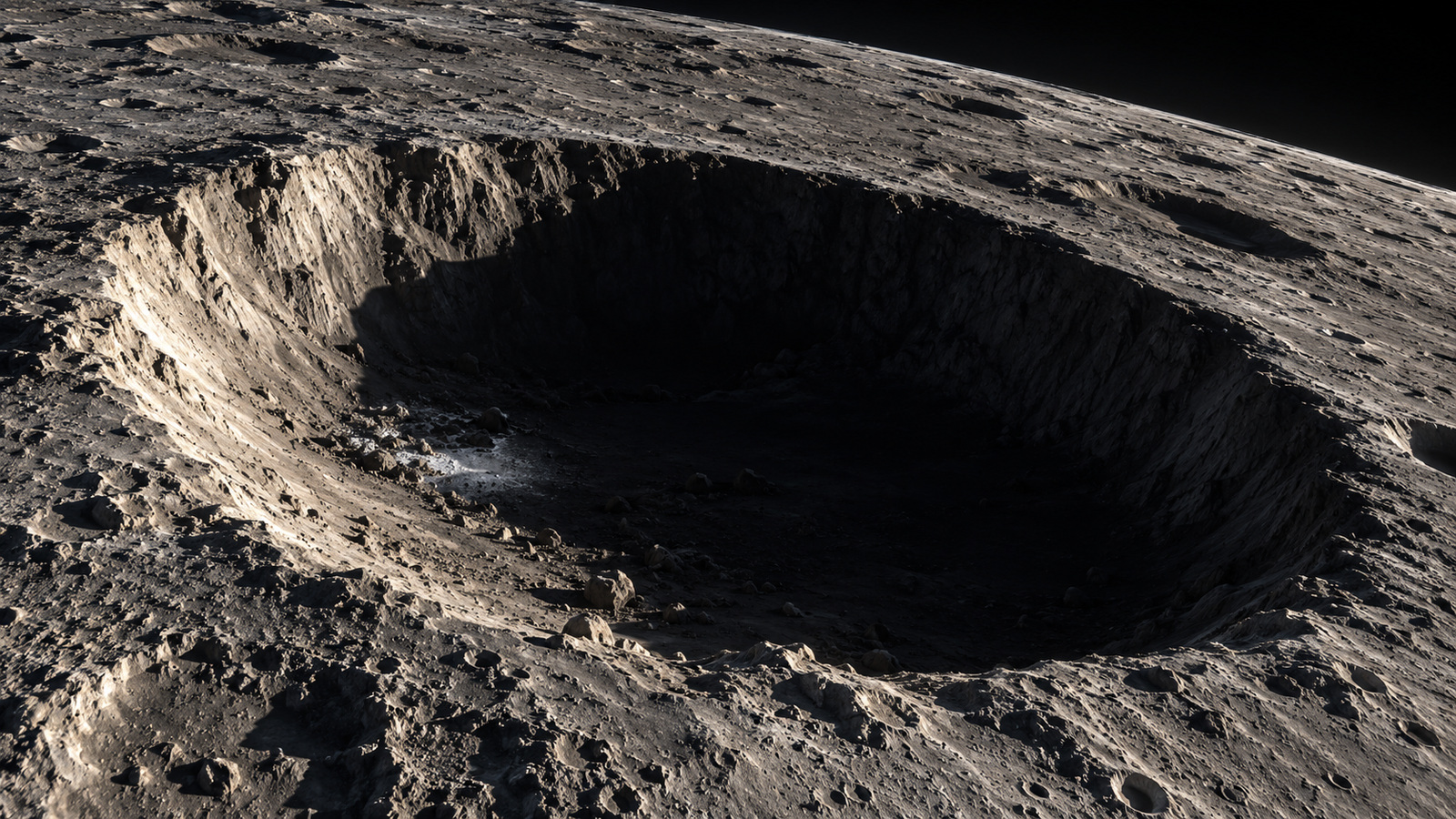
Mercury’s rotational axis has only a small tilt. Near the poles, sunlight remains low, allowing deep crater walls to shield some floors from direct illumination throughout the year. Those protected areas are permanently shadowed regions, not merely patches experiencing the ordinary nighttime interval. A sunlit ridge can sit close to a much colder crater interior because the local geometry changes the incoming energy. Proximity does not ensure the surfaces share one temperature. The familiar minus-180-degree-Celsius nighttime value describes a broad educational range, rather than a lower limit enforced in every permanent shadow. A location that never receives direct sunlight has a different energy history from an equatorial surface cooling between sunrises. Nearby warm crater walls can still radiate into a protected floor, so terrain geometry affects even these cold regions. Ordinary night and a permanent cold trap should consequently be understood as different physical settings.
Permanent shadow does not mean absolutely no energy arrives. Reflected sunlight, thermal radiation from nearby walls, and heat conducted through the ground can still contribute. Whether water ice survives depends on the full long-term temperature environment and the deposit’s depth. Some locations can preserve exposed ice, while others require insulating material above it. A cold-trap map therefore involves detailed terrain and thermal calculations rather than coloring every polar crater identically.
Ice Evidence Comes From Several Measurements
Radar-bright polar deposits were identified from Earth before MESSENGER investigated them closely. Spacecraft measurements added evidence involving hydrogen abundance, surface reflectance, topography, and calculated temperature conditions. Together, those lines of evidence support water ice in suitable permanently shadowed regions. A bright radar signal alone can be ambiguous, but a consistent combination of observations makes the interpretation much stronger. NASA’s MESSENGER scientific highlights summarizes this polar-deposit investigation.
The existence of water ice does not mean Mercury has lakes or a water-rich breathable environment. Frozen material can persist in a localized protected setting even when most of the planet is inhospitable to exposed water. Delivery and retention are separate questions: material may arrive through impacts or other processes, then survive only where conditions permit. Researchers investigate both supply and thermal stability. A dramatic hot-planet ice headline becomes much clearer once those stages are distinguished.
Nor should a visible artist’s image be treated as a photograph of a mapped icy floor. Permanent darkness makes ordinary imaging challenging, and scientific conclusions often rely on measurements beyond visible light. Illustrations can explain the crater geometry while remaining conceptual. Their captions should identify what is reconstructed and what is measured. The physical evidence for ice is more informative than a decorative white patch drawn inside a crater.
Loose Ground and Solid Rock Store Heat Differently
Thermal inertia describes how strongly material resists temperature change under varying energy input. It depends on density, heat capacity, and conductivity. Loose porous regolith can respond differently from coherent rock because grain contacts and empty spaces affect heat transfer. A boulder and the fine material around it may consequently retain different nighttime temperatures after sharing the same daylight. These differences can help researchers infer surface properties from thermal observations.
The thin upper skin changes more quickly than deeper material. Daily or seasonal temperature variations become damped with depth, depending on the relevant period and the ground’s thermal behavior. A surface measurement cannot automatically be assigned to a buried object. Conversely, an interior heat source need not keep the exposed surface warm against radiative losses. Temperature belongs to a defined depth and physical setting, not merely a place name.
Why Mercury Is Not the Hottest Planet Overall
Venus has a much hotter typical surface despite lying farther from the Sun, because its dense atmosphere produces a powerful greenhouse environment. Mercury’s intense local daylight does not recreate that sustained atmospheric state. The ranking changes if someone compares a maximum exposed patch, a global average, or a representative surface condition. Statements about the hottest planet should therefore identify the measure being used. Distance from the Sun is a major input, but atmosphere and energy transport can outweigh a simple proximity ranking.
Follow a Surface Patch Through Changing Illumination
Imagine a dark surface patch near the equator as the Sun slowly climbs above its horizon. The incoming energy initially arrives at a shallow angle, becomes stronger as the Sun rises, and declines again as the geometry changes. Mercury’s changing orbital distance adds another influence. Between about 47 and 70 million kilometers from the Sun, the sunlight intensity at the closer distance is approximately 2.2 times the value at the farther distance, calculated from the inverse-square relationship. A particular patch’s actual temperature still depends on its exposure angle, reflectivity and heat storage, so the sunlight ratio is not itself a temperature ratio. A thermal sequence can follow the delayed response of that ground instead of representing the whole planet with one fixed hot-side number.
Now compare a crater floor, a sunlit wall and a boulder within the same region. The floor may remain protected while the wall receives direct energy; the rock can conduct and store heat differently from loose ground. An instrument averaging all three sees a combined signal, whereas finer measurements can separate their behavior. An annual maximum-temperature calculation asks whether any point in the cycle warms a location enough to threaten volatile survival, while a single nighttime measurement asks how it is cooling at that moment. These are distinct physical questions. Their difference explains why a permanent-shadow ice assessment and an ordinary equatorial temperature reading can give very different results without contradiction.
A Planet of Unequal Exposure
Mercury’s extremes follow a coherent set of conditions: strong sunlight, long illumination cycles, little atmospheric redistribution, and terrain that controls exposure. Radiation provides an effective cooling route even in vacuum, while permanent polar shadows create rare locations where ice can endure. The resulting surface is thermally diverse rather than uniformly hot or divided into two fixed temperatures. That diversity is useful scientific evidence about material and geometry. Mercury demonstrates how local energy balance can defeat an intuitive assumption that the nearest planet must be warm everywhere.