
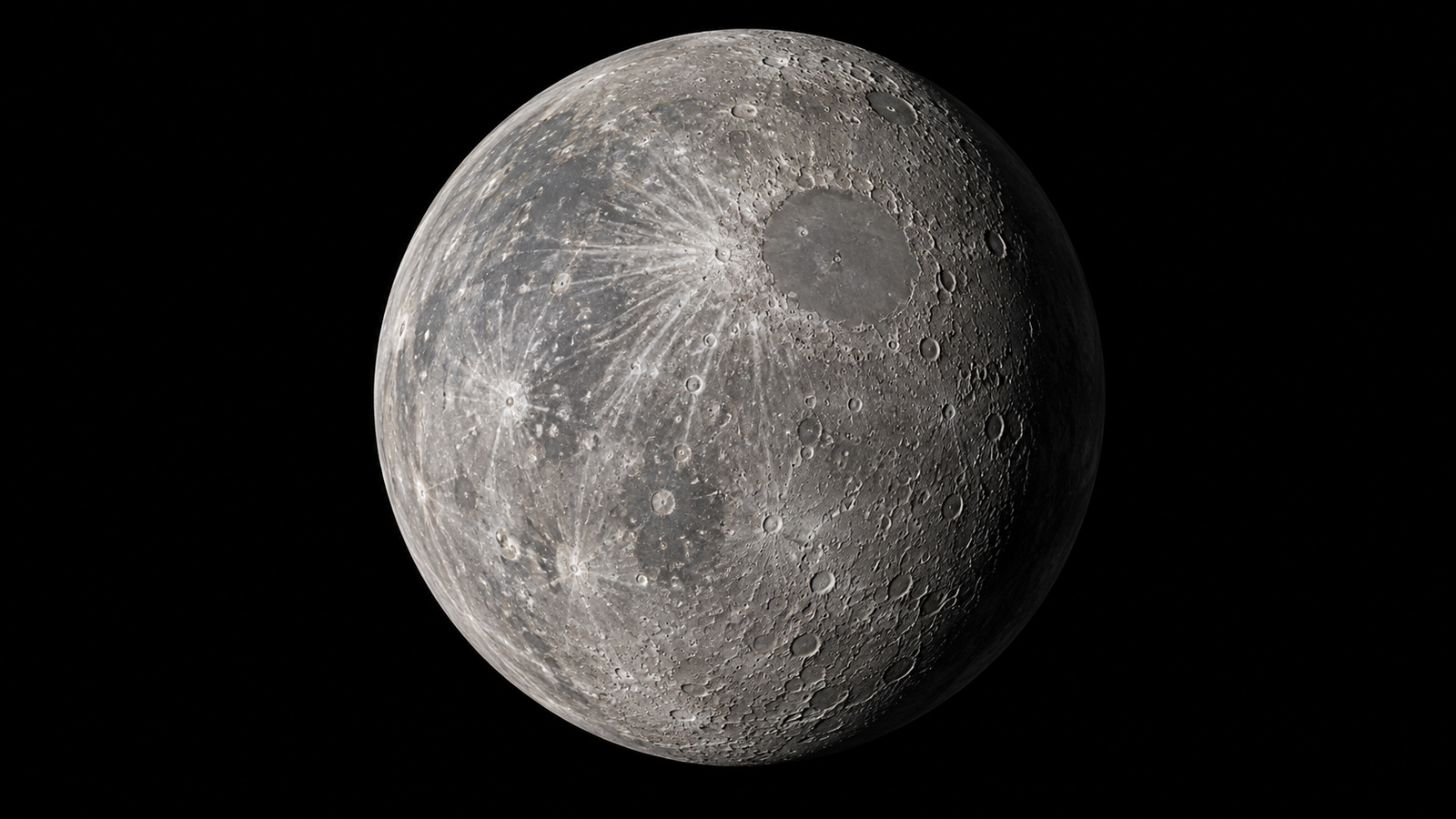
A Small Planet That Needs More Than One Number
Mercury is about 4,880 kilometers across, compared with roughly 12,740 kilometers for Earth. Its diameter is therefore around thirty-eight percent of Earth’s, making our planet about 2.6 times wider. That clear comparison is only the beginning: a smaller diameter does not mean the same fraction of volume, mass, or gravity. Mercury contains a remarkably large metallic core for its overall dimensions, so it is dense despite its modest size. Its surface gravity is weaker than Earth’s, but that relationship involves both mass and radius. Understanding these distinctions makes planetary scale more useful than a picture of two differently sized circles. Mercury is the smallest recognized planet in the Solar System, yet its compact structure provides important evidence about how rocky worlds formed and evolved.
Diameter Is a Straight-Line Comparison
A diameter passes through a globe’s center from one surface to the opposite surface. It is the appropriate measure when asking how wide the two planets would look in a carefully constructed same-scale display. Radius is half the diameter, so a consistent comparison gives the same ratio whether both dimensions use radius or diameter. Mixing Earth’s diameter with Mercury’s radius would create a false result. Units must also match before a ratio is calculated; kilometers and miles describe the same physical distance but cannot be divided as though their numeric values were interchangeable.
Earth is not a perfect sphere, and its equatorial and polar dimensions differ slightly. Mercury is also described through measured shape rather than an ideal mathematical globe. Rounded figures are usually adequate for a beginner’s comparison, provided they do not imply precision beyond the chosen reference. A diameter ratio of about 0.38 is more informative than an excessive string of decimals copied from mismatched sources. The physical relationship survives sensible rounding.
Volume Changes Much Faster Than Width
For similarly shaped spheres, volume scales with the cube of radius. Mercury’s roughly 0.38 radius ratio therefore corresponds to only about 0.056 of Earth’s volume, or around one-eighteenth. This explains why placing two circles beside each other understates the difference in the amount of space each body occupies. Doubling a sphere’s width increases its volume eightfold rather than twofold. Planetary comparisons become much clearer once linear dimensions are separated from three-dimensional capacity.
The frequently used phrase that eighteen Mercuries would fit inside Earth is a volume comparison. It does not mean eighteen rigid spheres could be packed into an Earth-sized shell without gaps. Packing geometry is a different problem, and real planetary material would not behave like little marbles in a container. The phrase is useful if its intended meaning is stated explicitly. Without that qualification, an accessible comparison can quietly turn into a misleading physical picture.
A human-scale model provides another route. If Earth were represented by a globe ten centimeters wide, Mercury would be about 3.8 centimeters wide on the same scale. A model using a different Earth size should preserve that ratio rather than adjust Mercury for visual convenience. Distance to the Sun would require vastly more space than a compact tabletop comparison allows. A size model and a distance model consequently need separate purposes or a much larger physical setting.
Mass Depends on What Fills the Volume
Mercury has roughly 5.5 percent of Earth’s mass, close to but not identical with its volume fraction. Mass measures the amount of matter, while volume describes the space it occupies. Their relationship is average density. Two equally sized planets could have different masses if their internal materials and compression differed. Likewise, a smaller object can be denser without outweighing a much larger one.
Planetary masses are measured through gravitational effects rather than by putting a planet on a scale. Spacecraft trajectories, orbital relationships, and other dynamical observations constrain the attraction produced by the body. Combining that mass with dimensions derived from imaging and shape measurements yields density. This chain uses independent kinds of evidence. A photograph alone establishes neither the planet’s mass nor the distribution of material beneath its surface.
A Compact World With a Large Core
Mercury’s bulk density is high for a body with its dimensions. Its large metallic core occupies much of its interior, making it different from a uniformly scaled-down Earth. The core’s proportion matters even when the total planet remains small. Internal composition is therefore part of a size story, not an unrelated extra fact. NASA’s Mercury lithograph describes the planet’s large core alongside its compact overall dimensions.
NASA’s structural summary puts the metallic core’s radius near 2,074 kilometers, roughly 85 percent of Mercury’s 2,440-kilometer radius. The rocky mantle and crust consequently occupy a comparatively thin outer region. This is a radial proportion, not a statement that the core contains exactly 85 percent of the planet’s mass. A spherical component with 85 percent of the radius would occupy about 61 percent of the volume, because volume grows with the cube of radius.
The mass share requires the densities of the different materials as well. Metal and silicate rock do not contribute the same mass for an equal volume, and compression changes their densities inside a planet. Mercury’s compact dimensions therefore coexist with a substantial concentration of metallic material. The width tells us where the outer boundary lies; gravity and interior measurements help explain what fills the space within it. Both are needed to compare the planet physically with Earth.
Why Earth Still Has a Slightly Higher Bulk Density
Earth’s stronger internal gravitational compression increases the density of material under pressure. Consequently, comparing average densities directly includes both composition and compression. A dense small planet and a dense large planet need not have identical proportions of metal and rock. Researchers can model the pressure effect to examine the uncompressed material comparison, but that is a calculated inference rather than the ordinary reported bulk density. The distinction explains why Mercury’s metal-rich structure can be remarkable even though Earth has a slightly greater average density.
This also limits conclusions drawn from a single statistic. Average density does not identify every layer’s thickness, state, or chemistry. Different interior models may share a similar overall value while differing in details. Gravity measurements, rotation behavior, magnetic observations, and geological constraints add information. The best internal picture uses these together rather than turning density into a complete underground photograph.
Gravity Combines Mass With Radius
At a spherical body’s surface, gravitational acceleration depends on mass divided by the square of radius. Mercury’s lower mass weakens attraction, while its smaller radius puts the surface closer to the center and partly compensates. The resulting surface gravity is about thirty-eight percent of Earth’s. This numerical similarity to the diameter ratio is not a universal rule that gravity always follows planetary width. It arises from Mercury’s particular mass and radius relationship.
A person with a mass of seventy kilograms would still have that mass on Mercury. Their weight, the gravitational force on them, would be much lower than on Earth. Bathroom scales calibrated to Earth gravity can display a misleading mass-like number when used elsewhere because they infer kilograms from force. Describing an astronaut as losing matter upon landing would therefore confuse mass with weight. Their body remains the same object under a different gravitational acceleration.
Lower gravity affects jumping, falling, and the mechanical environment, but it does not make Mercury an easy place to visit. Surface conditions, radiation, vacuum, and mission logistics impose separate challenges. A simple gravity comparison cannot establish habitability or safety. Nor does a hypothetical longer jump account for bulky equipment, terrain, or the need to avoid injury. Physical comparisons are most useful when their limited purpose remains visible.
Mercury Is Larger Than the Moon, Smaller Than Some Moons
Earth’s Moon has a diameter of about 3,475 kilometers, so Mercury is roughly forty percent wider. Their cratered appearances can suggest a closer equality than their dimensions support. Meanwhile, Ganymede and Titan have greater diameters than Mercury, although neither has its mass. Planet and moon describe orbital relationships and classification, not a strict ranking by width. The Solar System contains satellites larger across than its smallest planet.
These comparisons demonstrate why a largest-object list should state its criterion. Diameter, mass, and volume produce related but distinct rankings. A body rich in low-density material can be wider without being heavier, while a dense rocky world can be relatively compact. Mercury’s planetary status is not threatened by a larger satellite elsewhere. It orbits the Sun directly and belongs to the recognized planetary population, while those moons orbit their host planets.
Small in Space Does Not Mean Small to Cross
Mercury’s circumference is about 15,300 kilometers, far shorter than Earth’s roughly 40,000 kilometers but still an enormous terrestrial-scale journey. A straight-line diameter comparison does not describe travel over a curved surface. Mountains, craters, and the absence of infrastructure would also make an actual route different from a perfect great-circle calculation. Calling Mercury tiny is reasonable relative to planets, not relative to a walking expedition. The appropriate reference scale changes the meaning of the adjective.
Apparent Size Depends on Where You Stand
From Earth, Mercury can appear as a small disk in a telescope, but that apparent size varies with its distance. Physical diameter stays nearly the same while angular diameter changes. A nearby smaller world can consequently appear wider than a more distant larger one. Phase and atmospheric viewing conditions also affect what a telescope image reveals. An observer’s photograph cannot be used as a direct physical-size comparison without accounting for distance and projection.
Spacecraft portraits can create a different distortion when figures from separate encounters are placed together. A close Mercury image and a distant Earth image may occupy equal frame widths despite their unequal physical diameters. Editors can construct a genuine same-scale comparison, but the caption should identify that operation. Natural-looking globes in one composition are not necessarily naturally neighboring objects. A useful illustration must keep presentation choices distinct from the actual arrangement of the Solar System.
What Mercury’s Scale Reveals About Its History
A small rocky planet cools and evolves differently from a larger one because its volume, surface area, and internal material distribution differ. Surface area scales with the square of radius, while volume scales with the cube, so smaller comparable bodies have more surface per unit volume. Actual planetary cooling also depends on composition, heat production, layering, and transport rather than geometry alone. This relationship is a starting framework, not a prediction of a single universal cooling timetable. Mercury’s preserved faults, volcanic plains, and magnetic field supply the additional evidence needed for its particular history.
The surface-area comparison supplies another useful scale. Using the diameter ratio of roughly 0.38, Mercury has about 0.38 squared, or 0.14, of Earth’s surface area in a spherical approximation. That is approximately one seventh, while its volume is only about one eighteenth. A smaller world exposes proportionally more surface for the material it contains. This geometrical difference helps explain why copying Earth’s surface appearance at reduced size would not reproduce Earth’s thermal history, although the actual cooling still depends on the planet’s materials and internal structure.
NASA’s Mercury overview places the smallest planet within that broader geological setting. Its dimensions become scientifically meaningful when joined to the dense interior and measured gravitational behavior. The most useful comparison with Earth consequently keeps several answers side by side: about 0.38 of the diameter, about 0.056 of the volume, about 0.055 of the mass, and about 0.38 of the surface gravity. Those values describe different relationships. Together, they show why Mercury is a compact, metal-rich world rather than simply Earth reduced on a copier.


