Almost No Air, Yet Plenty of Atomic Questions
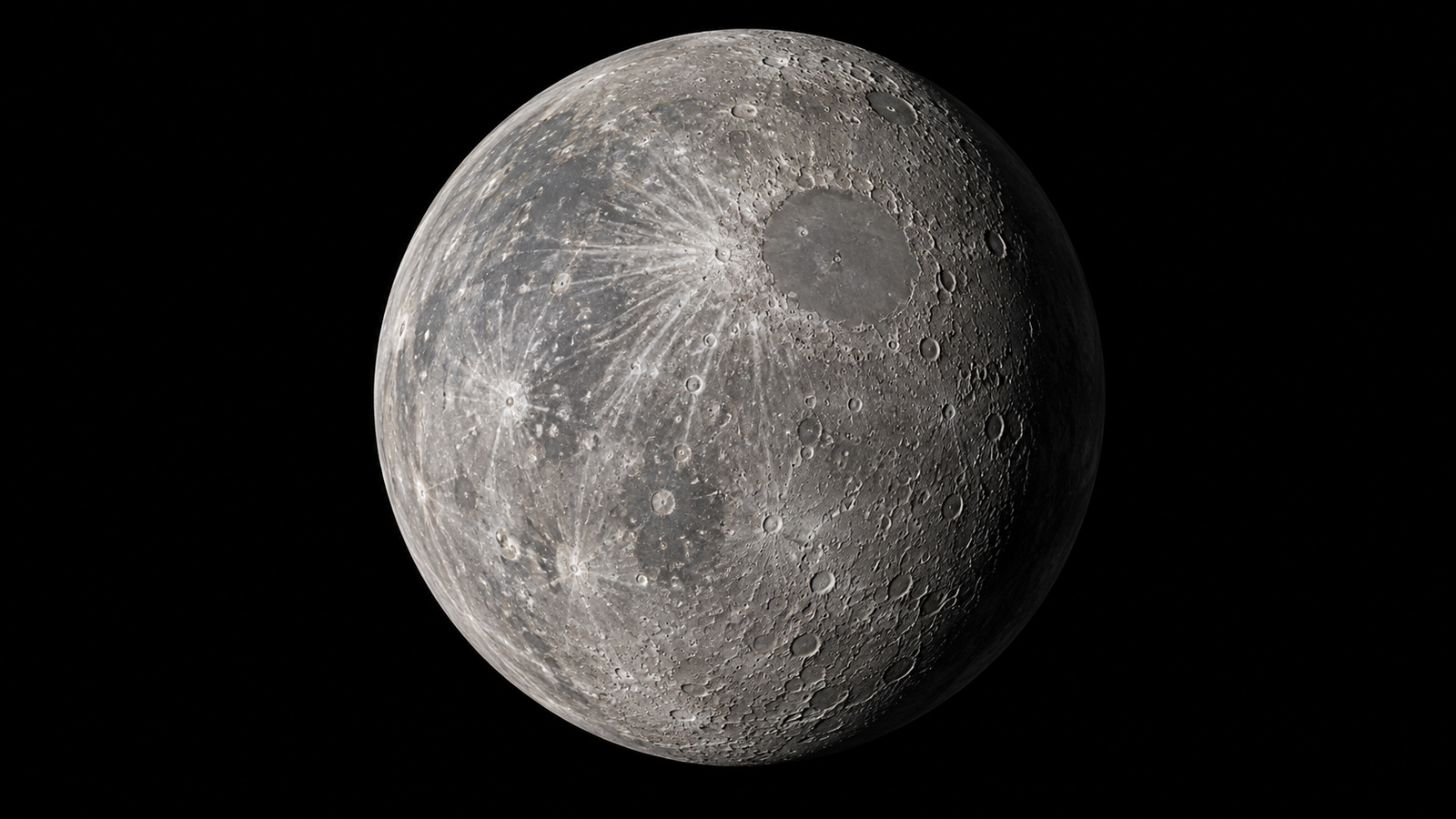
Mercury does not have a substantial atmosphere like Earth’s, but it is not completely free of surrounding gas. It carries an extremely sparse exosphere containing atoms released from the surface, supplied by the space environment, or redistributed through interactions with sunlight and charged particles. The particles rarely collide with one another, so they do not behave like an ordinary blanket of air. Individual trajectories matter more than familiar weather patterns. Some atoms fall back to the ground, some become electrically charged, and others escape into space. This constantly replenished population links the rocky surface with the Sun and Mercury’s magnetic environment. Understanding it requires a more precise question than whether the planet simply has or lacks an atmosphere: what material is present, how does it get there, and where does it go?
What Makes an Exosphere Different From Air
In a dense atmosphere, frequent molecular collisions support fluid behavior and help establish pressure, circulation, and a local thermal state. Mercury’s gas population is so sparse that an atom can travel a long distance without meeting another atom. Its path can therefore be governed largely by gravity, its initial velocity, and external forces. The familiar idea of an air parcel blowing across a landscape is not the best description. A collection of independent particle trajectories provides a more useful starting picture.
Earth also has an outer exosphere, but it sits above denser atmospheric layers. Mercury’s exosphere is directly connected to the surface instead of occupying the top of a substantial lower atmosphere. The phrase surface-bound exosphere identifies that setting. It does not mean every atom stays permanently attached to the rock or that no atom can escape. It describes a particle population whose sources and return pathways strongly involve the ground.
The Surface Is an Active Particle Source
Mercury’s surface contains minerals with several elements that can enter the surrounding population through different release mechanisms. Solar ultraviolet photons can stimulate the removal of some atoms from near-surface sites, while impacts and charged-particle bombardment provide other pathways. The efficiency depends on the species, material, and local conditions. A single process should not be assigned the same role for every element. The surface is part of a dynamic exchange system rather than an inert floor underneath independent air.
Some material can be temporarily held by or returned to the ground before being released again. This recycling complicates attempts to infer the original source from a single observation of an atom. An atom measured above one region may have arrived through several prior hops or interactions. Surface temperature and composition influence which pathways are effective. The resulting distribution reflects both the source locations and the history of particle movement.
It is consequently important to distinguish an elemental abundance in the exosphere from the total abundance in the crust. An easily released element may appear prominent in the gas despite occupying only a limited fraction of the solid material. A less mobile element can remain largely in minerals and be weak in a particular observing channel. Release physics and detection sensitivity intervene between the ground and the measurement. The exosphere is a chemical window on the surface, but not a simple proportional sample of all its ingredients.
Photons Do More Than Illuminate the Ground
Sunlight provides energy that can help release atoms, and it can also affect particles after they leave the surface. Radiation pressure acts on suitable atoms through their interaction with solar photons, changing trajectories in ways that depend on the species and spectral response. Sodium provides an important example because its interaction with sunlight can produce an extended anti-solar population. This is a physical momentum transfer, not sunlight behaving like ordinary wind. It belongs to the atomic-scale dynamics of a sparse environment.
Solar ultraviolet radiation can also ionize a neutral atom by removing an electron. Once charged, the particle responds to electric and magnetic fields in addition to gravity and other forces. Ionization therefore changes the type of population being followed and can redirect the atom’s fate. A neutral-gas map and an ion measurement need not reveal identical distributions. They trace related material under different physical conditions.
Solar-Wind Bombardment Adds Another Pathway
The solar wind is a flowing plasma, carrying charged particles and magnetic fields rather than terrestrial air. Its interaction with Mercury’s magnetic environment can deliver particles toward the surface in particular regions. Bombardment can eject surface material through sputtering, while solar-wind species can also contribute to the available particle inventory. The effectiveness changes with magnetic geometry and solar conditions. A description of sunlight alone would omit these charged-particle interactions. Conversely, attributing every observed exospheric feature to the solar wind would ignore the other release mechanisms.
Tiny Impacts Can Supply Vapor
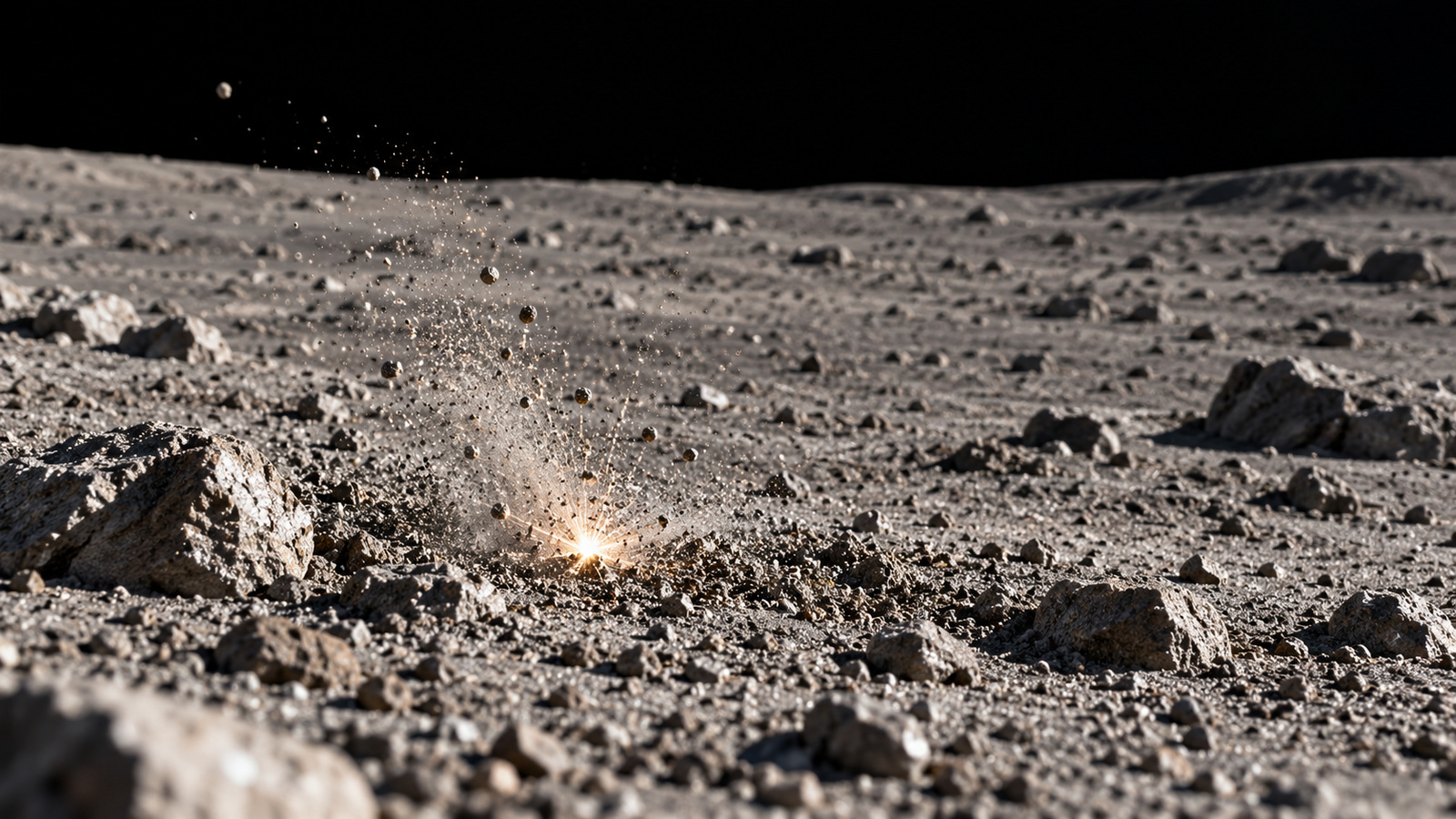
Micrometeoroids strike Mercury at high speed and can vaporize some material in their immediate impact region. The physical event is local, but the released atoms contribute to a broader population around the planet. Solid dust ejecta and vaporized material are different products and should not be visually confused. A spray in an illustration can represent the impact process without depicting the atoms themselves as a visible smoke cloud. The actual exosphere remains extraordinarily tenuous.
Impact supply varies with the dust environment and the geometry of Mercury’s motion. Different parts of the surface can face different encounter conditions, and those differences may produce spatial asymmetries. Researchers model the incoming dust population to compare predicted patterns with observations. NASA’s account of dust and exospheric asymmetry illustrates how particle delivery can help explain a nonuniform surrounding gas distribution. An uneven measurement is therefore not automatically evidence for a persistent air current.
Compare Particle Supply With Particle Loss
Consider an increase in neutral sodium above a sunlit part of Mercury. More atoms could have been released from the ground, or a previously supplied population could have moved into the observed line of sight; the brightness also depends on how effectively those atoms scatter sunlight. A photon-driven source should respond to illumination and surface conditions, whereas impact vaporization responds to the arriving dust population and its collision energy. Solar-wind sputtering adds another variable because magnetic geometry controls where charged particles reach the ground. Meanwhile ionization can reduce the neutral population even if release continues. Comparing time changes, species and locations separates these competing rates: the observed exosphere is the balance of supply, transport and removal, rather than a direct meter of one source alone.
Atoms Can Hop, Return, or Leave
An atom released below escape speed may follow a ballistic arc and encounter the surface again. Depending on its interactions there, it can be retained, released later, or participate in another stage of movement. Gravity organizes those trajectories without producing a familiar weather layer. The distribution changes as new particles are supplied and existing ones are removed. A surface-bound population can remain observable even when individual atoms do not stay for long.
More energetic particles or particles influenced strongly by external forces can travel much farther. Ionization may move material into the surrounding plasma, while radiation pressure can help shape an extended sodium tail. These pathways depend on species and initial conditions. A single universal residence time would hide that diversity. The balance between supply, recycling, and loss is more informative than imagining a permanent fixed shell.
Research on Mercury’s sodium exosphere examines both near-surface behavior and the role of sunlight. Such work emphasizes why a distant tail is not the whole exosphere: much of the population can remain associated with shorter trajectories closer to the planet. A visually striking extension can therefore represent only one portion of a larger particle budget. The scientific description must include the less dramatic component as well. Visibility and total inventory are not the same quantity.
Several Elements Reveal Different Behaviors
Observations have identified species including sodium, calcium, magnesium, hydrogen, and helium, among others. Their distributions and release pathways need not match, because different atoms interact differently with sunlight, surface material, and external particles. Sodium brightness cannot stand in for a complete map of all species. A feature strong in one wavelength channel may be weak or absent in another. Comparing species helps researchers separate source processes that would be ambiguous in a single-element observation.
The word gas also does not imply a breathable mixture. A population can contain hydrogen or oxygen-bearing products while remaining far too sparse and physically unsuitable to function as ordinary air. Earth-like biological requirements concern pressure, composition, and an entire environment, not the mere detection of a familiar element. Likewise, naming sodium does not make the exosphere a cloud of table salt. The measured atomic species and the chemical form of the source minerals belong to different descriptions.
How a Sparse Population Becomes Measurable
Spectroscopic instruments detect light associated with particular atomic transitions. Ground-based telescopes and spacecraft observe different geometries and wavelength ranges, complementing one another. Signal brightness depends on particle abundance, illumination, line-of-sight length, and instrument response. It is not simply a direct count of all surrounding material. A bright region can result from several interacting conditions, requiring a model to connect the measurement with particle density.
Why Geometry Matters in an Exospheric Map
A line of sight can pass through a longer or shorter part of the population depending on the observer’s position. Near the limb, the measured signal may integrate particles across an extended path rather than sample one local point. Researchers must account for that projection before assigning a bright patch to a specific surface source. Comparing successive geometries provides useful constraints. A two-dimensional image can encode a three-dimensional and time-dependent distribution.
The map may also be displayed with artificial colors chosen to show intensity or species differences. Those colors do not establish what a human observer would see from the ground. ESA’s early BepiColombo exosphere measurements illustrate how instrument signals can identify atoms without requiring a visible atmospheric haze. A plot or coded map is a measurement product, not a literal colored blanket around Mercury. Captions help preserve that distinction.
Temperature Needs Care in This Environment
Dense gas commonly permits a local temperature description because collisions help distribute energy. A sparse exosphere can instead contain populations with different release energies and trajectories, so one simple air-temperature value may be inadequate. The solid surface’s temperature is a separate quantity measured or modeled through its own energy balance. A hot particle population does not imply dense hot air capable of transferring heat like a terrestrial atmosphere. Density and energy distribution must be considered together. This is why Mercury’s surface thermal extremes and exospheric physics need related but distinct explanations.
A Boundary Between Rock and Space
Mercury’s exosphere responds to the planet’s surface, the dust environment, sunlight, charged particles, and magnetic conditions. None of those components operates in isolation, and their relative importance can change with place, species, and time. The absence of dense air makes the system different from terrestrial weather without making it scientifically empty. It is a sensitive record of material exchange at a rocky world’s exposed boundary. Studying that exchange helps researchers understand both Mercury and other airless bodies.
The most accurate short answer is that Mercury lacks a substantial conventional atmosphere but possesses a measurable, continually changing exosphere. Atoms are released, redistributed, recycled, ionized, or lost, forming a population whose behavior requires particle-level reasoning. The distinction resolves the apparent conflict between descriptions that say no atmosphere and observations that identify gas. Both can be useful when their meanings are specified. Precision about what counts as air turns a yes-or-no title into a coherent physical explanation.