
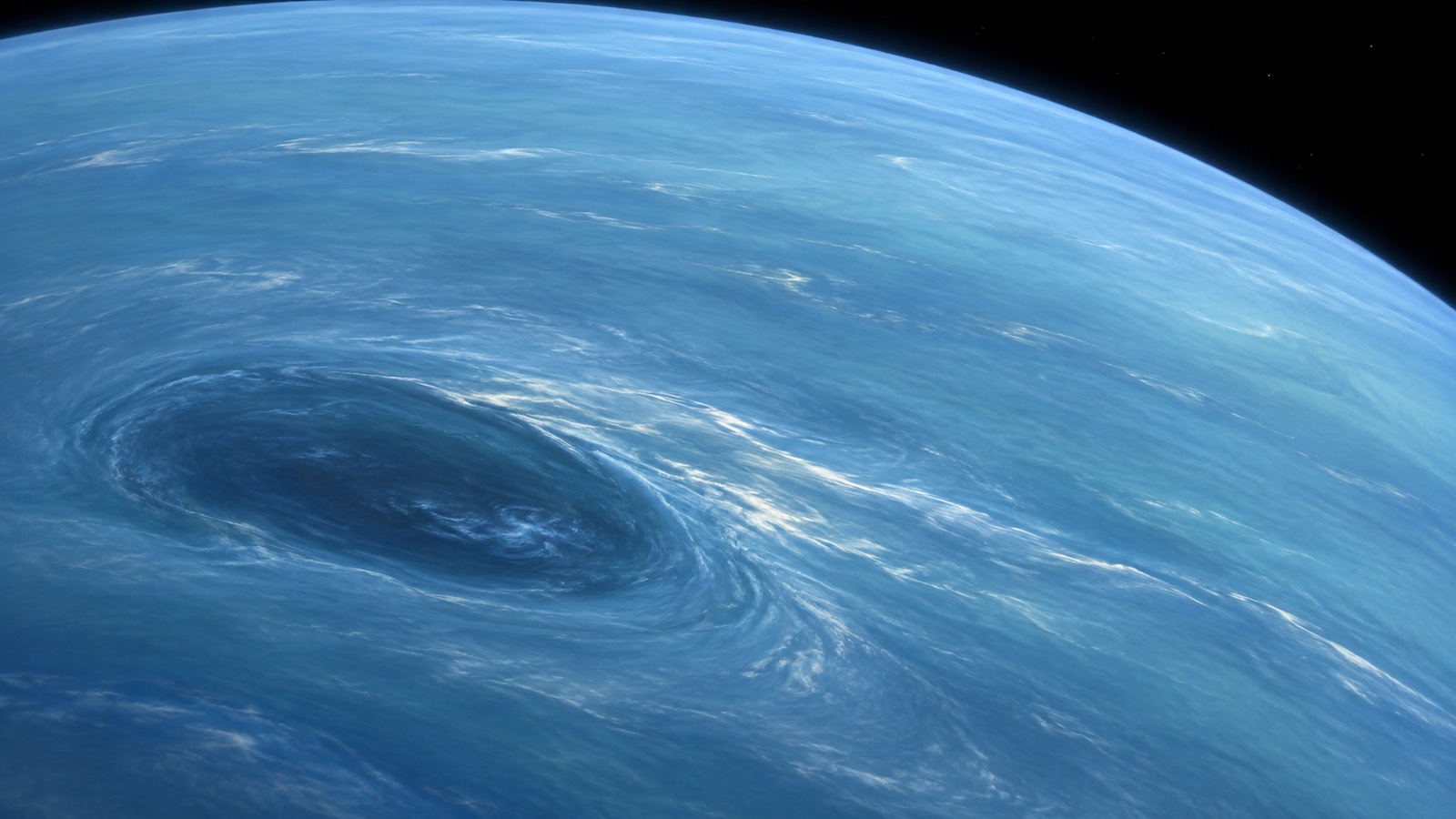
A famous portrait of a temporary storm
The dark oval in Neptune’s best-known Voyager portrait looks like a permanent mark on the planet. It was actually weather: an enormous rotating disturbance within a deep, moving atmosphere. Voyager 2 photographed the Great Dark Spot in 1989, but later observations did not find that same feature still occupying its old location. Other dark vortices appeared instead, sometimes changing shape, moving across latitude, or behaving in ways their watchers had not expected. The useful question therefore goes beyond identifying the oval in one image. It asks what makes a storm look dark, how bright neighboring clouds relate to it, and why a planet receiving so little sunlight can sustain such energetic circulation. Following the Great Dark Spot through observation and disappearance turns a familiar blue globe into a dynamic world.
The oval belonged to the atmosphere
A dark spot on a giant planet is not equivalent to a dark region on the Moon. Neptune has no exposed rocky landscape beneath the visible markings that a camera could map as a fixed surface. Its observable face consists of atmospheric layers containing gases, haze, and clouds. A feature can consequently shift, develop, or disappear while the underlying planet remains. The word spot describes the appearance in an image; vortex identifies the rotating atmospheric structure associated with that appearance.
Voyager 2’s encounter supplied the close views that made the original Great Dark Spot famous. The feature was extraordinarily large compared with terrestrial storms, measuring approximately 13,000 by 6,600 kilometers in the Voyager view, with its longer dimension comparable to Earth’s diameter. That size made comparisons with Earth useful for scale, but it did not make the disturbance a larger copy of a familiar hurricane. Different atmospheric composition, vertical structure, rotation, and environmental conditions alter the circulation. A dark oval alone cannot establish the complete physical mechanism operating below the visible clouds.
The nearby white streaks were another part of the scene rather than an icy border around a hole. Methane can condense into bright cloud particles under suitable conditions in Neptune’s upper atmosphere. Gas disturbed by a deeper circulation can rise and cool enough to produce clouds at a different altitude. This creates a layered arrangement: an atmospheric disturbance and luminous companions need not occupy one flat level. Their juxtaposition is informative precisely because they can respond to different pressures and temperatures.
Darkness is a radiative clue, not an empty opening
A region looks dark when less light reaches the detector from that direction at the wavelengths being observed. Several physical arrangements can produce that outcome, including changes in aerosol properties or the amount of material at a particular depth. The atmosphere is not transparent at every wavelength, so observers must distinguish a visible contrast from the underlying cause. Looking blacker than nearby haze does not demonstrate an open shaft through Neptune. It establishes a contrast that spectroscopy and atmospheric modeling can investigate.
Cloud tracking measures motion with important limits
Repeated images allow scientists to follow identifiable atmospheric structures over time. Their changing positions, combined with the planet’s rotation and an adopted coordinate system, constrain winds at the levels represented by those features. This is a remote measurement with geometrical and interpretive requirements. A bright cloud may evolve while moving, and a feature must be identified reliably in successive frames. Cloud-tracked motion should therefore be described with its observing level and method rather than treated as a universal velocity throughout the atmosphere.
Neptune is famous for extremely fast winds, but one headline value should not be assigned indiscriminately to every vortex. Winds surrounding a disturbance, background zonal circulation, and circulation inside the vortex are related but different quantities. NASA’s discussion of storm lifecycles emphasizes that winds inside the dark vortices have not been directly measured. Distinguishing an estimate from a cloud-tracking measurement prevents a striking speed from becoming an invented complete weather report.
The observer must also distinguish a feature moving around Neptune from the rotation assigned to the planet itself. A gaseous exterior has no painted meridian fixed to an exposed crust, and clouds at different latitudes can move differently. Coordinates provide a consistent framework for comparisons, but the inferred motion depends on that framework and the altitude represented by the tracked feature. A color movie showing a dark patch moving across the disk is consequently not a simple animation of the whole planet turning. It combines viewing geometry with actual atmospheric movement, and the analysis must account for both before a speed is attached to the visible oval.
The original Great Dark Spot did not persist
When Hubble observed Neptune in 1994, the prominent 1989 feature was absent. NASA’s storm-history account gives both that disappearance milestone and the approximate Voyager dimensions. Its disappearance established that the famous photograph did not show a centuries-long fixed landmark. Later observations revealed additional dark spots in other locations. These successors belong to the same broad class of atmospheric phenomena, but they are not automatically continuations of the original storm. A name used for a famous example should not conceal the different histories of independently observed disturbances.
This is an important difference from a casual comparison with Jupiter’s Great Red Spot. Both planets host enormous atmospheric vortices, yet the historical persistence of Jupiter’s familiar feature cannot simply be transferred to Neptune. Background winds and changes across latitude influence whether a vortex survives or breaks apart. Comparisons are most useful when they ask which conditions favor longevity, not when they imply that every giant planet must retain its own permanent colored oval.
Tracking lifetimes also requires sufficient observing cadence. A storm can form, alter its direction, or fade between observations made months apart. A gap in the record is not a film of the intervening events. Scientists combine the available images with dynamical models, while keeping the unseen intervals explicit. The distinction matters especially for distant Neptune, whose small apparent disk and limited spacecraft record make continuous high-resolution coverage difficult.
Bright companion clouds can sometimes become visible before a dark vortex is confidently identified. They offer possible clues to an evolving disturbance at deeper levels, but a cloud outbreak is not by itself a guaranteed birth announcement. Features can have several origins. The strongest lifecycle reconstruction follows cloud behavior, dark contrast, latitude, and timing together, with enough observations to test whether those pieces describe one connected event.
A later vortex challenged a simple migration story
One Hubble-tracked dark storm moved toward the equator and then changed direction, avoiding the expected route toward disruption. A smaller dark feature appeared nearby during the same observing history. NASA’s account of this reversal treats a possible fragment as an interpretation, not a directly witnessed separation movie. The episode shows why actual monitoring is needed even when numerical models suggest a plausible typical path.
The latitude of a vortex matters because the influence of planetary rotation changes across the globe. A structure embedded in one region does not experience exactly the same background conditions as it approaches the equator. Shear, surrounding winds, and interactions with other disturbances can modify its trajectory and survival. This does not mean the motion is arbitrary. It means that several physical influences operate together, so a single rule about the direction all spots must travel is too crude.
Spectra make the vertical structure accessible
In 2023, researchers reported an Earth-based detection of a Neptune dark spot using the Very Large Telescope’s MUSE instrument. The measurements supplied spectra across the scene instead of only a few broad-color images. ESO’s description of the observation explains how wavelength-dependent information helped investigate the atmospheric depth and darkening mechanism. An unexpected bright feature nearby also demonstrated that apparently similar luminous spots can arise at different levels. A resolved patch of light is the beginning of the analysis, not the complete atmospheric answer.
Models connect the spectrum to particles and pressure
Atmospheric gases absorb differently across wavelength, providing information about how deeply particular light can probe. A model that describes the gases and aerosols can compare proposed layer arrangements with the observed spectrum. If a change is visible in wavelengths sensitive to one depth but behaves differently elsewhere, that constrains its location and optical properties. The result is a physical inference from several measurements, not a camera viewing a labeled cross-section of the atmosphere.
Researchers studying dark spots have investigated darkening in a deeper aerosol layer and changes in particle behavior. The published spectral analysis makes clear why broad-band photographs alone left important ambiguities. Different particle properties can affect how sunlight is scattered or absorbed, while overlying gas alters which signals escape. Spectroscopy narrows the alternatives by demanding that a proposed explanation fit the pattern across many wavelengths rather than the appearance of one dark pixel group.
Uncertainty remains meaningful even when a model fits well. Particle sizes, composition, vertical distribution, and background atmospheric assumptions can influence the solution. Further spectra at another time or viewing geometry can test whether the inferred arrangement still works. Describing the result as evidence for a mechanism is stronger science communication than claiming that observers directly sampled the storm’s particles. Remote measurements are powerful, but their strengths come from tested interpretation rather than pretending distance has disappeared.
Neptune powers weather far from the Sun
Weak sunlight does not imply that the atmosphere must be motionless. Neptune releases internal energy as well as receiving solar energy, and its rotation organizes atmospheric circulation. Heat transfer through a deep atmosphere can supply motions even when the upper environment is very cold. The relationship between internal heating, cloud formation, and large-scale winds remains an active research problem. Cold visible clouds and energetic circulation are therefore compatible features of one planet, not evidence of contradictory descriptions.
Seasonal changes add another timescale because Neptune takes roughly 165 Earth years to complete its solar orbit. Observations covering a few decades examine only part of that long cycle. Weather can change rapidly within a season, while seasonal illumination and atmospheric chemistry develop more gradually. An unusually clear image on one date cannot be treated as the average face of Neptune for its whole year. Both short-lived features and longer environmental changes belong in the record.
One Famous Storm Belongs to a Changing Population
The short history is striking: Voyager photographed an Earth-scale southern oval in 1989, and Hubble found it missing in 1994. Other dark vortices appeared in later observations, including a northern feature whose changing path challenged an expected equatorward decline. These events describe distinct disturbances within a moving atmosphere. The classic photograph is therefore an important stage in Neptune’s weather history, rather than its permanent identifying face.
The bright companion clouds and the dark oval also tell different parts of that history. Higher methane-ice clouds can form around disturbed flow while lower atmospheric particles affect the darkness seen at selected wavelengths. A vortex can change its cloud surroundings without every visible change marking the disappearance of its circulation. Spectral results strengthen this physical picture by locating which components explain the wavelength-dependent contrast.
Neptune combines a cold upper environment with powerful winds, internal heat and evolving cloud systems. The Great Dark Spot made that combination memorable through a huge, well-defined example. Its later absence made the same lesson more compelling: even a storm comparable in width to Earth can be temporary. Following its successors reveals a planet whose atmosphere continually produces, reshapes and removes large structures.


