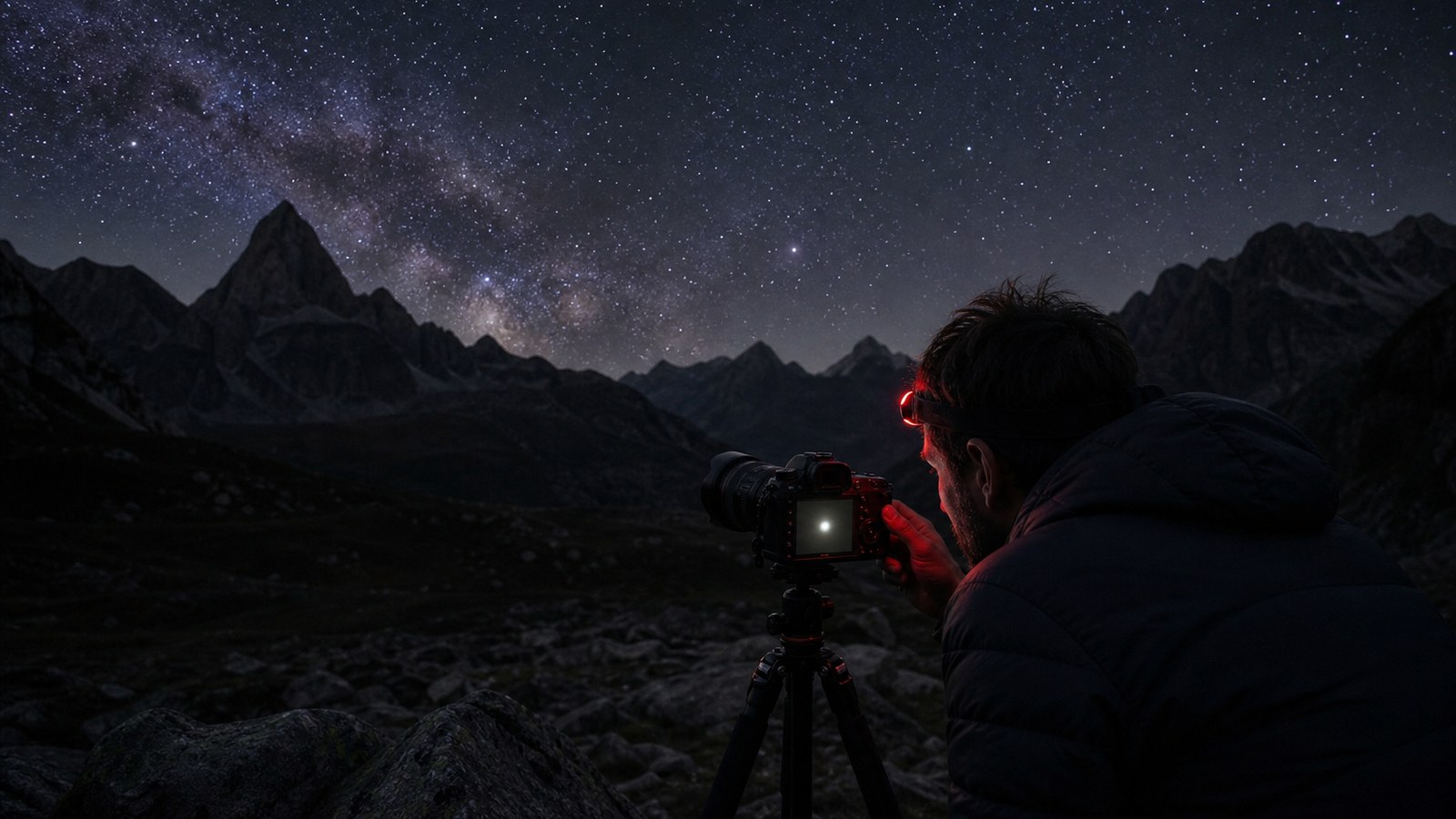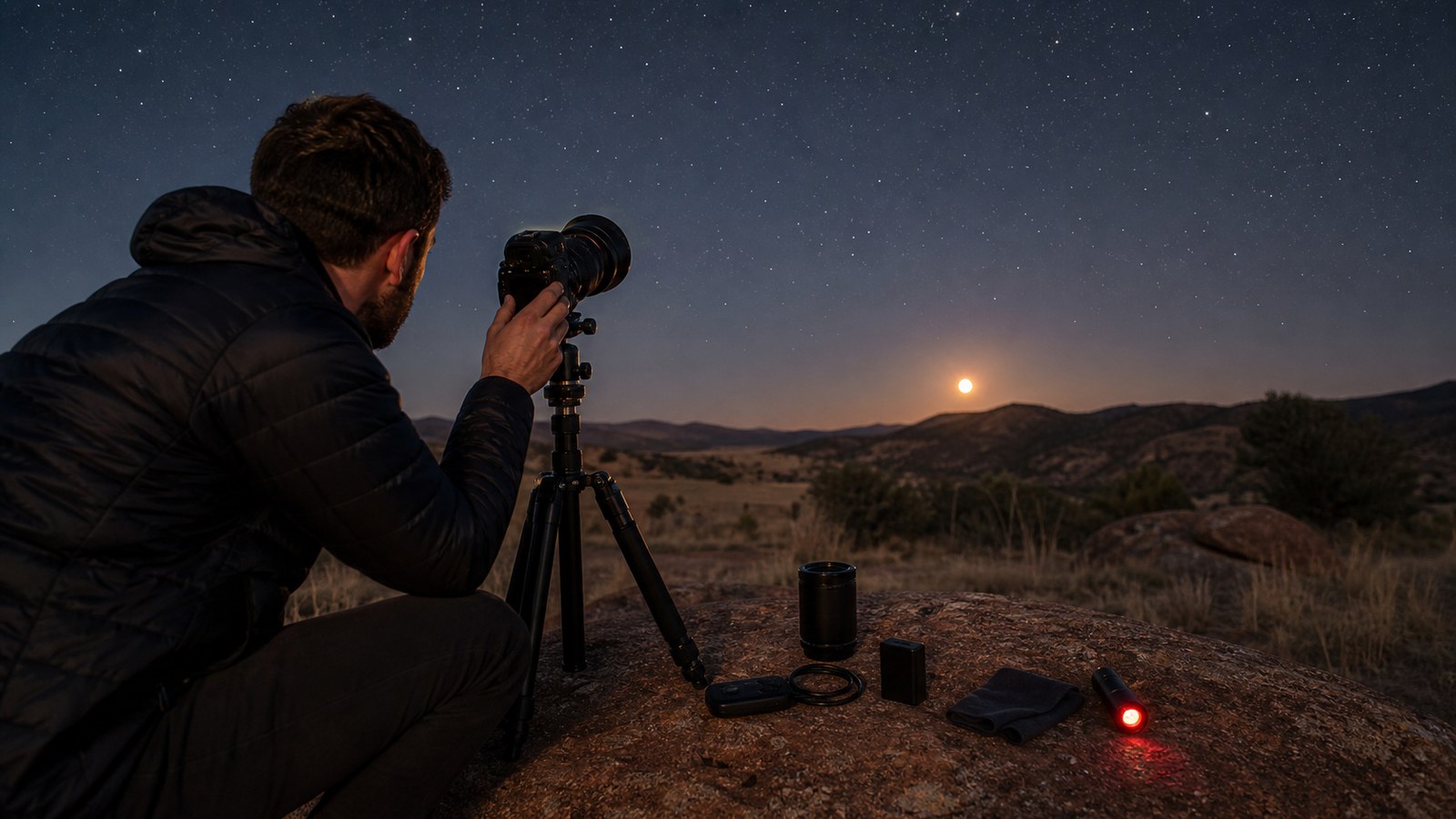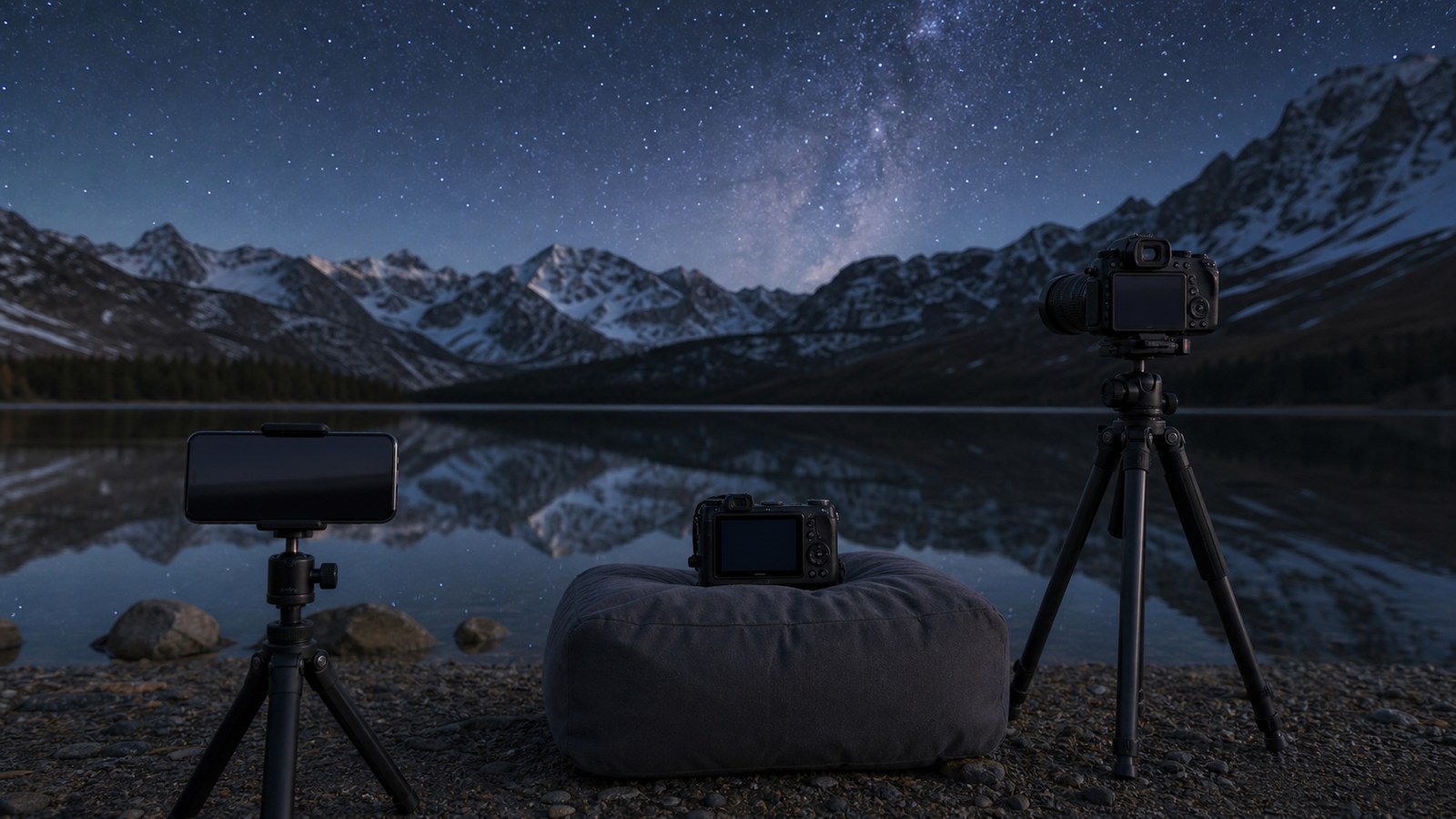
Every camera has a different ceiling, but almost every camera benefits from the same fundamentals: darkness, stability, accurate focus, controlled highlights, and a composition worth looking at. The practical challenge is to identify which controls the device offers and then design the photograph around those limits instead of imitating equipment it does not have.
Find the Camera's Honest Capabilities
Phones rely heavily on computational stacking, compact cameras may limit aperture, and larger cameras usually provide more direct control and raw latitude. Seen as a workflow problem, the solution becomes more manageable. Sensor size, lens brightness, processing, and stabilization determine which subjects can be recorded cleanly. Check for manual focus, raw capture, timed night mode, exposure compensation, and a self-timer before the session. Digital zoom does not add lunar or stellar detail; it enlarges existing pixels and magnifies movement. The most useful response is to observe the result, note the conditions, and adjust one variable at a time. This approach preserves both accuracy and the enjoyment of discovery.
Check for manual focus, raw capture, timed night mode, exposure compensation, and a self-timer before the session. The safest assumption is that conditions will vary and the plan must adapt. Digital zoom does not add lunar or stellar detail; it enlarges existing pixels and magnifies movement. Phones rely heavily on computational stacking, compact cameras may limit aperture, and larger cameras usually provide more direct control and raw latitude. Sensor size, lens brightness, processing, and stabilization determine which subjects can be recorded cleanly. The most useful response is to observe the result, note the conditions, and adjust one variable at a time. A second attempt under changed conditions will reveal whether the first result was typical.
Stabilize Whatever You Own
A phone clamp, mini tripod, beanbag, railing, or solid ground can replace handholding when exposures extend beyond a fraction of a second. For an observer, the consequence is immediate. Stable support lets the camera collect light without averaging the subject across a moving image. Trigger with a timer or remote, avoid touching the support, and keep straps from flapping in the wind. Optical stabilization cannot correct a composition that shifts during a long exposure or a support that vibrates. The most useful response is to observe the result, note the conditions, and adjust one variable at a time. Over time, those small checks become automatic and free attention for finer detail.
Trigger with a timer or remote, avoid touching the support, and keep straps from flapping in the wind. The strongest evidence comes from what changes when one condition is altered. Optical stabilization cannot correct a composition that shifts during a long exposure or a support that vibrates. A phone clamp, mini tripod, beanbag, railing, or solid ground can replace handholding when exposures extend beyond a fraction of a second. Stable support lets the camera collect light without averaging the subject across a moving image. The most useful response is to observe the result, note the conditions, and adjust one variable at a time. When uncertainty remains, choose the more conservative interpretation and gather another observation.
Use Bright Subjects Strategically
The Moon, twilight planets, silhouettes, conjunctions, and illuminated clouds demand less sensitivity than the Milky Way. The effect may be subtle at first, yet it becomes obvious across several sessions. Matching the subject to the camera's strengths produces cleaner files than forcing a small sensor to record extremely faint detail. Begin in blue hour, include a recognizable foreground, and expose to protect the Moon or brightest sky feature. Night mode may smear a moving Moon or stars because its software expects a mostly static low-light scene. The most useful response is to observe the result, note the conditions, and adjust one variable at a time. The same reasoning can then be applied to more difficult targets or environments.
Begin in blue hour, include a recognizable foreground, and expose to protect the Moon or brightest sky feature. The result is not merely aesthetic; it changes what information can be perceived. Night mode may smear a moving Moon or stars because its software expects a mostly static low-light scene. The Moon, twilight planets, silhouettes, conjunctions, and illuminated clouds demand less sensitivity than the Milky Way. Matching the subject to the camera's strengths produces cleaner files than forcing a small sensor to record extremely faint detail. The most useful response is to observe the result, note the conditions, and adjust one variable at a time. The goal is a repeatable result, not a single lucky success.
Stacking Beats a Single Desperate Exposure
Combining several aligned frames can reduce random noise while retaining real celestial signal. The practical importance of this point appears in the field. Random noise changes from frame to frame, whereas stars remain in predictable positions after alignment. Capture a consistent burst with fixed focus and exposure, then use reputable stacking software appropriate to the subject. Stacking cannot rescue clipping, gross motion blur, changing zoom, or focus that was wrong in every frame. The most useful response is to observe the result, note the conditions, and adjust one variable at a time. Keep the observation tied to time, direction, and conditions so it can be compared later.
Capture a consistent burst with fixed focus and exposure, then use reputable stacking software appropriate to the subject. Experience tends to confirm the value of a controlled approach. Stacking cannot rescue clipping, gross motion blur, changing zoom, or focus that was wrong in every frame. Combining several aligned frames can reduce random noise while retaining real celestial signal. Random noise changes from frame to frame, whereas stars remain in predictable positions after alignment. The most useful response is to observe the result, note the conditions, and adjust one variable at a time. This approach preserves both accuracy and the enjoyment of discovery.
Create Depth Without Artificial Spectacle
Foreground layers, reflections, scale figures, and natural color contrast can make modest star fields visually compelling. This is less a rule to memorize than a relationship to observe. The eye reads depth from overlap, size, tonal separation, and leading lines even when the sky contains few stars. Scout a clean silhouette, place the brightest celestial object intentionally, and allow negative space around it. Heavy saturation and invented sky replacement may attract attention but weaken credibility when light direction and scale disagree. The most useful response is to observe the result, note the conditions, and adjust one variable at a time. That record makes the lesson transferable instead of leaving it as a one-night impression.
Scout a clean silhouette, place the brightest celestial object intentionally, and allow negative space around it. A simple check before the session prevents a much harder correction later. Heavy saturation and invented sky replacement may attract attention but weaken credibility when light direction and scale disagree. Foreground layers, reflections, scale figures, and natural color contrast can make modest star fields visually compelling. The eye reads depth from overlap, size, tonal separation, and leading lines even when the sky contains few stars. The most useful response is to observe the result, note the conditions, and adjust one variable at a time. Over time, those small checks become automatic and free attention for finer detail.
Edit for the Device's File
A phone JPEG and a camera raw file tolerate different levels of shadow recovery, sharpening, and color change. The safest assumption is that conditions will vary and the plan must adapt. Compressed files break into banding and artifacts sooner because much of the original tonal information has been discarded. Make small adjustments, reduce color noise before sharpening, and inspect gradients at full size. Pushing dehaze and clarity too far creates dark halos around skylines and harsh rings around stars. The most useful response is to observe the result, note the conditions, and adjust one variable at a time. A second attempt under changed conditions will reveal whether the first result was typical.
Make small adjustments, reduce color noise before sharpening, and inspect gradients at full size. Planning improves once this constraint is treated as part of the system. Pushing dehaze and clarity too far creates dark halos around skylines and harsh rings around stars. A phone JPEG and a camera raw file tolerate different levels of shadow recovery, sharpening, and color change. Compressed files break into banding and artifacts sooner because much of the original tonal information has been discarded. The most useful response is to observe the result, note the conditions, and adjust one variable at a time. The same reasoning can then be applied to more difficult targets or environments.
Random noise changes from frame to frame, whereas stars remain in predictable positions after alignment. A useful way to test the idea is through repeated comparison. Capture a consistent burst with fixed focus and exposure, then use reputable stacking software appropriate to the subject. Stacking cannot rescue clipping, gross motion blur, changing zoom, or focus that was wrong in every frame. Combining several aligned frames can reduce random noise while retaining real celestial signal. The most useful response is to observe the result, note the conditions, and adjust one variable at a time. That record makes the lesson transferable instead of leaving it as a one-night impression.
Matching the subject to the camera's strengths produces cleaner files than forcing a small sensor to record extremely faint detail. A careful observer can turn this limitation into a diagnostic tool. Begin in blue hour, include a recognizable foreground, and expose to protect the Moon or brightest sky feature. Night mode may smear a moving Moon or stars because its software expects a mostly static low-light scene. The Moon, twilight planets, silhouettes, conjunctions, and illuminated clouds demand less sensitivity than the Milky Way. The most useful response is to observe the result, note the conditions, and adjust one variable at a time. A second attempt under changed conditions will reveal whether the first result was typical.
Sensor size, lens brightness, processing, and stabilization determine which subjects can be recorded cleanly. Good results follow when preparation and interpretation remain connected. Check for manual focus, raw capture, timed night mode, exposure compensation, and a self-timer before the session. Digital zoom does not add lunar or stellar detail; it enlarges existing pixels and magnifies movement. Phones rely heavily on computational stacking, compact cameras may limit aperture, and larger cameras usually provide more direct control and raw latitude. The most useful response is to observe the result, note the conditions, and adjust one variable at a time. The goal is a repeatable result, not a single lucky success.
Sensor size, lens brightness, processing, and stabilization determine which subjects can be recorded cleanly. The practical importance of this point appears in the field. Check for manual focus, raw capture, timed night mode, exposure compensation, and a self-timer before the session. Digital zoom does not add lunar or stellar detail; it enlarges existing pixels and magnifies movement. Phones rely heavily on computational stacking, compact cameras may limit aperture, and larger cameras usually provide more direct control and raw latitude. The most useful response is to observe the result, note the conditions, and adjust one variable at a time. Keep the observation tied to time, direction, and conditions so it can be compared later.
A Practical Next Session
A striking night photograph depends more on decisions than on a logo printed on the camera. Stabilize the device, select a subject it can render honestly, preserve highlights, gather multiple frames when useful, and compose with real depth. The strongest image is often the one that uses modest equipment without pretending its limitations do not exist.