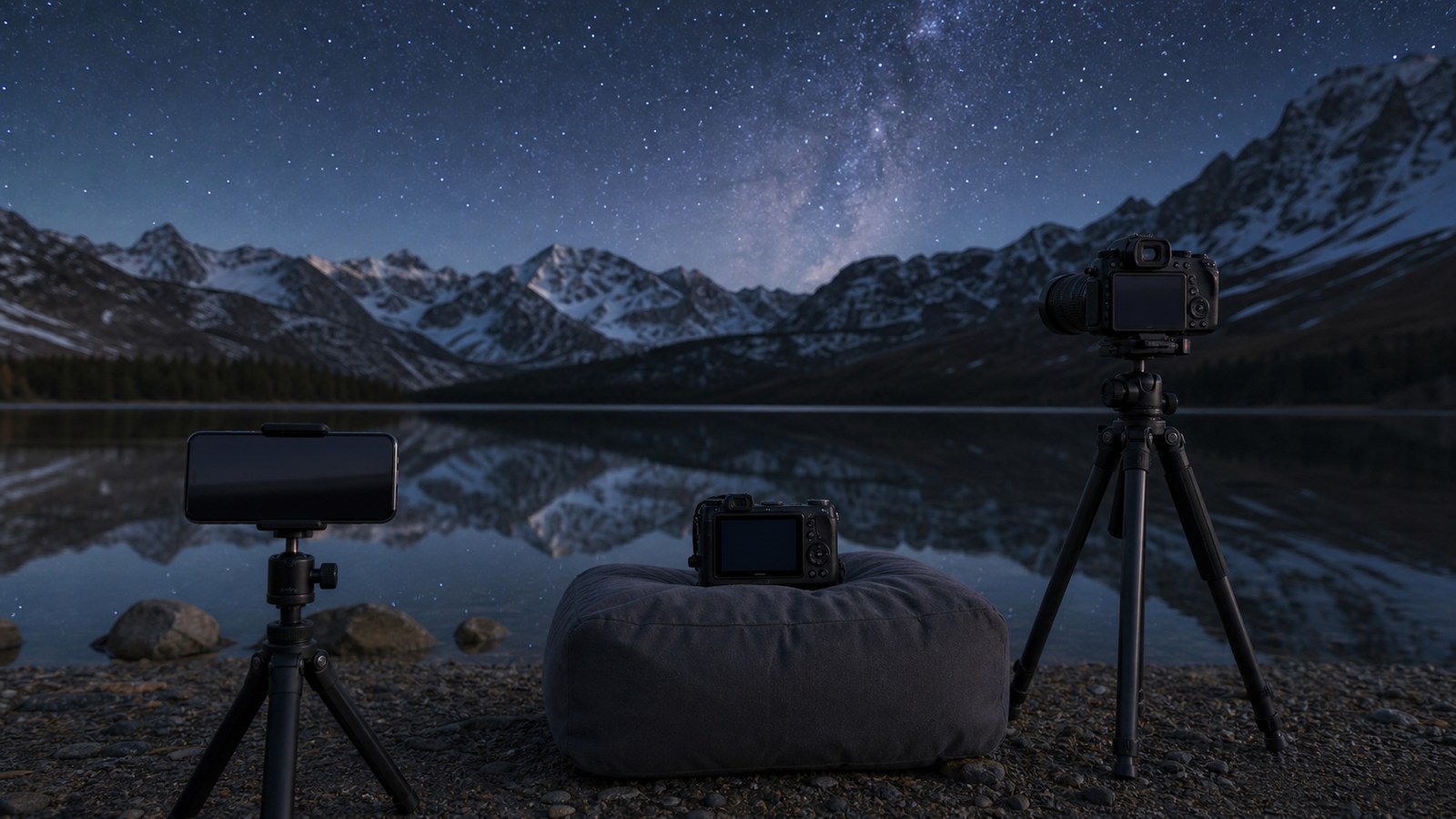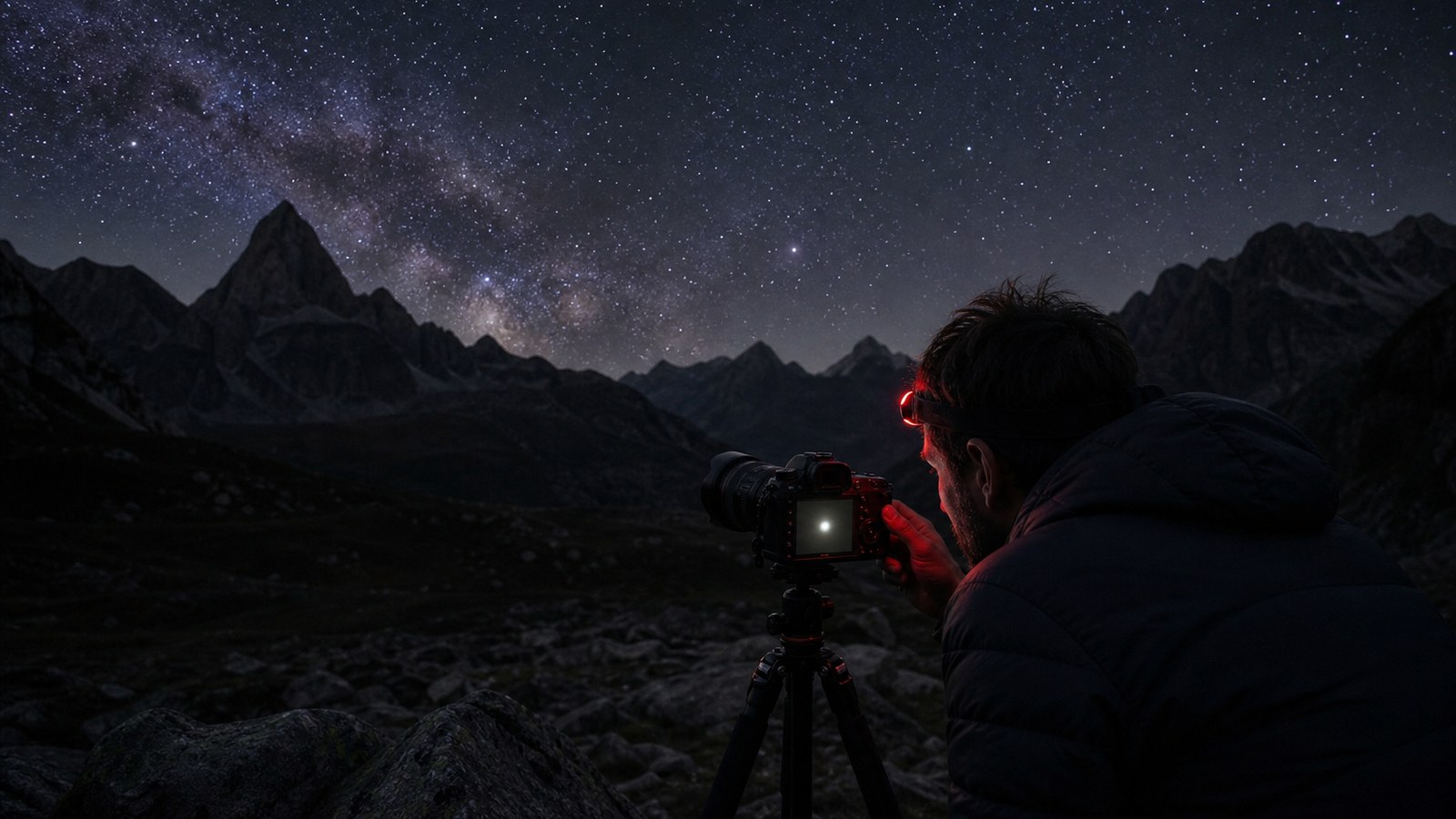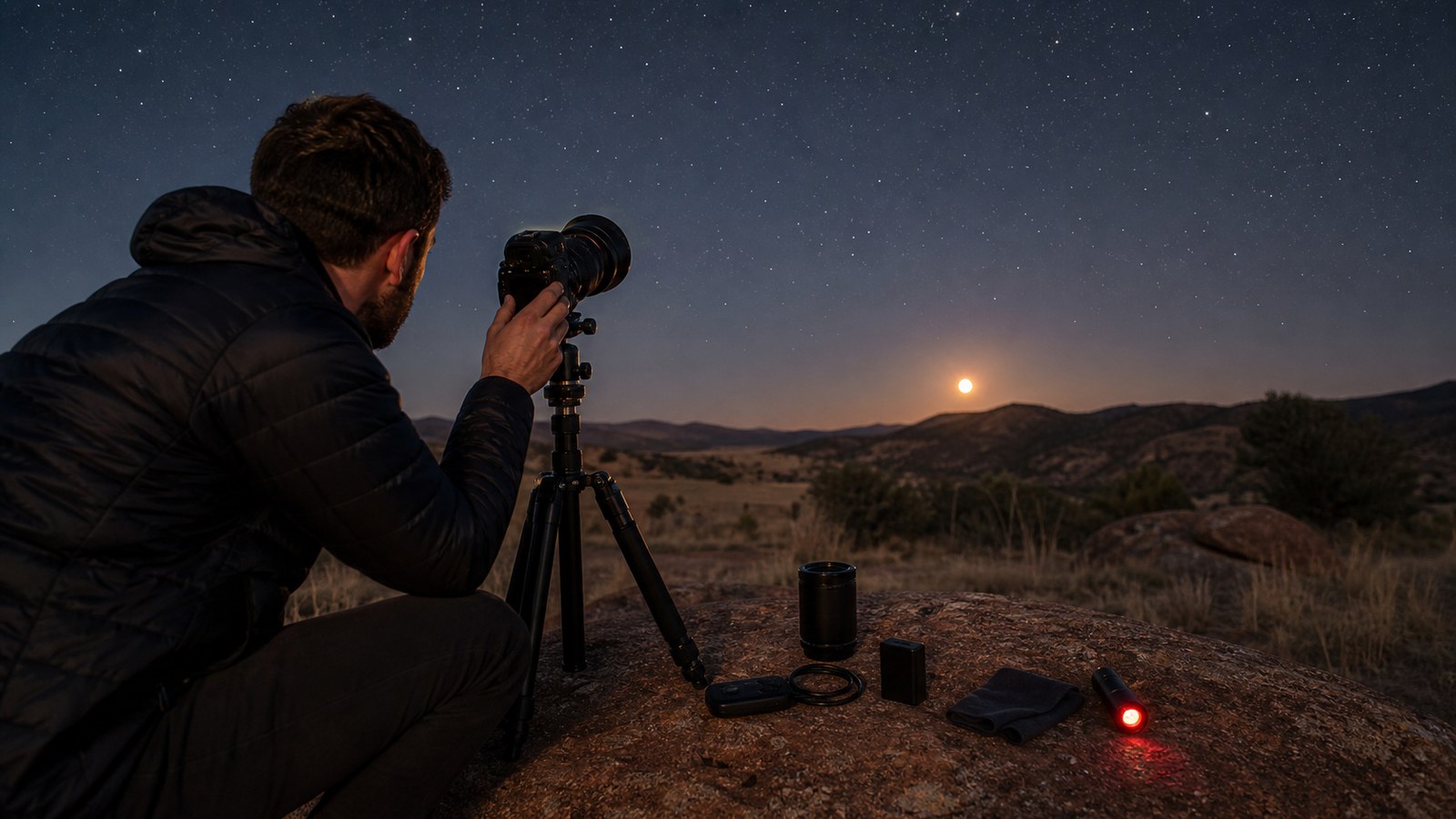
The best beginner kit is not the largest collection of accessories. It is a small group of components that removes predictable failure points: a camera that permits manual control, a lens suited to the desired field, a stable support, dependable power, and a way to verify focus. Once those basics are covered, the first subjects can be chosen to teach different skills in a deliberate order.
Build a Minimum Working Kit
Interchangeable-lens cameras offer flexibility, but many fixed-lens and recent phone cameras can save useful night exposures when manual controls are available. At night, small operational choices can produce large differences. A wide lens lowers tracking demands, a tripod holds composition, and spare batteries address the rapid drain caused by cold and long exposures. Carry a microfiber cloth, headlamp with red mode, memory card, remote release, and weather protection before considering specialized filters. Buying a tracker before mastering focus, framing, and basic exposure adds alignment complexity without fixing foundational mistakes. The most useful response is to observe the result, note the conditions, and adjust one variable at a time. Keep the observation tied to time, direction, and conditions so it can be compared later.
Carry a microfiber cloth, headlamp with red mode, memory card, remote release, and weather protection before considering specialized filters. Seen as a workflow problem, the solution becomes more manageable. Buying a tracker before mastering focus, framing, and basic exposure adds alignment complexity without fixing foundational mistakes. Interchangeable-lens cameras offer flexibility, but many fixed-lens and recent phone cameras can save useful night exposures when manual controls are available. A wide lens lowers tracking demands, a tripod holds composition, and spare batteries address the rapid drain caused by cold and long exposures. The most useful response is to observe the result, note the conditions, and adjust one variable at a time. This approach preserves both accuracy and the enjoyment of discovery.
First Shot: The Moon
The Moon is sunlit and much brighter than the surrounding night, so it requires short exposures rather than typical dark-sky settings. This is where technique matters more than expensive equipment. Its brightness fools photographers who expose for the black sky, producing a featureless white disk. Use manual exposure, low ISO, a fast shutter, and magnified focus; bracket frames as atmospheric sharpness changes. A full Moon has weak crater shadows, while phases near first or last quarter reveal stronger relief along the terminator. The most useful response is to observe the result, note the conditions, and adjust one variable at a time. That record makes the lesson transferable instead of leaving it as a one-night impression.
Use manual exposure, low ISO, a fast shutter, and magnified focus; bracket frames as atmospheric sharpness changes. For an observer, the consequence is immediate. A full Moon has weak crater shadows, while phases near first or last quarter reveal stronger relief along the terminator. The Moon is sunlit and much brighter than the surrounding night, so it requires short exposures rather than typical dark-sky settings. Its brightness fools photographers who expose for the black sky, producing a featureless white disk. The most useful response is to observe the result, note the conditions, and adjust one variable at a time. Over time, those small checks become automatic and free attention for finer detail.
Second Shot: Stars Over a Landscape
A wide star field teaches manual focus, foreground composition, and the shutter limit imposed by Earth's rotation. The distinction matters because similar-looking outcomes can have different causes. The foreground and sky may need different exposure priorities because one is dim and stationary while the other moves continuously. Start around f/2 to f/4, test 10 to 20 seconds depending on focal length, and review the histogram without clipping bright lights. An attractive camera preview can still conceal trailing, missed focus, or blocked shadows, so inspect at high magnification. The most useful response is to observe the result, note the conditions, and adjust one variable at a time. A second attempt under changed conditions will reveal whether the first result was typical.
Start around f/2 to f/4, test 10 to 20 seconds depending on focal length, and review the histogram without clipping bright lights. The effect may be subtle at first, yet it becomes obvious across several sessions. An attractive camera preview can still conceal trailing, missed focus, or blocked shadows, so inspect at high magnification. A wide star field teaches manual focus, foreground composition, and the shutter limit imposed by Earth's rotation. The foreground and sky may need different exposure priorities because one is dim and stationary while the other moves continuously. The most useful response is to observe the result, note the conditions, and adjust one variable at a time. The same reasoning can then be applied to more difficult targets or environments.
Third Shot: A Star-Trail Sequence
Many shorter frames can be combined into trails while preserving the option to remove aircraft, vibration, or accidental light. Real conditions rarely isolate one factor, so context must remain visible. An interval sequence avoids one extremely long exposure that amplifies heat, drains the battery, and risks losing the entire result. Lock white balance and focus, disable long-exposure noise reduction between frames, and keep gaps as short as possible. Automatic exposure changes create visible brightness steps when the sequence is stacked. The most useful response is to observe the result, note the conditions, and adjust one variable at a time. When uncertainty remains, choose the more conservative interpretation and gather another observation.
Lock white balance and focus, disable long-exposure noise reduction between frames, and keep gaps as short as possible. The practical importance of this point appears in the field. Automatic exposure changes create visible brightness steps when the sequence is stacked. Many shorter frames can be combined into trails while preserving the option to remove aircraft, vibration, or accidental light. An interval sequence avoids one extremely long exposure that amplifies heat, drains the battery, and risks losing the entire result. The most useful response is to observe the result, note the conditions, and adjust one variable at a time. Keep the observation tied to time, direction, and conditions so it can be compared later.
Settings Are Starting Coordinates
Sensor, lens, temperature, sky brightness, and editing goals make universal settings impossible. The underlying physics also explains a common surprise. The histogram and enlarged star shape provide direct evidence about exposure and tracking that a recipe cannot know in advance. Change only one setting per test series, label successful frames, and build a personal reference for each lens. Copying another photographer's numbers without matching focal length and sky conditions often produces misleading results. The most useful response is to observe the result, note the conditions, and adjust one variable at a time. The goal is a repeatable result, not a single lucky success.
Change only one setting per test series, label successful frames, and build a personal reference for each lens. This is less a rule to memorize than a relationship to observe. Copying another photographer's numbers without matching focal length and sky conditions often produces misleading results. Sensor, lens, temperature, sky brightness, and editing goals make universal settings impossible. The histogram and enlarged star shape provide direct evidence about exposure and tracking that a recipe cannot know in advance. The most useful response is to observe the result, note the conditions, and adjust one variable at a time. That record makes the lesson transferable instead of leaving it as a one-night impression.
Protect Data and Equipment
Night sessions expose cameras to dew, condensation, darkness, and easy-to-miss handling errors. Seen as a workflow problem, the solution becomes more manageable. A cold camera brought into warm humid air can collect moisture on internal and external surfaces. Use a lens hood or dew heater, keep cards organized, place the camera in a sealed bag before warming it, and back up files promptly. Leaving a tripod unattended near trails or roads risks both equipment loss and injury to others. The most useful response is to observe the result, note the conditions, and adjust one variable at a time. This approach preserves both accuracy and the enjoyment of discovery.
Use a lens hood or dew heater, keep cards organized, place the camera in a sealed bag before warming it, and back up files promptly. The safest assumption is that conditions will vary and the plan must adapt. Leaving a tripod unattended near trails or roads risks both equipment loss and injury to others. Night sessions expose cameras to dew, condensation, darkness, and easy-to-miss handling errors. A cold camera brought into warm humid air can collect moisture on internal and external surfaces. The most useful response is to observe the result, note the conditions, and adjust one variable at a time. A second attempt under changed conditions will reveal whether the first result was typical.
Its brightness fools photographers who expose for the black sky, producing a featureless white disk. This is where technique matters more than expensive equipment. Use manual exposure, low ISO, a fast shutter, and magnified focus; bracket frames as atmospheric sharpness changes. A full Moon has weak crater shadows, while phases near first or last quarter reveal stronger relief along the terminator. The Moon is sunlit and much brighter than the surrounding night, so it requires short exposures rather than typical dark-sky settings. The most useful response is to observe the result, note the conditions, and adjust one variable at a time. That record makes the lesson transferable instead of leaving it as a one-night impression.
The foreground and sky may need different exposure priorities because one is dim and stationary while the other moves continuously. A careful observer can turn this limitation into a diagnostic tool. Start around f/2 to f/4, test 10 to 20 seconds depending on focal length, and review the histogram without clipping bright lights. An attractive camera preview can still conceal trailing, missed focus, or blocked shadows, so inspect at high magnification. A wide star field teaches manual focus, foreground composition, and the shutter limit imposed by Earth's rotation. The most useful response is to observe the result, note the conditions, and adjust one variable at a time. A second attempt under changed conditions will reveal whether the first result was typical.
Its brightness fools photographers who expose for the black sky, producing a featureless white disk. This is where technique matters more than expensive equipment. Use manual exposure, low ISO, a fast shutter, and magnified focus; bracket frames as atmospheric sharpness changes. A full Moon has weak crater shadows, while phases near first or last quarter reveal stronger relief along the terminator. The Moon is sunlit and much brighter than the surrounding night, so it requires short exposures rather than typical dark-sky settings. The most useful response is to observe the result, note the conditions, and adjust one variable at a time. That record makes the lesson transferable instead of leaving it as a one-night impression.
A Practical Next Session
Photograph the Moon, a wide star field, and a trail sequence before expanding the kit. Those projects reveal whether the next limitation is reach, tracking, lens speed, power, or processing knowledge. Gear decisions made after that evidence are usually cheaper and more effective than purchases made from specifications alone.