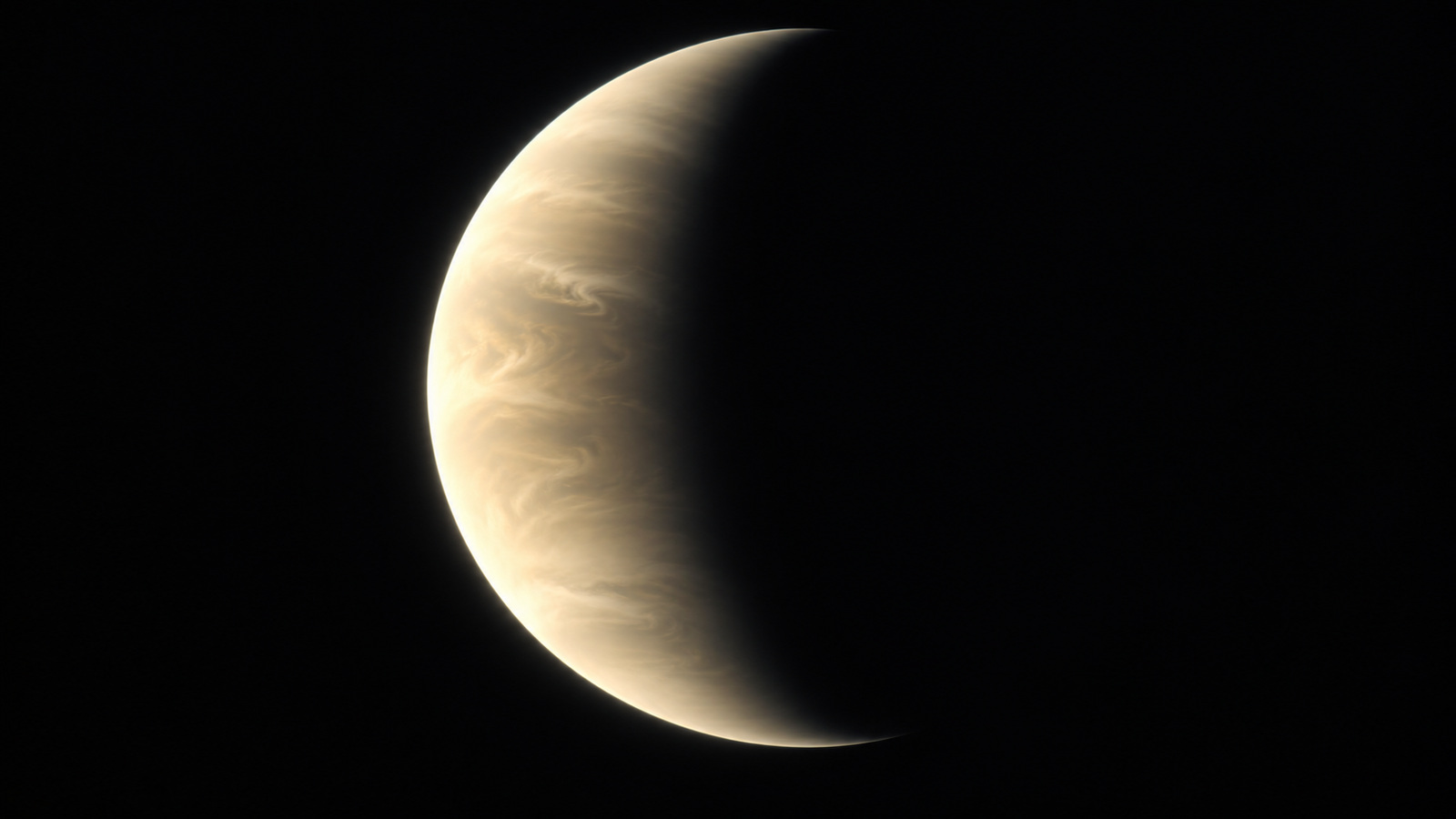
A Possible Habitat Is Not a Discovery of Life
Venus’s surface is intensely hot, but parts of its cloud region have temperatures that invite a different question: could an unfamiliar microscopic community survive above the ground? The idea remains a hypothesis, and no organisms have been established in those clouds. Concentrated sulfuric acid, very low water activity, and the challenge of maintaining a complete airborne life cycle impose serious barriers for known biology. Reports of phosphine added another controversy, because the gas measurements themselves have been disputed and a confirmed molecule would still require an explanation of its source. Laboratory studies can test whether particular organic molecules remain stable in acid, but molecular survival is not the same as a living cell. A useful assessment separates environment, chemistry, and biological evidence at every stage.
Why the Clouds Attracted Attention
Venus’s atmosphere changes sharply with altitude. NASA’s planet overview places a comparatively temperate cloud region around fifty kilometers above the surface, with temperatures roughly thirty to seventy degrees Celsius; NASA’s HAVOC concept discussion also describes pressure there as comparable to Earth’s surface atmosphere. These are approximate conditions within a varying atmospheric profile, not a uniform temperature for every cloud droplet. They explain why researchers consider airborne habitats despite the scorching ground. Thermal suitability alone remains incomplete, because a habitat also needs workable chemistry, usable solvent conditions, energy, and continued operation of its proposed biological system.
The cloud proposal also does not imply animals drifting through a comfortable sky. It concerns hypothetical microscopic systems associated with droplets or particles. Any such system would encounter changing conditions as material circulates, settles, evaporates, or moves between atmospheric layers. An explanation must therefore describe how organisms could remain in favorable settings or survive transitions. A static picture of one pleasant altitude leaves the life-cycle problem largely untouched.
Acid Tolerance Is Not a Universal Chemical Shield
Venus’s cloud droplets contain concentrated sulfuric acid, a solvent environment very different from ordinary liquid water. Some earthly organisms tolerate acidic conditions, but terrestrial acid habitats generally still involve water-rich systems unlike these droplets. Comparing acidity requires the full composition rather than one catchy label such as acid-loving microbe. A cell needs stable membranes, functioning reaction networks, repair, and replication in its actual surrounding medium. Survival in one aqueous acidic niche cannot simply be extrapolated to another solvent regime.
Water Activity Measures Availability, Not Just Presence
Water activity describes how available water is for physical and chemical processes, rather than merely whether a sample contains hydrogen and oxygen or a measurable amount of water. Solutes can reduce that availability sharply. Concentrated sulfuric-acid droplets can consequently contain water while remaining extremely unfavorable to water-dependent organisms. The phrase there is water in the clouds is therefore incomplete as a biological argument. The relevant quantity concerns the chemical state and accessibility of that water.
A 2021 study calculated water activity below 0.004 in the relevant Venusian droplets, compared with about 0.585 as the lowest demonstrated value for active terrestrial organisms. On this dimensionless scale, pure water has a value of one. The cloud estimate is therefore more than a hundred times below that known biological limit; the comparison concerns chemical availability, not a percentage of the droplet’s mass. This is a severe constraint on water-dependent life under the studied conditions. It does not test every conceivable alternative solvent, but invoking another chemistry requires a functioning mechanism rather than treating the word unknown as a solution.
The distinction helps organize the debate. Researchers can disagree about particular microenvironments or proposed modifications while still acknowledging that ordinary droplet conditions are difficult for known life. A claim that some particles differ from the bulk environment needs evidence about those particles. A claim that a biological system creates a more favorable local setting also needs a feasible pathway and energy budget. The assumption cannot be smuggled in as though the required habitat had already been measured.
What the Phosphine Reports Actually Added
Phosphine is a phosphorus-containing gas, and reported spectral features interpreted as phosphine brought renewed attention to Venus. The original announcement did not identify cells or directly observe metabolism. It proposed a gas detection and discussed the difficulty of explaining its abundance with considered processes. The original phosphine paper is one part of a continuing technical record. The existence of a published claim should be distinguished from agreement that the signal and inferred abundance are robust.
Independent analyses challenged aspects of the detection, including processing choices, spectral baselines, and possible contributions from other molecules. Observations at different wavelengths and altitudes also sample different portions of the atmosphere. An independent-analysis paper illustrates why the identification remains disputed. Describing this as a completed discovery of life skips both the measurement controversy and the separate source question. Those are not minor caveats attached to a settled biological conclusion.
One Weak Feature Can Carry Several Uncertainties
A spectroscopic absorption feature must be separated from instrumental structure and identified among plausible molecular transitions. Venus is bright and extended on the sky, creating demanding observing and calibration conditions. Processing a baseline can affect the apparent significance of a weak feature. Researchers therefore compare reduction methods, transition predictions, and independent observations. A persuasive detection should survive reasonable analysis choices rather than depend on one especially favorable procedure. Even then, the abundance estimate requires assumptions about where the gas lies and how the atmosphere forms the observed signal.
A Confirmed Gas Would Still Need a Source
Suppose future observations firmly establish phosphine at a defined altitude and abundance. The next question would concern how it is produced, transported, and destroyed under Venusian conditions. Biological production would be one proposed explanation to evaluate alongside chemical, geological, and photochemical pathways. Difficulty with currently modeled nonbiological sources does not automatically prove metabolism. It can indicate incomplete inputs or an unrecognized process as well as a genuinely unusual source.
A valid source model must match more than the existence of a line. It should account for rates, spatial distribution, accompanying chemistry, and the gas’s lifetime in the environment. Different pathways may predict other measurable substances or time variations. Those predictions allow comparison with additional data. The investigation becomes stronger when it asks which explanation fits the full chemical system, rather than treating one molecule as an unambiguous label for living organisms.
Molecular Stability Experiments Test a Smaller Claim
Laboratory researchers have examined whether certain organic building blocks persist in concentrated sulfuric acid. Some amino acids and nucleic-acid-related molecules show notable stability under specified experimental conditions. A study of twenty biogenic amino acids reports both stable structures and chemical modifications. These results challenge a blanket assumption that every relevant organic molecule must immediately disintegrate in acid. They do not demonstrate a complete working biochemical system.
An amino acid can remain chemically recognizable without participating in metabolism, assembling into functional proteins, or supporting replication. A living system requires linked processes, compartmentalization, and continued access to usable resources. Laboratory concentration, temperature, duration, and contaminants also matter when applying a result to clouds. A successful test answers the question it was designed to examine. It should not be enlarged into a claim that scientists grew Venusian organisms in a flask.
The experiments remain valuable because they replace intuition with measured chemistry. They can identify which reactions deserve further study and which candidate structures fail under relevant conditions. That narrows the space of plausible proposals. Scientific progress does not have to take the form of a dramatic yes-or-no life announcement. Demonstrating a material property can be an important step while leaving the much larger biological hypothesis unsupported.
Changing the Droplet Environment Is a Hypothesis Too
Some proposals suggest that additional chemistry, including possible neutralizing compounds, could alter the acidity or physical state of particular cloud particles. A 2021 model considered ammonia and its consequences for cloud chemistry. That published hypothesis provides predictions to test rather than an observed population of habitat-building microbes. The proposed compound, its source, and the altered particle properties each require evidence. Adding a mechanism to a model does not establish that the mechanism operates in Venus’s actual clouds.
The distinction is especially important when a biological source is used to create the environment needed by the same biology. Such feedback may be conceivable, but its starting conditions, resource requirements, and sustained operation must be explained. Otherwise the proposal assumes the result it needs. Independent chemical measurements can help test the pathway without beginning by assuming organisms exist. A model is most useful when it produces consequences that would distinguish it from an ordinary nonbiological cloud.
An Airborne Life Cycle Must Keep Working
Cloud particles grow, move, and settle. A hypothetical population would need to stay in a suitable region, reproduce before conditions deteriorate, or survive unfavorable phases before returning. A proposed protected particle must therefore have a specified composition, size, and lifetime, not merely a favorable name. If its refuge disappears faster than replication can proceed, temporary chemical compatibility cannot sustain an ecosystem. Evaporation also changes the setting in which a cell or precursor operates. Measuring particle residence times and recurring favorable conditions would test whether the proposed cycle actually closes. This joins the microenvironment question to the airborne life-cycle problem instead of treating each as a separate escape from the measured constraints.
What Direct Sampling Could Clarify
A probe could measure particle composition, size, acidity-related properties, trace gases, and local atmospheric conditions along a defined descent. Those measurements would constrain the actual cloud environment more directly than a distant spectral feature alone. Sampling several levels would help distinguish spatial structure from a single local result. The instrument design would need to preserve or characterize material without changing it in misleading ways. Collection and analysis methods belong in the evidence chain, not just the final reported chemical list.
Searching for life also requires contamination controls and alternative explanations for organic material or unusual particles. A shape resembling a cell can have nonbiological causes, and a detected organic molecule can arise without organisms. Several independent indicators would be more persuasive than one attractive microscopic image. A future mission could greatly improve the debate even if it found no biological signature. Reliable environmental measurements would test the premises on which competing habitability proposals depend.
Uncertainty Can Be Stated Without Flattening the Evidence
No established organisms have been identified in Venus’s clouds. Known biology faces severe acid and water-activity constraints, while unconventional chemical proposals remain hypotheses rather than demonstrated ecosystems. Phosphine identification and interpretation remain technically disputed. Those statements do not mean every scientific subproblem is equally unknown. Cloud composition, measured atmospheric structure, laboratory stability results, and spectral datasets provide concrete constraints on what a viable explanation must address.
The strongest answer to the title is therefore cautious and structured. The cloud region motivates testable questions, but temperature suitability, molecular persistence, and a possible trace gas are not interchangeable evidence for life. Each must be evaluated at its own level before connecting them into a biological story. Future sampling and independent spectroscopy can make those connections stronger or show that proposed pathways fail. Until then, curiosity is justified by the unresolved science, while a claim of discovered Venusian life is not.
A constraint on known water-dependent organisms remains a strong result even though it does not exclude every imaginable chemistry. Conversely, the logical possibility of unfamiliar life is not evidence of an organism. Progress requires a specific chemical proposal whose predicted conditions can be measured or tested in a laboratory.