A Dazzling Point Powered by Reflected Sunlight
Venus can dominate the twilight sky even though it is neither a star nor the largest planet. Its bright appearance comes from a favorable combination: strongly scattering clouds, a relatively nearby position, and an illuminated disk whose apparent area changes as Venus and Earth orbit the Sun. No single ingredient explains every phase of its brightness. A full-looking Venus lies farther away, while a nearby Venus shows a thinner crescent, so greatest brilliance occurs between those extremes. Earth’s atmosphere and the background sky then affect how striking the planet looks to an observer. Understanding the balance explains the familiar morning-star and evening-star names, why a telescope reveals a crescent, and why a bigger planet elsewhere can appear fainter. The glow is an optical and geometric story rather than evidence that Venus generates stellar light.
Clouds Provide an Efficient Reflecting Surface
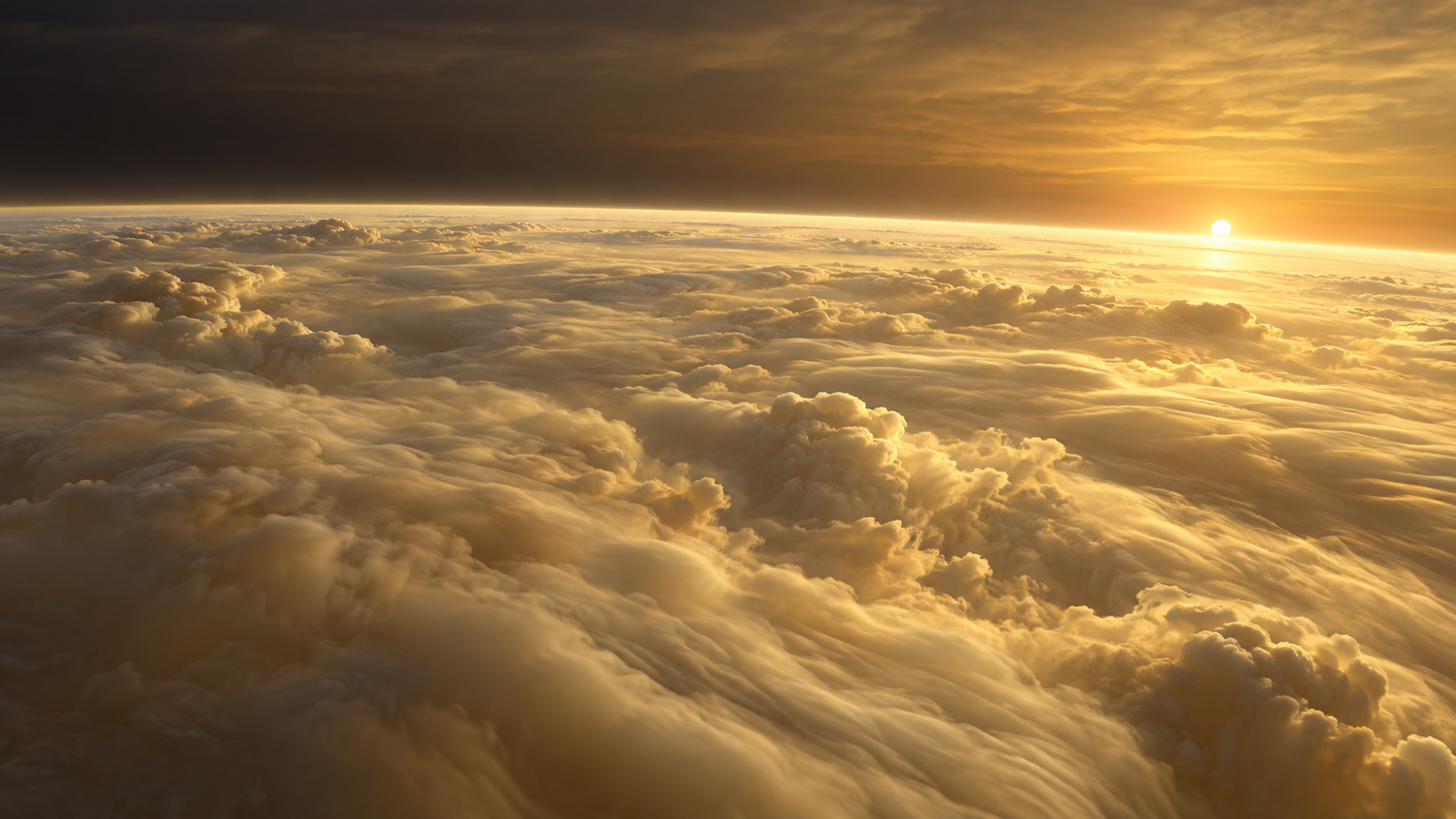
Venus’s upper atmosphere contains an extensive cloud and haze system that scatters a large share of incoming sunlight back to space. The visible disk therefore presents a highly reflective atmospheric surface rather than exposed dark rock. Its sulfuric-acid cloud particles interact with light differently from a bare lunar landscape.
The detailed scattering depends on wavelength, particle properties, and angle, but the overall effect makes Venus exceptionally conspicuous. A bright disk is evidence of reflected light, not a view of the hidden terrain underneath.
Reflectivity is often summarized with the word albedo. Different albedo definitions answer different questions, so published figures should retain their convention rather than be treated as one universal fraction. Bond albedo concerns the total reflected energy over relevant wavelengths and directions, while geometric albedo describes brightness under a defined viewing comparison. JPL’s albedo glossary explains that distinction. It prevents a comparison intended for energy balance from being substituted directly for a particular apparent-brightness geometry.
Nearby Worlds Cover More Apparent Sky
Earth and Venus occupy neighboring orbital regions, and their separation changes considerably as both travel around the Sun. When Venus is nearer, its physical globe subtends a larger angle and presents a larger apparent disk. The light received from a given reflected source is consequently stronger than it would be at a greater distance, all else equal. Jupiter’s enormous physical size does not automatically overcome its much greater distance in a comparison of apparent brightness. The observer receives light from an object at a specific geometry, not a size ranking printed in a textbook.
There Are Two Solar-System Light Journeys
Sunlight first travels to Venus, is scattered by its atmosphere, and then reaches Earth. The amount arriving at Venus depends on its solar distance, while the amount received here also depends on Earth-Venus separation and the direction in which the light is scattered. Venus’s relatively small orbital eccentricity limits its solar-distance variation compared with some planets, but it does not make every part of the observed brightness constant. The second journey and changing phase are major parts of the visible cycle. A simple distance statement should identify which leg it describes.
The planet’s reflectivity also does not guarantee that equal quantities of light leave in every direction. A cloud-covered sphere has a phase curve connecting apparent brightness with the angle between illumination and observation. Particle scattering and the distribution of the illuminated visible area both contribute. A reflective object can be faint when we see little of its lit side. The complete explanation therefore needs surface or atmospheric optical properties combined with the geometry.
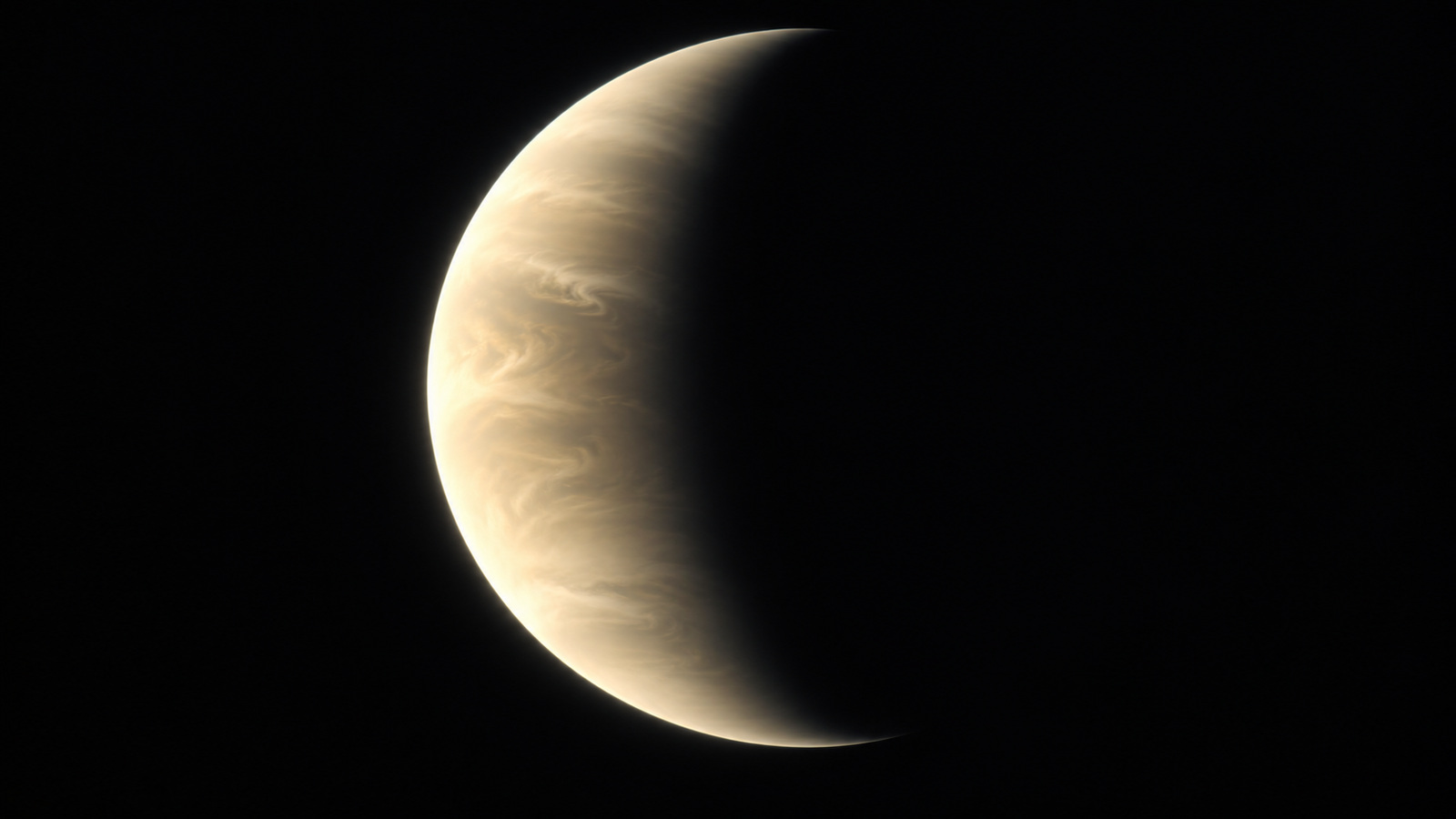
ESA’s reflected-light observations of Venus illustrate how a distant instrument can obtain spectra from a crescent. The measurement samples light that has already interacted with the atmosphere. Absorption features carry information about gases along that route, while the total recorded brightness depends on the observing configuration. Even a simple pale crescent can therefore supply both an obvious visual phase and a much richer spectroscopic signal.
Phase and Distance Pull in Opposite Directions
When Venus lies on the far side of the Sun from Earth, a large fraction of its visible hemisphere is illuminated. The disk appears small because the planet is relatively distant, and its closeness to the solar direction makes ordinary viewing difficult. As the geometry shifts toward nearer configurations, the apparent disk grows while the illuminated fraction decreases. A crescent can consequently occupy a larger apparent area than a much more fully illuminated distant disk. The fraction lit and the angular size must be considered together.
Near inferior conjunction, Venus is relatively close but mostly presents its night side toward Earth. This does not make it automatically brightest at the moment of minimum distance. The very thin illuminated region and the nearby Sun change the observing situation. Conversely, a full-looking phase does not guarantee the brightest apparent planet. The competing relationships create a brightness maximum in an intermediate crescent configuration rather than at either intuitive endpoint.
Greatest Brilliance Is Not Greatest Elongation
Greatest elongation means the largest angular separation from the Sun in the sky during a particular apparition. It often provides a useful observing geometry, but it is not the definition of greatest brightness. Greatest brilliance concerns the received visible light, which depends on phase, apparent size, and scattering. The two events need not share a date. A calendar or diagram labeling one should not silently substitute it for the other. Specific dates also belong to a particular apparition rather than a permanent annual rule.
The Magnitude Scale Runs Backward
Astronomers express apparent brightness with magnitudes, where lower values mean brighter objects. For a representative peak, NASA’s July 2023 observing forecast gave Venus approximately minus 4.6 in visible light. Sirius, the brightest ordinary night-sky star, is around minus 1.4, making Venus roughly twenty times brighter using these rounded magnitudes. The scale is logarithmic: five magnitudes represent a hundredfold light difference, rather than a percentage or linear ranking. The exact planetary value varies with geometry and observing band, but the comparison explains why Venus dominates a twilight sky when many stars are difficult to see.
An apparent magnitude also needs an observing band and relevant conditions. A visible-light number cannot automatically describe infrared brightness, where thermal emission may become important. Extinction in Earth’s atmosphere can reduce the observed light near the horizon. A nominal planetary magnitude is consequently distinct from what a particular observer measures through haze on a particular evening. The physical prediction and the local observing result are connected but not identical quantities.
Morning Star and Evening Star Are One Planet
Venus orbits inside Earth’s path, so it remains relatively close to the Sun in our sky rather than appearing at arbitrary separations. Suitable configurations make it visible before sunrise or after sunset, producing the traditional morning-star and evening-star names. They refer to one planet in different parts of its apparent cycle. NASA’s Night Sky Network Venus explanation connects those names with the changing view. The words describe a familiar appearance, not a stellar classification.
Because Venus is an inner planet, it cannot normally occupy the sky opposite the Sun the way an outer planet at opposition can. It is not an all-night fixture whose rising at sunset guarantees setting at sunrise. Latitude, season, orbital geometry, and the local horizon affect the useful viewing interval. A bright point seen at midnight in the opposite part of the sky should not be assigned to Venus solely because it looks impressive. Identity requires a position consistent with the actual geometry.
Current charts or ephemerides supply that position for a date and location. A remembered view from several months earlier may no longer be relevant because the apparition changes. The planet itself has not become a different kind of object when it disappears into solar glare or returns before dawn. Our viewing arrangement has changed. Distinguishing those changes from the underlying reflected-light source keeps the appearance understandable through the full cycle.
Brightness and Visibility Are Not Synonyms
A bright Venus against a bright daytime or twilight background may be harder to recognize than a somewhat fainter Venus against a dark sky. Contrast, atmospheric clarity, elevation, and visual adaptation affect detection. The received planetary flux is only one part of the viewing problem. A faint object can be conspicuous on a very dark background, while a strong source can vanish into glare. This explains why an event called greatest brilliance need not provide every observer’s easiest or most comfortable view.
Near the horizon, light crosses more earthly atmosphere, adding attenuation, distortion, and sometimes color changes. Venus can appear to flicker or wobble when turbulent air alters the image. Planets often look steadier than stars under favorable conditions, but that is not an absolute rule at low altitude. An unusual shimmer does not require an unusual planetary energy source. It can be an effect of the air between the observer and an otherwise ordinary moving planet.
A Telescope Reveals the Source Behind the Point
Unaided eyes generally see Venus as a brilliant point rather than a resolved globe. A telescope can reveal its changing illuminated shape, connecting the visual phase with the brightness explanation. The crescent does not identify a crescent-shaped planet; it shows the lit part of a spherical world. Cloud detail is much subtler than the bright silhouette in routine visual observations. Optical viewing should use a safely Sun-free field rather than searching near the Sun, because Venus’s useful sky positions can still lie close to it.
Heat Emission Is a Different Wavelength Story
Venus’s surface and atmosphere emit thermal radiation, but that is not what creates its ordinary dazzling visible point in Earth’s sky. Reflected sunlight dominates the familiar optical presentation. Instruments operating in infrared bands can investigate different atmospheric levels and, in suitable spectral windows, information associated with deeper conditions. ESA’s day-side and night-side observations demonstrate why observing band matters. A visibly dark night side can still carry scientifically useful radiation outside the ordinary visual picture.
This distinction also prevents the hot-planet explanation from replacing the cloud explanation. Venus does not need stellar fusion or a glowing visible surface to appear bright. Its severe surface heat and its reflective atmospheric portrait arise within the same world but answer different energy questions. One concerns retained and emitted thermal energy; the other concerns sunlight redirected toward the observer. Joining them correctly requires wavelength and geometry rather than a single broad word such as shining.
Three Factors Explain the Familiar Dazzle
An observing diary can make this combination easier to recognize across an apparition. Record the date, approximate position against the twilight horizon, and whether a telescope shows a broad or narrow illuminated disk. Comparing those observations with an ephemeris reveals that apparent size, illuminated fraction, and solar separation do not peak together. Repeated observations also help distinguish a planet’s evolving geometry from a single evening’s haze or poor horizon. Differences in the observing conditions need attention before changes are attributed entirely to Venus. The exercise connects the bright point with its orbital geometry, rather than an imagined change in internal energy output.
Reflective clouds, changing observer distance, and the illuminated fraction combine to produce the brightness cycle. A thin crescent can still be brilliant when the planet’s apparent disk has grown large. Local haze then affects how prominently that physical signal stands out. The point seen by eye and the crescent resolved through optics are two views of the same changing arrangement.
The morning star and evening star are one planet seen on different sides of the Sun in our sky. Its bright point is reflected sunlight made conspicuous by clouds and favorable geometry. Understanding those ingredients explains the dazzle while keeping its changing position, phase, and seasonal visibility connected to Venus’s actual orbit.