
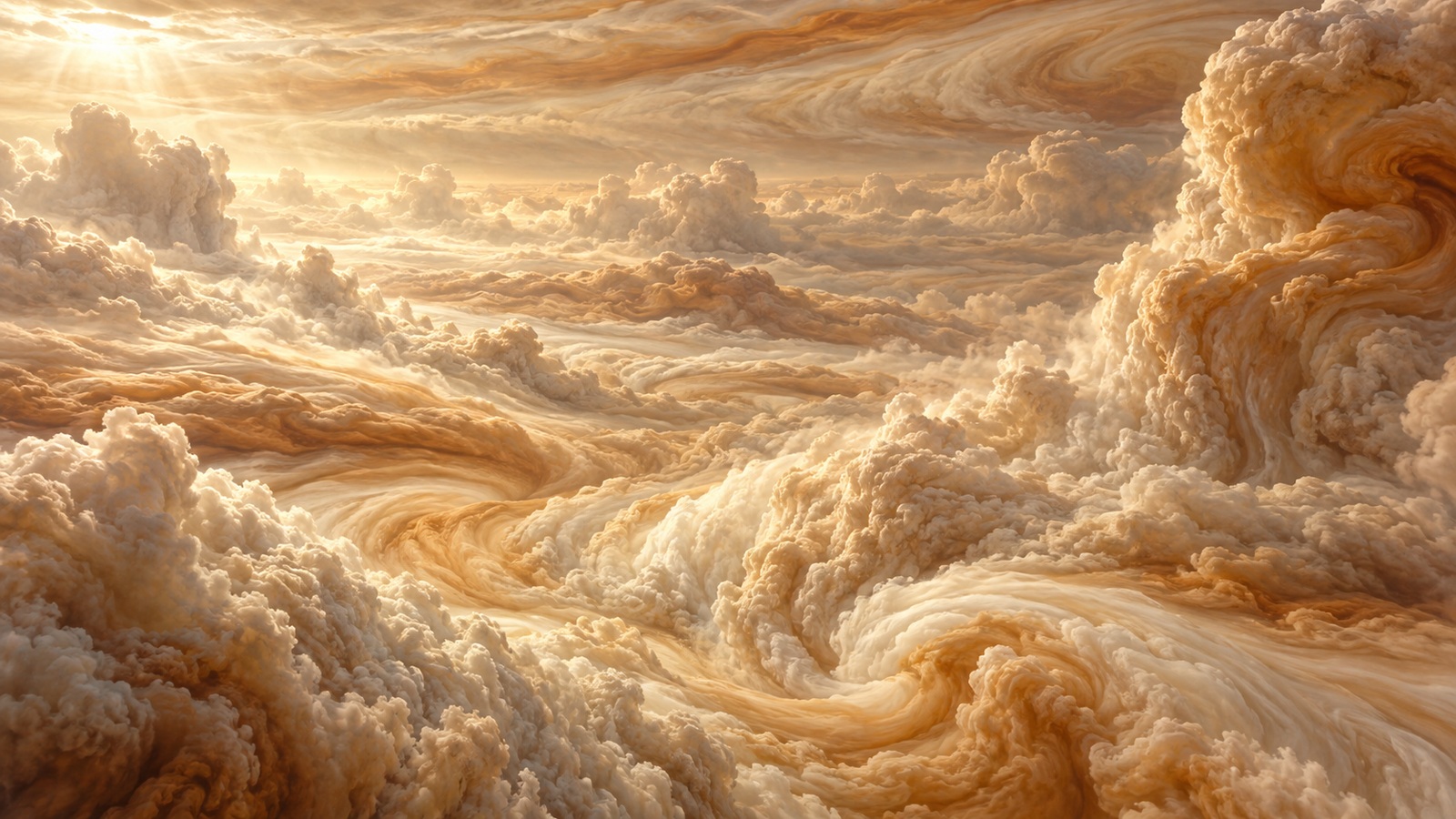
A Visit to Jupiter Would Become a Descent Through Fluid
Imagine approaching Jupiter in a small, purpose-built atmospheric capsule, with no promise that a human could survive the trip. The cloud bands ahead look like the surface of a globe, but they offer no place to put down a pair of boots. A descent instead follows changing pressure, temperature, winds, and fluid density. To make that journey concrete, we can use a defined atmospheric reference and the measurements from Galileo’s real 1995 probe, then stop where the actual record stops. Deeper interior physics explains why that endpoint would not conceal a nearby rocky landing site. This is a protected-instrument thought experiment, with the protection stated once; the interesting part is what the planet does to a vehicle moving through its atmosphere.
The Cloud Bands Do Not Supply the First Landing Site
From space, Jupiter presents a sharply bounded disk with stripes, vortices, and clouds that reflect sunlight. The visual boundary is an atmospheric appearance. It does not mark a rigid shell that could carry a spacecraft’s weight. The comparison with Earth’s cloud deck is useful at the start of the journey: a bright, apparently continuous expanse can be made of suspended particles in gas rather than ground. Jupiter’s much deeper fluid environment makes that distinction essential long after the first clouds have been crossed.
A person can stand only when a supporting structure supplies an upward force. Earth provides rock or a constructed floor, while a balloon can support a cabin through buoyancy and an aircraft can remain aloft through aerodynamic lift. Jupiter’s gravity supplies the downward acceleration but does not supply the opposing platform. Entering denser surroundings can change the forces on our imagined capsule, yet that is a question about fluid motion. It does not turn the visible stripe beneath it into a continent.
Begin With the Real Entry Problem
A capsule arriving from space must lose a tremendous amount of motion relative to the atmosphere. Compressed and shocked gas around it heats the entry environment, requiring a heat shield before a parachute can become useful. Galileo’s probe endured a particularly severe encounter on December 7, 1995; NASA’s probe history reports a peak deceleration of roughly 228 times Earth’s gravitational acceleration. This transient deceleration is not Jupiter’s normal cloud-level gravity. It results from the vehicle slowing rapidly during entry, and the extreme temperature associated with that event should likewise not be mistaken for the undisturbed upper atmosphere’s temperature.
One Bar Is a Location Convention, Not a Floor
As the capsule enters the atmosphere, pressure becomes a more useful guide than the apparent outline of the clouds. Scientists commonly use the one-bar level as a reference for gas-giant dimensions. One bar is 100,000 pascals, close to Earth’s sea-level atmospheric pressure, but matching pressure does not make the environment Earthlike. NASA’s Jupiter fact sheet lists a representative one-bar temperature of 165 kelvin, approximately minus 108 degrees Celsius. Those numbers describe a reference level inside a hydrogen-and-helium atmosphere, with no breathable oxygen supply or solid platform implied.
The exact temperature varies with place and the atmospheric reconstruction. A reanalysis of Voyager radio-occultation measurements found one-bar temperatures a few kelvin above some earlier values at particular sampled latitudes. The useful lesson for a visit is the physical scale: these upper levels are extremely cold compared with a habitable room. A capsule would need thermal control and a sealed internal environment even before increasing pressure becomes its main structural challenge.
Gravity near the adopted reference is about 24.8 meters per second squared, roughly two and a half times Earth’s familiar value. A supported 80-kilogram passenger would retain the same mass but require a support force of roughly 2,000 newtons in this simplified comparison. A freely falling passenger does not simply experience that number as boot pressure; contact forces and the capsule’s acceleration determine the felt load. This distinction separates the question of heavier standing weight from the actual descent, where drag and buoyancy influence motion.
The Nearby View Changes With the Cloud Environment
Once immersed, our sensor-equipped capsule would lose the clean overview seen in spacecraft portraits. Particles along the local sightline can block distant features, and the light would depend on illumination, opacity, and which cloud region the vehicle entered. The Great Red Spot would not appear as a complete red circle hanging overhead: it is a large atmospheric circulation in which a local observer would occupy only a tiny part. Winds, turbulence, and passing layers would define the surroundings. The global stripes are a map from far away, while the capsule samples the weather of one location.
Increasing Pressure Acts From All Directions
As the vehicle descends, more atmospheric mass lies above it and the surrounding pressure increases. Pressure is a local fluid property acting on all exposed directions, rather than a load placed only on the roof. A cabin maintained at a low internal pressure must resist the difference between inside and outside. Windows, joints, seals, and instrument penetrations become part of that problem. The pressure reference tells us about a structural demand even when the outside mixture cannot be breathed.
Consider a simple pressure difference of ten bars across a flat panel with an area of one square meter. The net force magnitude would be about one million newtons, obtained by multiplying pressure difference by area. That is an illustrative load calculation, not a claim that a particular Jovian depth would break every possible structure. A smaller window or a shaped pressure vessel faces a different engineering problem, and an internal pressure system changes the differential. The physical point is that pressure and geometry matter together; the planet need not provide a solid wall to place enormous demands on a vehicle.
The Temperature Rises Beneath the Cold Upper Layers
Continuing inward does not preserve the frigid conditions near the reference clouds. Greater compression and the atmosphere’s thermal structure lead to increasing temperatures. Internal heat moving outward contributes to the energy budget, while the gas’s circulation transports energy through the fluid environment. The capsule therefore passes from a cold upper region into conditions that become hot for ordinary instruments. A heat shield suitable for brief entry is a different system from protection against prolonged exposure to hot, compressed surroundings.
The observed Galileo profile supplies a practical endpoint. NASA’s extreme-environment technology report summarizes the probe’s late environment as approximately 22 bars and 152 degrees Celsius. The pressure is roughly twenty-two times the one-bar reference, while the temperature is over 250 Celsius degrees warmer than that reference value. These measurements belong to one descent trajectory and its local conditions. They are more useful than assigning an invented fatal depth to an astronaut or presenting every atmospheric location as identical.
That contrast also explains why a general claim of gas-giant coldness is inadequate. Far from the Sun, Jupiter has cold upper layers, but pressure and temperature increase inward into a deep planetary interior. The capsule’s materials would face an evolving combination of stresses rather than a single fixed problem. Electronics may cease operating, seals may fail, or communication may be lost as conditions change. Exactly which system fails first depends on the design, so the scientific journey should end with the available record rather than continue as a comfortable human tour.
Drag and Buoyancy Change the Fall
Our capsule would not accelerate through the atmosphere as if it were falling in a vacuum. The surrounding fluid resists its motion, with drag depending on speed, shape, area, and local density. A parachute deliberately increases drag during a suitable part of the descent. As conditions evolve, the same configuration need not produce the same terminal speed. The inward pull of gravity and the forces from the gas together determine the trajectory.
Buoyancy supplies a separate upward contribution related to the weight of displaced fluid. An object can stop sinking if the conditions and its effective density permit a force balance, but that outcome means floating within a fluid rather than standing on ground. A sealed cabin’s volume and density can also change if its structure compresses. An indestructible fictional object would still need a specified physical design before its motion could be predicted. Real equipment reaches material limits long before a hypothetical model can follow it indefinitely.
There Is No Hidden Ordinary Shore Just Below the Record
Dense hydrogen under Jovian conditions does not have to form an abrupt air-to-ocean boundary resembling the coast on Earth. The change from tenuous atmosphere toward a dense fluid interior can occur gradually under high temperatures and pressures. Farther inward, hydrogen becomes electrically conducting in a metallic state. Metallic describes that material behavior, not a rigid sheet on which a traveler could plant boots. NASA’s interior introduction uses this deeper change to explain an unfamiliar world rather than a buried terrestrial landscape.
What We Infer Far Below a Probe’s Reach
Juno’s gravity measurements help constrain the distribution of material deep inside Jupiter. Models favor an extended heavy-element region often described as a dilute core, with the detailed composition depending on the model. That information comes from the gravitational effects of internal mass, combined with material physics. It is not a measured descent through the core and does not locate a feasible human destination.
The distinction between direct measurement and inference is especially useful here because the two answer different questions. A descending probe measures local pressure, temperature, and composition along its track. An orbiting spacecraft can investigate the integrated gravitational field across the globe. Laboratory work then tests how proposed mixtures behave under compression. Together these methods constrain the deep structure while leaving important uncertainties about particular layers and compositions. The absence of a traveler does not prevent the interior from being a scientific subject.
Those deep models also have no need to rescue the standing premise. Even if heavy elements concentrate in a central region, it lies beneath an enormous overburden under extreme conditions. The imagined capsule would have ceased functioning much earlier. The practical conclusion is therefore tied to the physical route actually encountered: a changing atmosphere, increasingly demanding fluid conditions, and finite spacecraft capability. A distant reference to a core does not provide a nearby substitute for the missing ground.
Stop at Galileo’s Actual Achievement
Galileo returned atmospheric measurements for about 58 minutes during its 1995 descent, recording gases, winds, pressure, and temperature before the transmission ended. The mission history explains the achievement alongside the orbiter’s investigation of the Jovian system. The record reaches a limited pressure range, not metallic hydrogen or the central core. Its importance lies in making the upper-atmosphere journey measurable, including the discovery that one entry location did not simply reproduce every expectation from remote observations.
Standing on Jupiter fails because its visible globe offers no supporting geological surface, but the descent explains much more than that short answer. Entry braking, cold hydrogen-rich upper layers, a defined one-bar reference, increasing pressure, rising temperature, drag, and buoyancy all belong to one connected encounter. Galileo showed how far an engineered atmospheric investigation could carry useful instruments. Beyond that measured journey, the interior remains a problem for remote sensing and physical models. Jupiter replaces the familiar relationship between sky and ground with a world whose structure has to be understood through moving fluids and extreme compression.


