Two Rocky Worlds With Very Different Outcomes
Mars is familiar enough to invite comparison with home. It has mountains, valleys, polar ice, seasons, and a day only a little longer than Earth’s. Robotic photographs show rocks and dusty horizons rather than the cloud-covered depths of a giant planet. Yet the resemblance can hide differences that affect almost every process at the surface. Mars is smaller, colder, and surrounded by much thinner air; it preserves evidence of ancient flowing water without hosting Earth’s modern ocean-and-atmosphere system. A useful comparison therefore goes beyond deciding which features look similar. It asks how size, sunlight, internal evolution, and atmospheric history interact. Those relationships explain why two planets made largely of rock followed such different paths, and why traces of a wetter ancient Mars remain scientifically important today.
Smaller Diameter Means a Much Smaller Mass
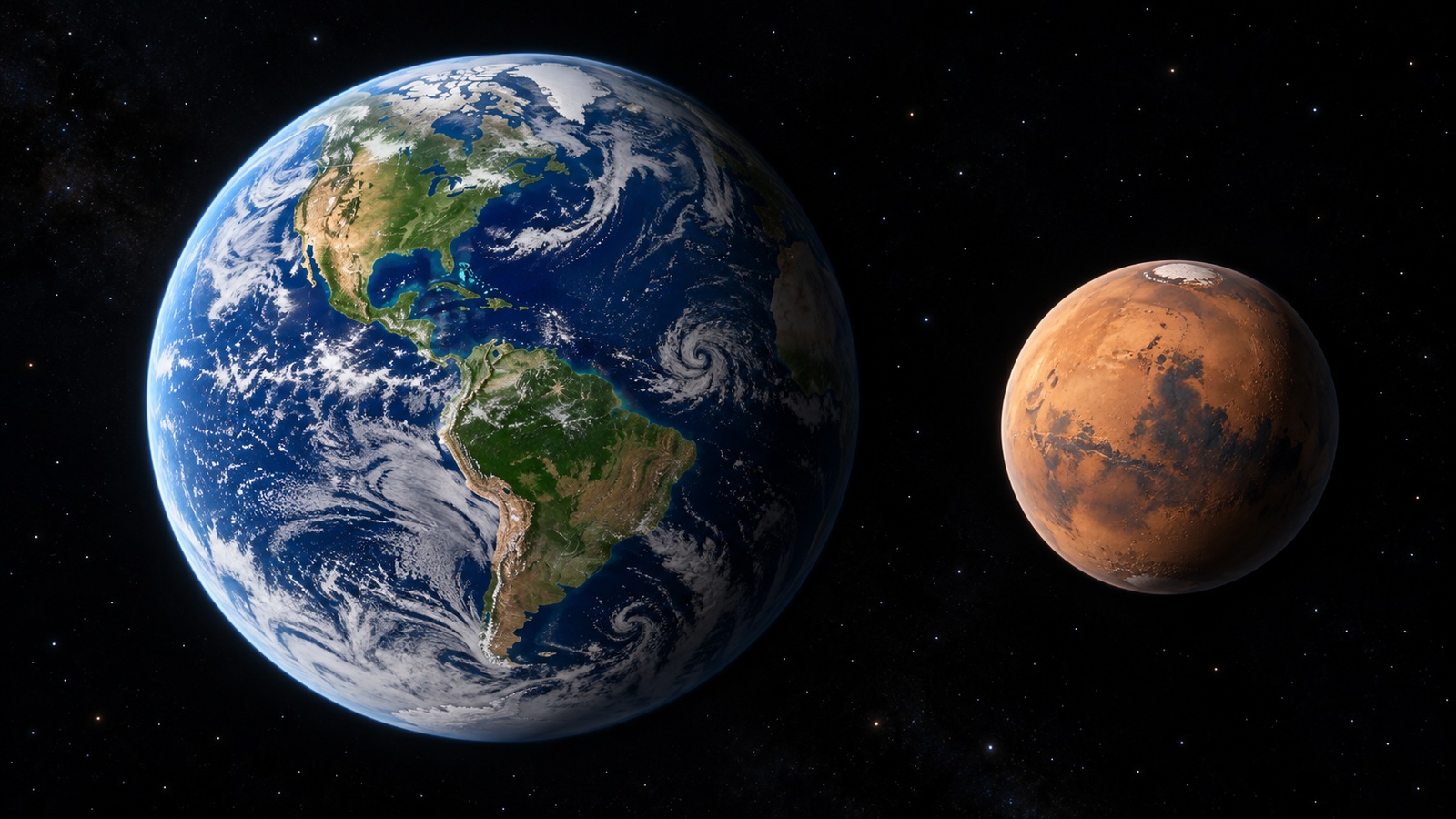
Mars has a diameter of roughly 6,800 kilometers, a little over half Earth’s. Its mass is only about one-tenth Earth’s, so the two size comparisons are not interchangeable. Volume changes rapidly with diameter, and the planets also have different average densities. A globe that appears half as wide is not simply half as massive. Keeping these measures separate is the first step toward understanding the differences in gravity, interior evolution, and atmospheric retention.
Surface gravitational acceleration on Mars is about 38 percent of Earth’s. A person’s mass would remain the same on either planet, but their weight would be lower on Mars. Objects still fall, and a vehicle still needs to manage terrain and inertia. Reduced weight does not remove the effort of accelerating a heavy machine or make an enclosed habitat effortless to build. The practical consequences depend on which force or motion is being considered.
Size also helps shape a planet’s long-term cooling history. A smaller rocky planet generally has more surface area relative to its volume, though composition and internal processes complicate the comparison. Its internal heat budget and evolution therefore need not match Earth’s. This relationship connects a simple diameter difference to a much longer geological story. Planetary dimensions influence how a world changes, rather than serving only as attractive numbers in a facts chart.
NASA’s Mars quick facts provides a compact comparison of physical and orbital quantities. The values are useful when their definitions remain visible. Diameter, mass, gravity, and atmospheric pressure each describe a different property. Replacing all four with the phrase “smaller Earth” obscures more than it explains, because the consequences arise from their combination.
A Similar Day Sits Within a Much Longer Year
A Martian solar day, called a sol, lasts about twenty-four hours and thirty-nine minutes. That makes its day–night rhythm comparatively familiar, although mission schedules must account for the extra minutes. The year is much less familiar: Mars takes about 687 Earth days to orbit the Sun. A resident using Earth-length calendar days would wait substantially longer for the annual cycle to repeat. Similar daily timing therefore does not mean that the seasonal calendar transfers unchanged.
Both Planets Have Tilt-Driven Seasons
Mars and Earth have inclined rotational axes, so each hemisphere alternates between greater and lesser sunlight during the orbit. Their tilts are similar enough that the basic seasonal mechanism has a recognizable counterpart. The details differ because Mars has a longer year and a more eccentric orbit. Its distance from the Sun changes more strongly over the year. That change combines with axial tilt to produce a stronger distinction between the two hemispheres’ seasonal conditions.
Mars also receives less solar energy overall because it orbits farther from the Sun. Surface temperatures respond to that energy, the thin atmosphere, local material properties, and day–night timing. A briefly mild daytime reading cannot establish an Earth-like climate. It describes a particular location and moment. NASA’s comparison of planetary seasons explains why shared axial geometry can coexist with very different seasonal environments.
The calendar comparison is consequently a useful lesson about cause and effect. Rotation controls the daily cycle, revolution sets the annual scale, and axis orientation distributes sunlight across hemispheres. Atmosphere and surface properties determine how the energy is retained and exchanged. Sharing one of these ingredients does not require sharing every outcome. Mars resembles Earth in the existence of seasons while differing in their duration, intensity, and climatic setting.
The Atmospheres Differ in Both Amount and Composition
Earth’s atmosphere is mostly nitrogen and oxygen, with smaller constituents playing important roles in climate and chemistry. Mars’ atmosphere is mostly carbon dioxide and has a typical surface pressure far below Earth’s, approximately six millibars compared with about a thousand millibars at terrestrial sea level. Martian pressure varies with elevation, season, and weather. The comparison concerns both the gas mixture and how little of it is present above the surface.
A high percentage of carbon dioxide does not guarantee a strong greenhouse effect when the total atmosphere is very thin. Percentage describes the fraction of a mixture; pressure helps indicate its amount. Mars cannot retain heat like Earth simply because carbon dioxide dominates its composition. Its atmosphere is also unbreathable for humans. A familiar rocky landscape can therefore exist beneath air that fails several conditions central to everyday life on Earth.
Dust and Wind Operate in Thin Air
Mars still has winds, clouds, and dust storms. Thin air is not the absence of an atmosphere, and mobile dust can change sunlight reaching the ground and affect spacecraft operations. But a wind speed cannot be translated directly into the force of an equivalent Earth wind without accounting for density. A cinematic storm that throws heavy objects around as if it occurred in terrestrial air can exaggerate the mechanical effect. Atmospheric motion is real, while its consequences depend on the amount of moving gas.
Water Is Abundant on Earth and Preserved Differently on Mars
Earth has persistent surface oceans linked to evaporation, clouds, precipitation, runoff, and groundwater. That cycle transports heat and redistributes material across the planet. Mars today has water ice in polar and subsurface deposits, but no global system of exposed liquid oceans. Its low pressure and cold conditions strongly constrain the persistence of liquid water at the surface. Saying Mars has water is correct, provided the phase and location are stated.
Its polar environment also includes seasonal carbon dioxide ice. A bright ice cap should not automatically be interpreted as a single slab of ordinary frozen water. Different substances and seasonal layers can contribute to what an image shows. The distinction matters when assessing water inventories and atmospheric exchange. A visual resemblance to an earthly snowfield is an opening observation, not a chemical identification.
Ancient Mars presents a different record. Valleys, sedimentary layers, and minerals altered by water indicate periods when liquid water flowed or persisted. The Curiosity evidence for ancient lakes connects sedimentary structures to conditions in Gale crater. These findings document real watery environments. They do not establish that the entire planet continuously enjoyed a modern Earth-like climate, because timing, geography, and climate mechanisms still require reconstruction.
The evidence is strongest when several observations support a consistent history. A channel shape alone may allow alternatives, while sediment textures and chemistry can add independent constraints. Researchers also study how later erosion exposes or removes the original record. Comparing Mars with Earth helps interpret these processes, but the comparison must not become an assumption that every Martian feature formed under precisely terrestrial conditions. Familiar physics operates within a different planetary setting.
Past Lakes Do Not Automatically Demonstrate Past Life
A habitable environment has conditions that could support life as understood from terrestrial biology. An inhabited environment actually contains life, and establishing that requires additional evidence. Mars has compelling records of ancient environments relevant to habitability. Those records do not by themselves identify organisms. Earth supplies the only confirmed inhabited planet, so its geology and biology help formulate tests without providing permission to assume the answers on Mars.
NASA’s Perseverance account of Jezero’s ancient lake describes a sequence involving igneous rocks, incoming water, a lake, and deposited sediments. That geological context matters when searching for preserved chemical or structural evidence. A promising setting is a reason to investigate carefully. It is not a substitute for separating biological interpretations from nonbiological alternatives.
Rocky Interiors Share an Outline but Differ in History
Both Earth and Mars have crust, mantle, and core regions. Their internal organization reflects the separation of materials during planetary evolution. Earth now has active global plate tectonics, continually creating, moving, and recycling portions of its surface. Mars does not display the same present-day global system. Its enormous volcanic constructs and old crust preserve a different balance between construction, internal activity, and surface renewal.
That difference should not turn Mars into a perfectly inactive museum. It experiences marsquakes, impacts, erosion, and continuing atmospheric and surface changes. Interior measurements from InSight demonstrated that a rocky planet without Earth-style plate tectonics can still have seismic activity. NASA’s InSight science overview explains why seismology helps constrain hidden layers. Interior similarity at the level of three broad names does not require identical composition, temperature, or motion.
Earth also destroys or transforms much of its older geological record through plate recycling, erosion, and biological processes. Mars can preserve ancient surfaces that offer valuable windows into early planetary conditions. Preservation is not the same as perfect readability: impacts and later alteration can complicate the record. The comparison is scientifically useful because each planet retains different evidence. Earth provides richly observed ongoing processes, while Mars supplies a contrasting archive of planetary evolution.
Magnetic and Atmospheric Histories Are Connected
Earth has a substantial global magnetic field generated by motion in its conducting interior. Mars lacks a comparable present-day global intrinsic field, though magnetized crust and induced magnetic structures remain important. Atmospheric escape involves gravity, solar radiation, charged-particle interactions, chemistry, and planetary history. It cannot be reduced completely to one missing shield. NASA’s MAVEN atmospheric-loss findings identify solar wind and radiation as major contributors to Mars’ changing atmosphere, linking modern measurements to its long-term climatic evolution.
Earth and Mars at a Glance
The comparisons can be collected in one place without treating the planets as interchangeable. These rounded values describe the modern worlds, with surface pressure especially variable across Mars’s terrain and seasons. A solar day measures noon returning to noon, whereas an orbital year follows the journey around the Sun. NASA’s Mars fact sheet and its Earth counterpart provide the reference quantities behind this summary.
| Property | Earth | Mars |
|---|---|---|
| Approximate diameter | 12,740 kilometers | 6,800 kilometers |
| Mass relative to Earth | 1 | About 0.107 |
| Surface gravity | About 9.8 meters per second squared | About 3.7 meters per second squared |
| Mean solar day | 24 hours | About 24 hours 39 minutes |
| Orbital year | About 365 Earth days | About 687 Earth days |
| Representative surface pressure | About 1,013 millibars at sea level | About 6 millibars, strongly site-dependent |
The nearly familiar day and tilted-axis seasons explain why a Martian landscape can invite an Earth comparison. The pressure and water columns explain why that resemblance does not extend to breathing or modern surface oceans. Smaller mass also changes gravity and contributes to the planet’s different internal evolution. Those relationships are more revealing than any single Earth-like label. Mars offers recognizable processes operating within a much colder, thinner-aired environment, and studying their different outcomes helps explain both planets.