
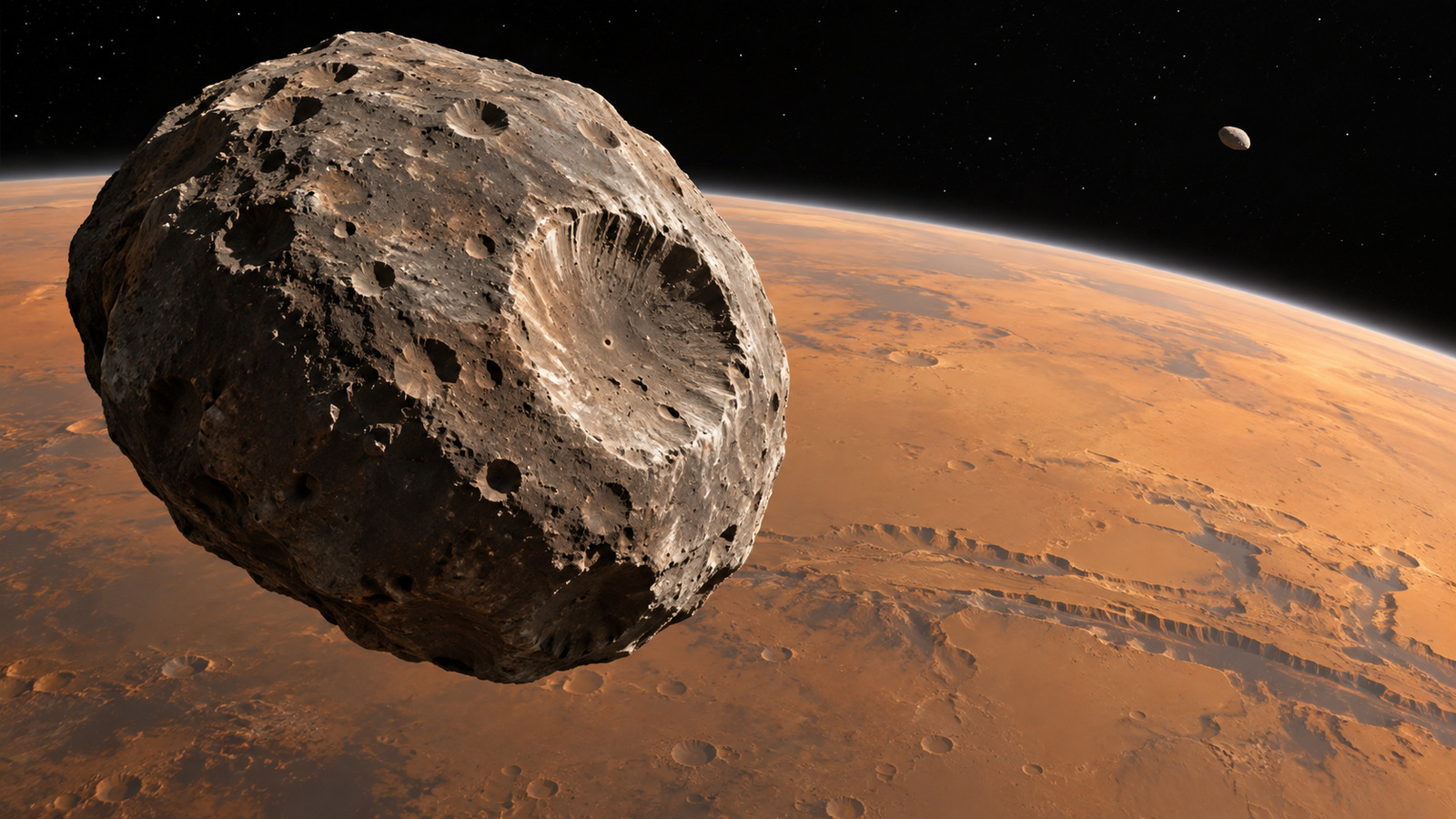
Two Small Moons With Very Different Lives
Mars has two moons, but neither resembles the broad, round disk that dominates many earthly nights. Phobos and Deimos are small, irregular rocky bodies whose shapes, surfaces, and orbits tell contrasting stories about life beside the Red Planet. One races around Mars faster than the planet turns, while the other travels more slowly and farther away. Their dark appearance makes them tempting to describe as captured asteroids, yet that appealing explanation must account for surprisingly orderly orbital paths. An origin in material scattered by an ancient impact has different strengths and challenges. Learning the pair therefore means separating what spacecraft have measured from what researchers are still reconstructing. These modest satellites are important clues to Mars’s history, not simply miniature versions of our own Moon.
Recognizing the Unequal Pair
Phobos is the larger moon, extending roughly 27 kilometers along its longest dimension; Deimos is only about half that length. Because neither body is spherical, a single diameter can hide important differences between length, width, and height. Their gravity is too weak to reshape the material into the smooth round form associated with large planets and satellites. Craters, irregular outlines, and accumulated surface debris consequently remain prominent parts of their appearance. These are worlds whose geography must be described in three dimensions rather than reduced to a neat circular silhouette.
The moons are also tiny beside Mars itself. A photograph placing Phobos near the planet can make the satellite look enormous because the camera is much closer to it than to the Martian surface below. A comparison at equal scale would reveal a very different relationship. Image captions that state viewpoint and distance are therefore essential for understanding the apparent proportions. The dramatic photographs remain valuable, but their perspective should not be mistaken for a physical size chart.
A Discovery Made From Earth
Asaph Hall identified both moons in 1877 using the large refracting telescope at the United States Naval Observatory. Their faintness beside a much brighter planet made the search demanding, even though they occupy a relatively nearby part of the Solar System. The names Phobos and Deimos draw on figures associated with fear and terror in Greek mythology, fitting the traditional connection between Mars and the god of war. Naming history explains the labels without assigning scientific meaning to those mythological associations. Later spacecraft transformed the objects from faint points into mapped geological bodies, providing observations that a distant telescope could not supply.
Separating a Moon’s Mass From Its Appearance
A satellite’s outline tells researchers its dimensions, but mass requires evidence about gravity. Tracking a spacecraft during a close encounter can reveal small accelerations caused by the body’s attraction. Combined with a reconstructed volume, the mass gives an average density that can constrain material and porosity. A low bulk density may reflect empty spaces as well as the composition of the solid grains. The result is an important interior clue, although several different internal arrangements can produce similar average values.
This distinction matters when imagining the moons as solid captured rocks. A loosely organized body, a fractured interior, and a more coherent structure can respond differently to tides or a major impact. Surface photographs alone cannot choose among those possibilities. Researchers therefore connect gravitational measurements with thermal behavior, surface geology, and mechanical calculations. The modest size of the moons makes that combination especially revealing: an apparently simple lump in a picture can contain a complicated history of collisions and rearrangement.
Phobos Runs Ahead of the Planet
Phobos completes an orbit in about seven hours and forty minutes. Mars takes roughly twenty-four hours and thirty-seven minutes to rotate relative to distant stars; a solar day, measured by the Sun’s return, lasts about twenty-four hours and thirty-nine minutes, so its close satellite circles the planet several times during a Martian day. The orbit lies only about 6,000 kilometers above the surface, although its distance from the planet’s center is larger because Mars’s own radius must be included. Confusing altitude with orbital radius creates errors in both size comparisons and explanations of orbital speed. Phobos’s rapid movement is the consequence of this close gravitational partnership.
For an observer in an appropriate part of Mars, Phobos can rise in the west and set in the east. That reverses the direction people commonly associate with a moon crossing Earth’s sky. The effect combines the satellite’s orbital motion with the rotation of the ground beneath the observer; it does not require Phobos to orbit Mars in the opposite direction from normal planetary rotation. Visibility also depends on latitude because the orbit stays close to the Martian equatorial plane. A scene drawn for one location cannot automatically represent every landing site.
The moon presents approximately the same face toward Mars because its rotation is synchronized with its orbital period. This familiar tidal relationship resembles Earth’s Moon’s orientation without making the rest of the system similar. From the Mars-facing side of Phobos, the planet would dominate the sky, while its far side would have a different view. The surface would provide a remarkably close vantage on Martian weather and geology, but standing there would involve extremely weak gravity. A casual terrestrial-style jump would be a poor model for moving safely across such terrain.
Deimos Takes a Slower Route
Deimos orbits farther out and takes approximately thirty hours to complete a circuit. Its motion is therefore slower than Mars’s rotation, giving it a different apparent path and lingering behavior for a surface observer. It is still close to the equatorial plane, but the wider orbit changes its viewing geometry. Its angular size is so small from the ground that it resembles a bright point more than a familiar lunar disk. That contrast helps explain why illustrations showing two large round moons over a Martian landscape can mislead.
Deimos looks smoother than Phobos at comparable scales, although the body is not genuinely smooth like a polished stone. Loose material blankets much of the surface and can soften the appearance of smaller features. Impacts eject debris in a weak-gravity environment, where material can escape or move along unusual paths before returning. Researchers examine the distribution of that debris alongside crater shapes to reconstruct surface evolution. Smoothness in an image is consequently an observation requiring explanation, not proof that the smaller moon escaped an impact history.
Reading Stickney and the Surface Grooves
Phobos’s most recognizable landmark is Stickney, a large crater that occupies a striking share of the moon’s visible face. Its presence shows that a major collision profoundly altered a very small body, but surviving the event does not tell us exactly how strong or internally organized the satellite was. Grooves crossing parts of Phobos have attracted several proposed explanations, including processes involving impact debris and structural response. Their origin should not be presented as settled by a single dramatic photograph. Geological interpretation must join surface patterns with mechanical models and additional observations, especially when an object’s hidden interior remains uncertain.
Why Captured Asteroids Are an Attractive Idea
The moons are dark and share some broad spectral characteristics with primitive small bodies. That makes capture an appealing possibility: Mars might once have acquired objects that formed elsewhere. Appearance alone, however, cannot reconstruct an orbital history. A passing asteroid must lose enough energy to become permanently bound, and subsequent evolution must produce the nearly circular, equatorial orbits seen today. Simple gravity acting between an isolated planet and a passing object does not conveniently accomplish every part of that transformation.
Capture scenarios consequently investigate additional circumstances, such as interactions with other bodies or an early gas environment. Each proposed pathway has to be tested against the relevant conditions and timescales. The problem is more specific than asking whether Mars is capable of attracting a nearby rock. It concerns whether a plausible early history can create both present moons and preserve compatible material properties. A familiar asteroid-like color is only one part of that evidential package.
What an Impact Origin Would Need to Explain
A large collision with ancient Mars could have placed debris into orbit, allowing some material to assemble into satellites. This route naturally connects the moons to a disk around the planet and can help explain an orderly orbital arrangement. It also introduces questions about the material available, the fate of larger temporary moons, and the survival of the small bodies we see now. The collision’s conditions determine how much rock is heated, mixed, and launched. An impact narrative must therefore do more than provide an attractive artist’s illustration.
The composition of Phobos is especially useful for comparing these possibilities. Material that originated in Mars should carry clues differing from a primitive asteroid captured from elsewhere, although mixing and surface processing can complicate the distinction. Researchers use spectra, density estimates, and models to examine that issue. No single measurement necessarily identifies an unambiguous birthplace. The most persuasive account will connect composition with orbital dynamics and the system’s geological history rather than treating those clues separately.
JAXA’s Martian Moons eXploration mission plans to connect close-up observations with returned Phobos grains. Its researchers’ published science plan identifies a concrete comparison: carbonaceous-meteorite-like material rich in hydrated minerals and organic constituents would support a captured-body origin, whereas volatile-poor, igneous characteristics would support material affected by a giant impact. Those are contrasting material histories, not simply dark versus bright colors. Laboratory analyses can examine grain mineralogy and chemical relationships while the spacecraft maps the region from which they came. Material transferred from Mars or other impacts must also be distinguished from Phobos’s own building blocks. Linking a sampled grain with its wider geological setting is what makes a returned collection useful for choosing between the origin pathways.
Tides Give Phobos a Changing Future
Phobos moves inside the orbit at which a satellite would match Mars’s rotation. Tidal interactions therefore tend to remove orbital energy and bring it inward over long timescales. Eventually it may fragment into debris, collide with Mars, or undergo a sequence involving disruption and falling material, depending on its physical properties. Popular countdowns simplify a future that involves uncertain internal strength and structural behavior. The inward trend is much better established than every detail of the eventual breakup. Deimos occupies a different tidal regime and should not be assigned the same immediate fate simply because it is also a Martian moon.
What Rover Transits Really Show
Rovers have photographed the moons crossing in front of the Sun. These transits provide striking silhouettes and can help refine orbital knowledge when their timings and observing positions are understood. Phobos does not normally produce the Earth-like total solar eclipse people may imagine, because its apparent outline is too small and irregular to cover the Sun completely from the surface. The image is a direct demonstration of a nearby moving body, not a statement that Mars possesses a familiar lunar eclipse calendar. Carefully timed sequences turn a beautiful event into a useful measurement.
Observing the moons from Mars also exposes their contrast more effectively than a decorative two-moon scene. Phobos changes position rapidly and shows a discernible irregular shape in suitable cameras, while Deimos is much smaller in the sky. Illumination phase, local horizon, dust, and the rover’s optics all affect what a particular photograph reveals. A bright dot need not indicate a large body, and a dark silhouette can reveal dimensions better than a bright unresolved point. These viewing constraints are part of the story rather than flaws in the observations.
Small Satellites, Large Scientific Questions
The pair combines several kinds of evidence: orbital motion, irregular geometry, impact scars, surface composition, and a slowly changing tidal relationship with Mars. NASA’s Martian-moon overview provides the essential observational setting for these distinctions. Together, the moons offer a test of how planets acquire and retain small companions. Their uncertain origins also warn against translating resemblance directly into identity. Phobos and Deimos are firmly established worlds, while the route that placed them beside Mars remains a problem to solve.


