
Jupiter Became More Than Its Cloud-Top Portrait
Before Juno, Jupiter already had a recognizable face: alternating bands, the Great Red Spot, and an imposing system of moons. What remained harder to understand was the planet beneath that face. How deeply did the winds extend? How were heavy elements arranged inside? What happened at the poles, poorly presented in ordinary views from Earth? NASA’s Juno mission used close passes and complementary instruments to turn those questions into measurements. Its discoveries include surprisingly organized polar storms, deep atmospheric motion, a strongly irregular magnetic field, and evidence for a diffuse rather than neatly separated core. The important achievement was not a single spectacular picture. It was the ability to connect visible weather with hidden structure while distinguishing direct observations from the models that explain them.
A Polar Orbit Changed the Available View
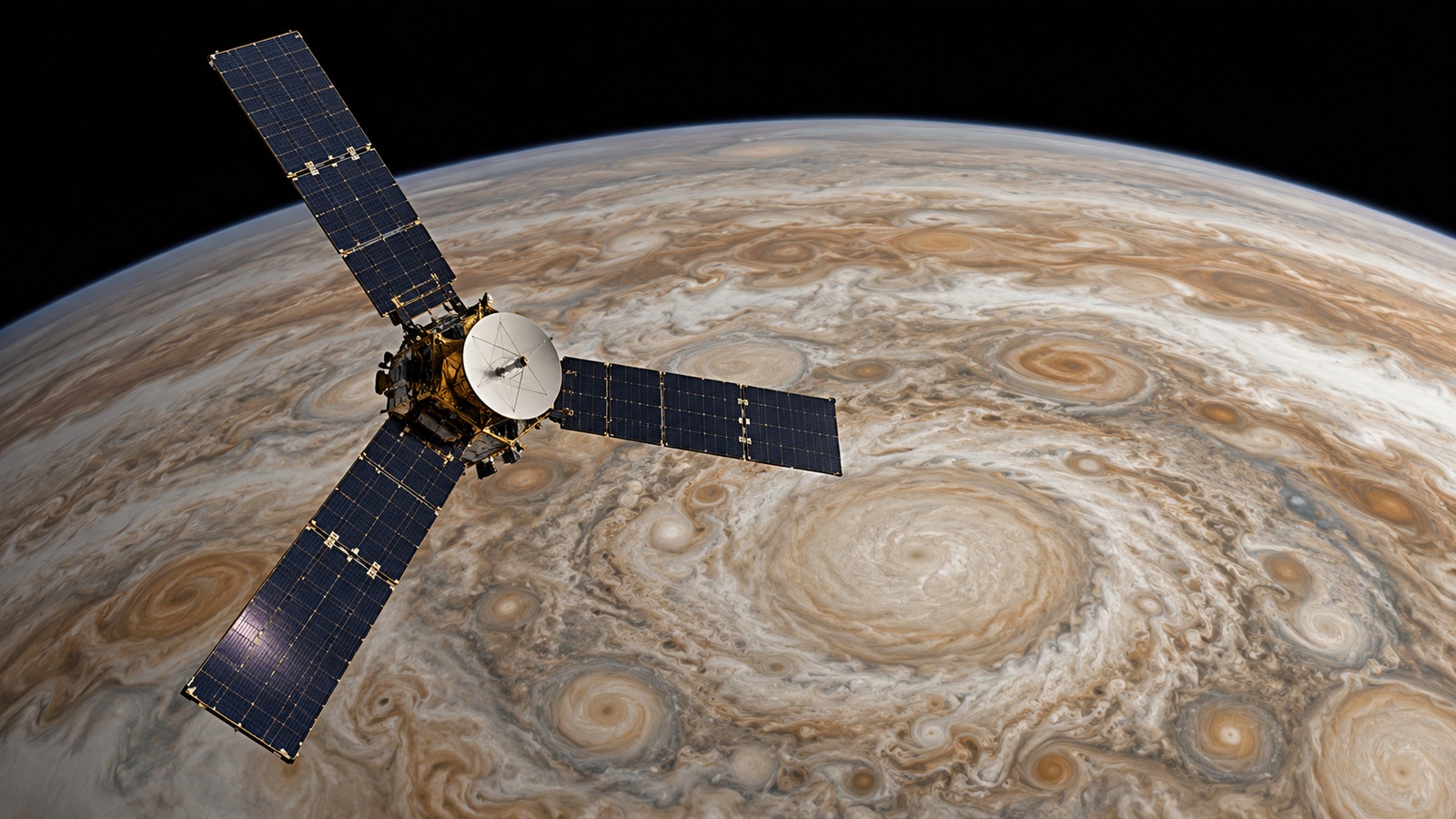
Juno launched in 2011 and entered orbit around Jupiter in July 2016. Its elongated polar orbit brought the spacecraft close to the planet during brief passes and much farther away between them. Cameras and infrared instruments could examine polar weather, while a microwave radiometer investigated beneath the visible clouds. Radio tracking measured the spacecraft’s changing motion under gravity, and magnetic instruments mapped Jupiter’s uneven field. The JPL mission overview explains how these experiments connected atmospheric discoveries with the investigation of the planet’s origin and interior.
Before Juno, familiar views emphasized the belts crossing Jupiter’s equatorial regions. A polar perspective exposed a different organizing pattern, and close passes supplied gravity and magnetic measurements that photographs could not provide. The discoveries therefore include both directly imaged structures and hidden properties inferred from their effects on the spacecraft. A useful way to follow them is to compare the earlier simple picture with the new observation and the physical explanation it changed.
The Poles Host Organized Families of Cyclones
Juno revealed cyclones gathered around Jupiter’s poles in arrangements quite different from the familiar equatorial bands. At the north pole, a central cyclone is surrounded by eight others; southern arrangements have shown their own distinct geometry. The structures persisted across observations rather than appearing as random isolated swirls in one image. Their interactions offer a laboratory for fluid dynamics under rapid rotation. The discovery showed that extrapolating the banded equatorial appearance to the poles was a poor substitute for seeing the poles directly.
Gravity Measurements Revealed Deep Jets
Jupiter’s visible belts and zones correspond to strong atmospheric flows. Juno’s precise tracking helped scientists infer that these jets extend roughly three thousand kilometers beneath the cloud tops. Moving material redistributes mass, leaving a measurable imprint on the gravity field. Researchers compare that imprint with dynamical models to estimate how far the flows penetrate. The depth is an inference from gravitational measurements, not an image of a three-thousand-kilometer trench.
Below the region of differential atmospheric motion, the deeper planet behaves more nearly as a body rotating together. The transition helps constrain how winds interact with electrically conducting material farther down. A measured wind depth therefore links weather to interior physics. It also prevents two opposite oversimplifications: the bands are neither merely superficial paint nor proof that all of Jupiter’s interior circulates exactly like the visible clouds.
A jet system and an individual storm need not have the same depth. Different structures leave different signatures and can be constrained by different combinations of measurements. Saying that Jupiter’s weather is deep without identifying the feature can blur an important result. NASA’s Juno science overview reports the deep jets alongside the broader interior findings, while individual storm studies provide more specific vertical scales.
The general lesson extends beyond Jupiter. A cloud pattern is the visible expression of a fluid system, and its horizontal size does not uniquely reveal its vertical extent. Tracking a spacecraft can supply information that a camera cannot. That connection between an orbit and atmospheric dynamics is one of Juno’s most striking scientific achievements. A tiny measured change in motion can answer a question about a planetary-scale current.
The Great Red Spot Has Substantial Roots
Juno found that the Great Red Spot extends hundreds of kilometers below the visible cloud tops. Studies using microwave observations and gravity constraints place its depth on the order of three hundred to five hundred kilometers. This is much deeper than a thin surface cloud pattern, yet shallower than the major jet systems. The two discoveries should retain their separate scales rather than being merged into a claim that every Jovian storm reaches three thousand kilometers.
NASA’s account of the Great Red Spot’s depth explains the result in the context of its longstanding visible prominence. Knowing the depth improves constraints on how the vortex stores energy and interacts with its surroundings. It does not by itself solve every question about the storm’s longevity or changing size. The mission replaced a two-dimensional outline with a much stronger physical description while leaving meaningful dynamical questions open.
The Core Appears Extended and Dilute
A familiar textbook sketch gives a giant planet a small compact heavy-element core surrounded by a sharply separated hydrogen envelope. Juno’s gravity measurements instead favor models with heavy elements spread through a broader interior region. This is often called a dilute or fuzzy core. The word fuzzy refers to a less distinct compositional boundary, not to an actual cloud photographed at the planet’s center. It complicates the simple layered picture and provides new constraints on how Jupiter formed and evolved.
Two Interior Pictures Give Different Gravity Predictions
Imagine two rotating planets with the same total mass: one concentrates most heavy material in a compact central region, while the other spreads it through a larger volume mixed with hydrogen and helium. Their internal density distributions need not produce identical external gravity fields once rotational flattening and atmospheric motion are included. Juno’s radio signal changed as gravity accelerated the spacecraft during its passes. The measured changes allowed scientists to test detailed versions of these interior pictures, making the core question an experiment rather than a choice between attractive cutaway drawings.
Wahl and colleagues’ 2017 model comparison found that an extended dilute core helped reconcile calculated gravity with Juno’s observations. The heavy-element concentration remained greater toward the center, but a simple sharply separated ball was not the only arrangement worth considering. Properties of compressed hydrogen and the treatment of temperature and winds affect the permitted models. The discovery narrowed the interior possibilities while leaving the exact distribution subject to continuing investigation.
The same 2017 calculations placed the heavy elements associated with the modeled core in a range of approximately seven to twenty-five Earth masses. This describes a constituent mass inside the tested models, not a directly weighed solid object or the total mass of all hydrogen mixed through that region. An extended enriched zone can contain a substantial quantity of heavy material while lacking a sharp outer surface. The numerical range makes the proposed interior significant even though its boundary remains less simple than the core boundary in a classroom drawing. It also shows why measuring Jupiter’s total mass alone cannot settle the interior arrangement.
The result also changed the formation problem. A planet that began with a compact core could redistribute some of its material through dissolution or mixing as the surrounding envelope developed. Alternatively, its growth history could establish an extended enriched region without a later single dramatic event. Atmospheric measurements supply complementary clues about the ingredients accumulated during that growth. The core structure and chemical inventory therefore tell connected parts of Jupiter’s history, rather than turning a fuzzy-core nickname into a complete reconstruction.
The Magnetic Field Is Uneven and Changes With Time
Juno mapped a field that is more spatially complicated than a tidy bar-magnet drawing suggests. A strong region nicknamed the Great Blue Spot is a feature of magnetic maps, not a blue-colored cloud visible in photographs. Field patterns offer clues to the motion of conducting material inside Jupiter. Their irregularity matters because an internal dynamo depends on the arrangement and movement of that material. Mapping the field therefore complements the gravitational approach to the hidden planet.
Comparison with earlier spacecraft measurements also established changes in Jupiter’s internal magnetic field over time. NASA’s 2019 magnetic-field report describes this secular variation. A field can be immensely strong while also evolving. Following that evolution helps researchers test relationships between deep flows and magnetic structure, rather than assuming Jupiter’s magnetism is a permanent static shape.
Ammonia Revealed Unexpected Atmospheric Transport
Microwave measurements showed that ammonia abundance varies with latitude and depth in ways that a simply well-mixed atmosphere could not explain. The instrument detects thermal emission influenced by absorption, so researchers use atmospheric models to infer abundance patterns. A weak observed ammonia signature does not necessarily mean the element is absent from the planet. It can mean that weather has redistributed it relative to the depths and locations being sampled.
One proposed explanation involves ammonia-water hailstones called mushballs. Storms can mix ammonia with water ice, creating slushy material that grows and falls. That material can transport ammonia downward before evaporating in warmer layers. The proposal connects chemistry to vertical transport and helps explain why particular regions appear depleted. It should be described as a physical interpretation of several observations, rather than as a handful of recovered Jovian hailstones.
Juno also detected shallow lightning at unexpectedly high, cold atmospheric levels. An ammonia-water mixture can remain liquid under conditions where pure liquid water would not, helping explain cloud electrification there. NASA’s shallow-lightning and mushball account connects the detected flashes with the proposed transport mechanism. The pairing illustrates how an observation can support a chemical model without making every detail of that model directly observed.
Weather does not erase the value of composition measurements; it makes their interpretation richer. Sampling one location or one pressure range may reveal a local circulation feature rather than the planet-wide average. Multiple wavelengths and repeat observations help separate those possibilities. Jupiter’s atmosphere is consequently a record of both its original material and its present movement. Juno showed why those two records cannot always be read independently.
Water Measurements Needed a Geographic Qualification
Juno’s equatorial measurements provided a new estimate of atmospheric water abundance after the Galileo probe had sampled an unusually dry region. The finding improved the evidence but did not turn one equatorial result into an automatically uniform planet-wide value. The research summary of equatorial water abundance identifies the latitude range and uncertainties explicitly. That qualification is part of the discovery: understanding how much water Jupiter acquired requires attention to where and how its atmosphere was measured.
Later Results Kept Connecting Different Layers
Findings announced in 2025 included a cooler north polar stratospheric cap and fast surrounding winds, alongside further work on atmospheric ammonia and Jupiter’s moon Io. NASA’s April 2025 results report distinguishes these measurements and their interpretations. They extend the mission’s central approach of connecting images and emission measurements to physical structure. Later findings should be dated rather than folded into a claim that every observation was made during the initial arrival.
Juno’s legacy is a more complicated but better-tested Jupiter. The poles contain organized storm systems, the jets reach deep below the clouds, individual vortices have measurable roots, and the interior resists a simple compact-core sketch. Its magnetic field evolves, while ammonia and water record atmospheric processes as well as composition. Each result has its own evidence and limits. Together they replace the idea of a striped surface hiding an unknowable interior with a connected investigation of a changing planet.


