
Shared Ingredients Do Not Make Jupiter a Star
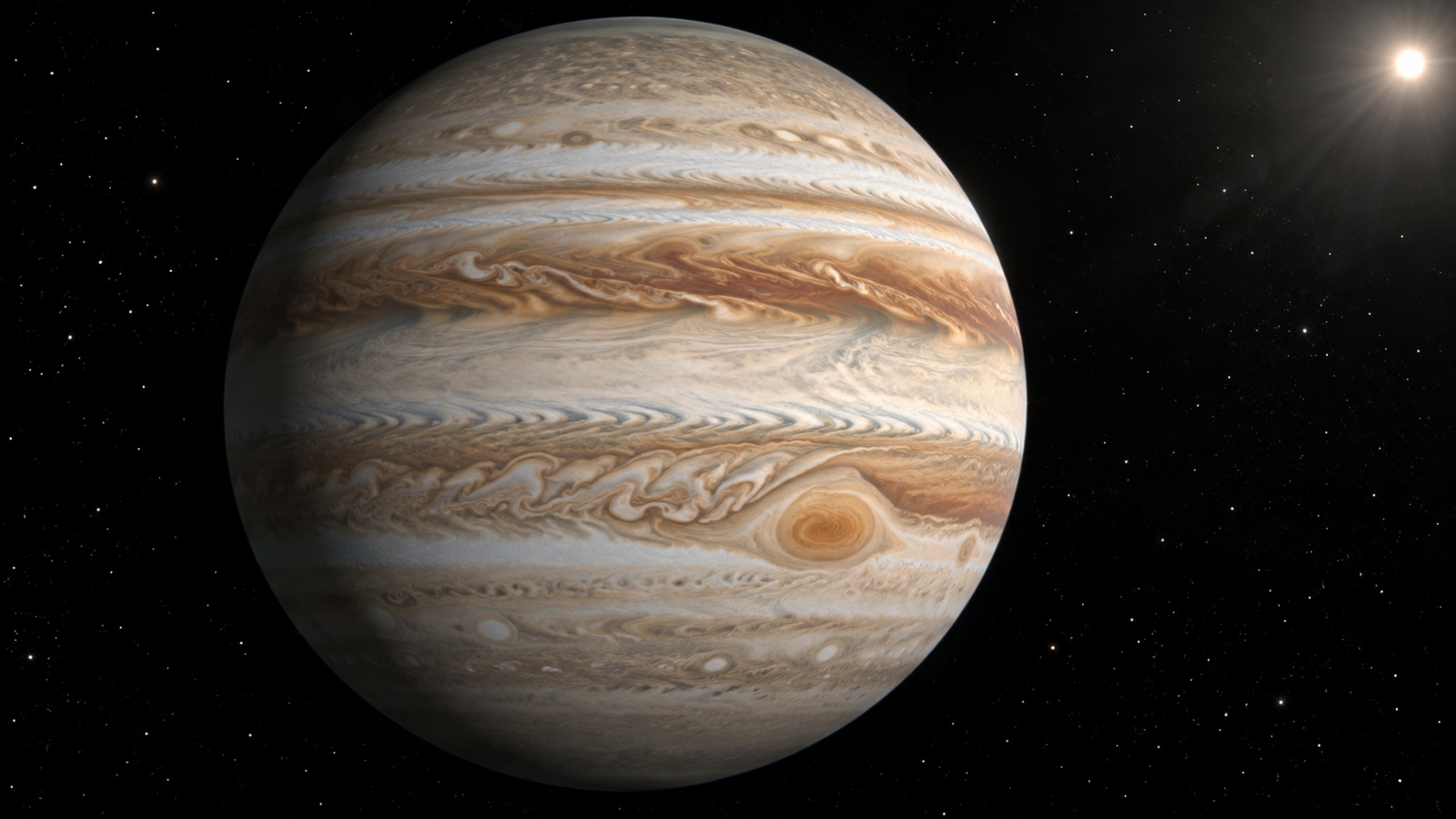
Jupiter contains enormous quantities of hydrogen and helium, gives off internal heat, and outweighs every other planet in our solar system. Those facts make the phrase “failed star” sound plausible. Yet the phrase confuses several different comparisons: what an object is made of, how it formed, and whether its interior can sustain the nuclear reactions that power ordinary stars. Jupiter is a gas giant, and its present mass falls far below the threshold for long-lived hydrogen fusion. Brown dwarfs occupy part of the territory between planets and stars, but Jupiter is not simply one of those objects waiting for a spark. Looking at the underlying physics replaces a dramatic near-miss story with a more interesting account of planetary formation, gravitational compression, and the many ways astronomical objects release energy.
The Sun’s Fuel Needs Very Particular Conditions
A main-sequence star such as the Sun produces energy by fusing hydrogen into helium in its central region. Hydrogen nuclei repel one another electrically, so fusion requires conditions that allow them to approach closely enough for nuclear processes to operate. High temperatures and densities in a stellar core make a sufficient reaction rate possible. Hydrogen’s presence is therefore necessary for this particular fuel supply, but presence alone does not establish that an object can use it.
Gravity plays the decisive structural role. A forming object’s own mass compresses its interior, increasing central pressure and temperature. In a sufficiently massive star, sustained fusion supplies energy that helps support the object against further gravitational compression. The result is a long-lived balance rather than a chemical fire started by an external flame. A spark, a lightning bolt, or a passing hot spacecraft could not turn Jupiter’s bulk hydrogen into a self-sustaining stellar core.
The Sun is about a thousand times as massive as Jupiter. Jupiter is huge compared with Earth, but that familiar comparison disguises its much smaller gravitational scale beside a star. Its interior is compressed and hot without reaching the conditions needed to sustain ordinary hydrogen fusion. It is useful to compare central physics rather than visual size: two bright or large-looking objects can operate through entirely different energy sources.
A Planetary Giant Is Far Below the Stellar Boundary
The minimum mass for long-lived hydrogen burning is roughly seventy-five to eighty Jupiter masses, with the precise value depending on composition and the model used. This is not a shortage that can be corrected by adding a modest amount of gas. It is a radically different total mass. The NASA overview of stellar types places brown dwarfs below the main-sequence boundary and explains why they do not sustain hydrogen fusion like ordinary stars. Jupiter occupies a much lower mass scale than even that intermediate population.
Brown Dwarfs Explain the Origin of the Nickname
Brown dwarfs are substellar objects that never sustain the long-lived hydrogen fusion characteristic of the main sequence. Many are understood to form through gravitational collapse resembling stellar formation. Their interiors and atmospheres can nevertheless resemble aspects of giant planets. The nickname “failed star” refers most naturally to this population, although it still describes a human comparison rather than an intended goal that the object somehow missed.
A frequently quoted lower boundary is around thirteen Jupiter masses, associated with the ability to burn a substantial amount of deuterium under suitable conditions. Deuterium is an isotope of hydrogen, and its fusion is not the same as sustained ordinary hydrogen burning. The exact threshold depends on composition and other assumptions. Astronomers also debate whether a mass boundary alone adequately separates planets from brown dwarfs, particularly for objects whose formation history is difficult to establish.
Jupiter lies well below this conventional deuterium-burning scale. It is consequently not a borderline case whose name depends on shifting a numerical cutoff slightly. The uncertainties in classification become significant for more massive objects, not for deciding whether present-day Jupiter can power itself like the Sun. This distinction keeps genuine debates at the planet–brown-dwarf boundary from being borrowed to manufacture uncertainty where the physics is comparatively clear.
NASA’s brown dwarf explainer describes why these objects combine star-like formation with complex, planet-like atmospheres. That combination makes them valuable subjects rather than defective versions of something else. Their cooling, cloud chemistry, and spectra help researchers explore the transition between object types. Jupiter belongs in the comparison because it is a nearby giant planet, not because the comparison erases their substantial mass differences.
How an Object Forms Also Matters
The Sun formed as part of the collapse of an interstellar cloud, while Jupiter developed within the young Sun’s surrounding disk. The details of giant-planet formation remain an active subject, but models connect it to that disk environment and the assembly of planetary material. In the commonly discussed core-accretion picture, a growing concentration of solids eventually acquires a substantial gaseous envelope. The amount of available gas and the timing of disk evolution influence the resulting planet.
Some giant planets may form through disk instability, and some low-mass free-floating objects can challenge a simple formation-based classification. Those complications deserve careful treatment. They do not make every hydrogen-rich object a failed star. Formation history, mass, orbital context, and energy production answer related but distinct questions. An explanation becomes misleading when one of those criteria is silently substituted for all the others.
The Same Elements Can Produce Different Worlds
Hydrogen and helium were abundant in the material from which the solar system formed. Their importance in both Jupiter and the Sun reflects that shared supply. Earth, by contrast, accumulated and retained a much more rock-dominated composition. Starting ingredients influence an object’s properties, but the amount assembled and the conditions of assembly determine what those ingredients become. A planet and a star can share major elements without sharing the same interior reactions or evolutionary path.
Jupiter’s Heat Does Not Require Fusion
Jupiter emits thermal radiation as it gradually loses energy from its interior. Energy retained from formation and released through continuing gravitational evolution contributes to that budget. A cooling object can remain warmer than its surroundings and shine in infrared wavelengths without being a fusion-powered star. The same distinction applies to many young planets and other astronomical objects. Radiation tells us that energy is escaping; it does not by itself identify how that energy was produced.
The planet’s visible brightness has another major origin: reflected sunlight. When observers see Jupiter in the night sky, they mostly receive sunlight scattered from its upper atmosphere. Its internal thermal emission is studied especially at longer wavelengths. Distinguishing reflected light from emitted heat prevents the claim that Jupiter shines from becoming evidence of stellar fusion. Almost any sufficiently warm physical object emits radiation, while a main-sequence star has a much more specific central energy process.
Internal heat also helps drive Jupiter’s atmospheric behavior. It participates in the energy supply behind circulation and weather, alongside the sunlight absorbed by the planet. A dramatic storm or a warm interior is thus entirely compatible with a planetary classification. Energy can move through convection and be radiated away without any hydrogen-fusion engine at the center. The NASA explanation of Jupiter’s interior introduces the extraordinary pressure conditions beneath the familiar clouds without presenting a miniature Sun.
Adding Mass Would Not Simply Inflate the Planet
It is tempting to imagine making Jupiter a star by enlarging its visible globe until it looks like the Sun. But mass and radius do not increase in a simple fixed proportion for giant planets and brown dwarfs. Added gravity compresses the material, and the behavior of densely packed matter becomes increasingly important. A considerably heavier object can have a radius broadly comparable to Jupiter’s. The decisive increase is in mass and central conditions, not merely the diameter drawn in an illustration.
This is why astronomers measure both mass and size when possible. A transit can constrain radius, while gravitational effects can constrain mass. Together they help establish density and distinguish a giant planet from a substantially heavier companion of similar diameter. The comparison is especially important for distant objects that cannot be studied as richly as Jupiter. An impressive radius alone does not prove proximity to the stellar-fusion boundary.
Metallic Hydrogen Is an Interior State, Not a Stellar Label
Deep within Jupiter, pressure changes hydrogen’s behavior. At sufficiently high pressures, hydrogen can become electrically conducting in a metallic state. This helps explain the planet’s powerful magnetic field when combined with motion in its conducting interior. The term metallic describes physical behavior under extreme conditions. It does not mean Jupiter contains an accessible shell of ordinary shiny metal, nor does it identify a region of sustained hydrogen fusion.
Measurements of gravity and magnetic fields constrain the internal arrangement indirectly. Jupiter’s heavy elements may be distributed through an extended region rather than confined to a small, sharply separated central ball. Models are tested against several kinds of observations, and important details remain uncertain. Those uncertainties concern planetary structure. They do not overturn the enormous gap between Jupiter’s actual mass and the minimum mass of a hydrogen-burning star.
The distinction between pressure effects and nuclear reactions is especially helpful here. Compressing hydrogen changes its density, phase behavior, and electrical properties. Fusion changes atomic nuclei and releases nuclear energy. Both involve extreme interiors, but they are different physical processes. Treating the word hydrogen as a complete explanation of either one removes the conditions that make the science meaningful.
NASA’s Jupiter facts summarizes the planet’s hydrogen-rich structure and the evidence for a diffuse interior core. That overview can anchor a mental picture, but it should not be turned into a literal map of every depth. Interior models necessarily infer hidden conditions. The careful conclusion is that Jupiter is a strongly compressed, chemically structured gas giant, not that its interior is merely a cold cloud or an unlit stellar furnace.
Compare the Three Objects by What Powers Them
Consider three illustrative objects made largely of hydrogen and helium: Jupiter at one Jupiter mass, a brown dwarf at thirty Jupiter masses, and a small star at ninety Jupiter masses. These are examples placed comfortably apart, not exact category boundaries. Their broad similarity in ingredients or possible diameter does not imply similar central pressures or energy histories. NASA’s brown-dwarf comparison shows why mass can increase dramatically while diameter stays near a planetary scale.
| Illustrative object | What distinguishes its energy history |
|---|---|
| Jupiter: one Jupiter mass | Cooling and slow contraction supply internal heat; no sustained hydrogen fusion |
| Brown dwarf: thirty Jupiter masses | Can have burned deuterium earlier, but cannot sustain ordinary hydrogen fusion |
| Small star: ninety Jupiter masses | Central conditions can maintain hydrogen burning over a long stellar lifetime |
The brown dwarf’s early deuterium supply is limited, so its present luminosity does not have to come from an active nuclear reaction. Age matters when comparing its glow with a young giant planet or an old star. Sustained hydrogen burning offers the small star a much longer-lived energy supply. Jupiter’s internal warmth instead fits a cooling, contracting giant whose weather and magnetic environment remain active without stellar ignition. The useful comparison is therefore a history of energy production as well as a mass ranking.
Jupiter’s ordinary future does not include collecting the dozens of extra Jupiter masses needed to approach the stellar boundary. Adding that much matter would create a profoundly different object, rather than reveal a hidden destiny of the planet we know. Its size, composition and heat make it an important bridge for studying gaseous worlds across a wide mass range. They do not make it a near-miss Sun. Jupiter is best understood as a gas giant whose own interior physics explains its remarkable warmth and activity.


