
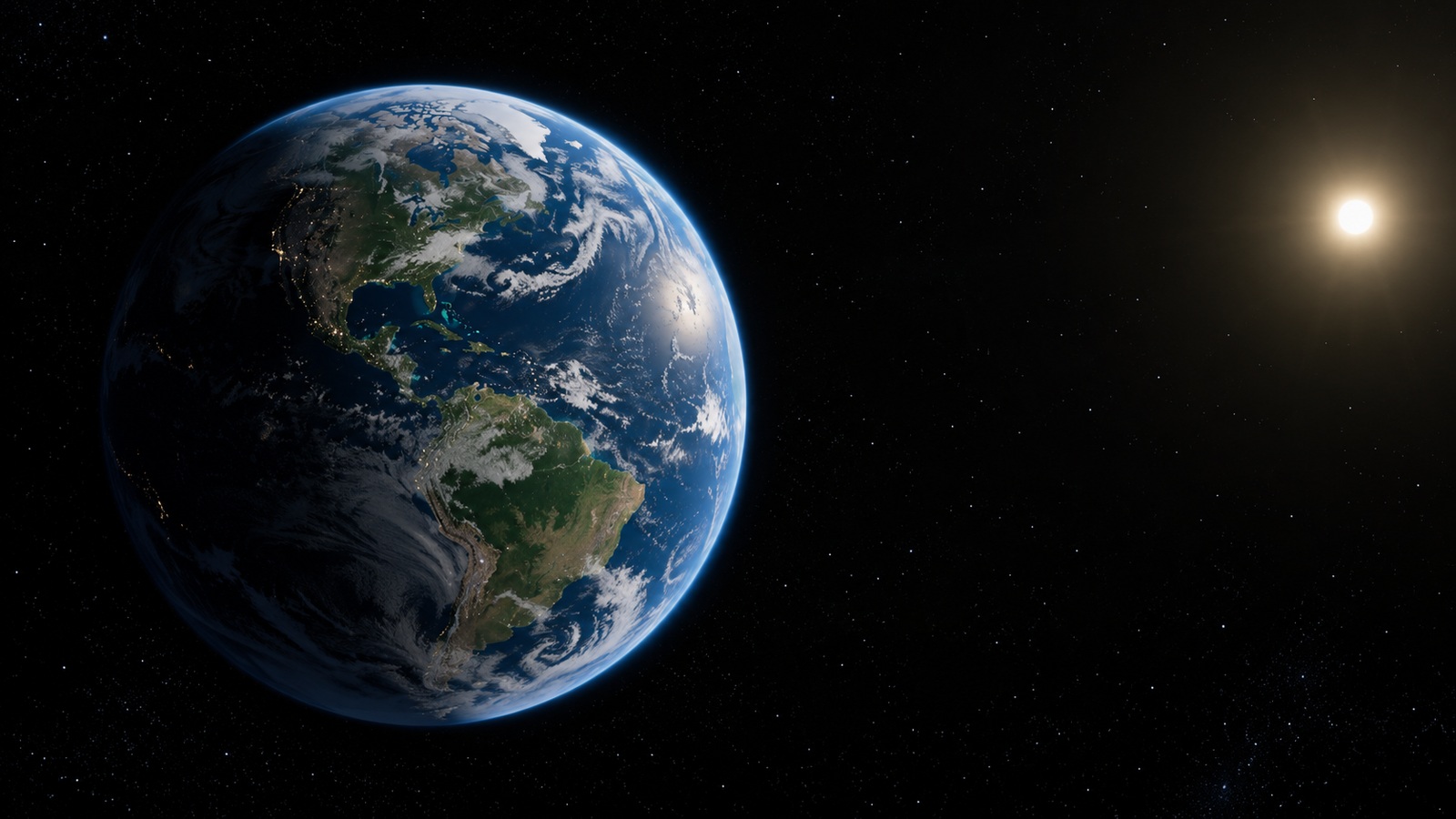
The Year Follows a Nearly Circular Journey
Every birthday marks another journey around the Sun, but Earth’s annual path is more interesting than a circle drawn on a schoolroom page. The orbit is a gentle ellipse, the planet travels at different speeds along it, and the axis of daily rotation leans relative to that path. Those features explain different things: the ellipse governs changing distance, orbital motion supplies the year, and the tilted axis controls the familiar seasonal pattern. Combining them too quickly creates the mistaken idea that summer simply arrives when Earth gets closer to the Sun. Separating the geometry from the sunlight received at a particular latitude makes the annual cycle much clearer. It also reveals why a calendar year, a complete orbit, and the return of spring are not precisely identical measurements.
An Ellipse With Very Little Stretch
In a simple two-body description, Earth follows an ellipse with the Sun at one focus. A focus is a geometrical point within the ellipse; it is not the same as its center. Earth’s orbital eccentricity is about 0.0167, so the ellipse is close to circular. Diagrams often stretch it heavily to make its features visible. That illustration choice can create an exaggerated impression of the actual difference between the closest and farthest parts of the journey.
The semimajor axis describes half the longest diameter of the ellipse and is close to 149.6 million kilometers for Earth. This familiar distance is approximately one astronomical unit, although the modern astronomical unit is an exactly defined length rather than a yearly measured average. Earth’s distance from the Sun varies around that scale. The orbit also responds to other bodies, so an accurate navigation calculation uses a more complete gravitational model than a fixed ellipse on paper.
January Brings the Closest Approach
Earth reaches perihelion, its closest orbital point to the Sun, around early January. Aphelion, the farthest point, occurs around early July. The corresponding distances are roughly 147 million and 152 million kilometers. Exact dates and distances vary slightly from year to year. These facts immediately challenge a Northern Hemisphere assumption that the hottest season must occur at closest approach: its winter happens near perihelion, while its summer happens near aphelion.
The difference changes the sunlight available at the top of the atmosphere. Radiation from the Sun spreads over a greater area with increasing distance, so nearer Earth receives somewhat more energy per unit area perpendicular to the rays. But the distance variation acts on the planet as a whole. It cannot explain why opposite hemispheres experience opposite seasons simultaneously. That contrast comes primarily from how the tilted axis changes the angle and duration of sunlight.
NASA’s explanation of orbital cycles and climate places perihelion and aphelion within a broader account of eccentricity and seasonal influences. The annual distance effect is real without being the main seasonal driver. Its consequences combine with land, oceans, atmospheric circulation, and seasonal timing. A single distance measurement cannot replace that full physical context when explaining a city’s weather.
Gravity Keeps Changing the Direction of Motion
Earth does not need an engine to complete its orbit, and it does not rest on an invisible track. The planet’s motion carries it forward while the Sun’s gravity continuously changes its velocity. In the simplest description, the resulting path bends around the Sun rather than terminating in a straight-line departure or a direct fall. Gravity supplies the acceleration, even when the size of the speed changes little. An orbit is therefore a continuing gravitational motion, not a sequence of unsupported pauses between fixed calendar positions.
The Planet Travels Faster Near Perihelion
Orbital speed is not constant along an ellipse. Earth moves faster when closer to the Sun and slower when farther away. Its average orbital speed is about 30 kilometers per second, with a modest variation through the year. The change is tied to the same gravitational mechanics that govern the orbit’s shape. It is not caused by the Sun pulling the planet along with a rotating beam or by seasonal weather pushing it.
Kepler’s equal-area rule expresses this behavior geometrically. A line joining the Sun and Earth sweeps equal areas in equal times. Near perihelion, a shorter Sun–Earth distance is balanced by faster progress around the orbit; near aphelion, a longer distance accompanies slower progress. The rule makes the relation understandable without implying that equal lengths of the orbital path are covered each month. Calendar months themselves also have unequal lengths, adding a separate human convention to the physical motion.
This unequal speed helps make the astronomical seasons unequal in duration. The stretches between successive equinoxes and solstices do not all require the same number of days. Earth’s position near perihelion and aphelion determines how quickly it passes through those parts of the year. Exact intervals depend on the year and the definition used. A four-quarter calendar picture is convenient, but the physical orbit does not divide itself into four identical timed segments.
The NASA explanation of Kepler’s laws connects elliptical paths, equal swept areas, and orbital periods. These rules are a useful first model rather than the complete modern method for forecasting every planetary position. Small interactions with the Moon and other planets also matter at high precision. For an introductory picture, however, the difference between constant speed and equal swept area is the crucial correction.
The Tilted Axis Sets the Seasonal Pattern
Earth’s rotational axis leans about 23.4 degrees from the direction perpendicular to its orbital plane. During one part of the orbit, the Northern Hemisphere is tilted toward the Sun; roughly half an orbit later, the Southern Hemisphere is favored. The favored hemisphere receives more direct sunlight and generally longer daylight. Each change raises the energy available during its summer. The axis does not flip back and forth each season; Earth’s changing position around the Sun produces the alternating orientation relative to sunlight.
Sunlight Angle and Day Length Work Together
A high midday Sun concentrates incoming energy over a smaller patch of ground than a low Sun does. The same beam arriving at a shallow angle spreads across a larger area. Longer daylight also provides more time for energy to arrive. These two geometrical effects reinforce one another during summer in many latitudes. Temperature still responds through the atmosphere, oceans, ground, clouds, and stored heat, so the warmest day need not coincide with the longest day.
Latitude changes the size of the seasonal contrast. Near the equator, the annual variation in day length is smaller than at high latitudes. Near the poles, the annual geometry permits periods of continuous daylight and continuous darkness. Local climates then add their own patterns of rainfall and temperature. The physical definition of a season should therefore be distinguished from a particular region’s agricultural or cultural seasonal calendar.
Equinoxes and Solstices Mark Geometrical Events
An equinox occurs when the Sun’s apparent path crosses the celestial equator. Around that time, daylight and darkness are approximately balanced in many locations. They are not exactly twelve hours everywhere because sunrise and sunset definitions include the Sun’s finite disk and atmospheric refraction. An equinox is a specific event in Earth’s seasonal geometry, not a promise that every observer experiences precisely equal clock-measured day and night.
At a solstice, the Sun reaches its greatest apparent northward or southward displacement from the celestial equator. These events correspond to the strongest annual daylight extremes in the hemispheres. The June solstice brings the Northern Hemisphere’s longest daylight and the Southern Hemisphere’s shortest; December reverses those relationships. Seasonal names depend on hemisphere, while the astronomical events are shared. NASA’s discussion of seasons across planets places this tilt-driven behavior within a wider planetary comparison.
The word apparent is useful because the yearly movement is described as seen from Earth. The Sun is not physically circling the terrestrial equator once each year. Earth’s orbit and inclined rotational axis produce that changing direction on our sky. The celestial description is convenient for observations, calendars, and navigation. Recognizing the viewpoint keeps an accurate sky description from becoming an incorrect account of which body is traveling around which.
A Day and a Year Measure Different Motions
Rotation turns Earth around its axis and produces the daily pattern of daylight and darkness. Revolution carries Earth around the Sun and supplies the annual cycle. A solar day measures the return of the Sun to a similar sky direction, while a sidereal day measures rotation relative to distant stars. Because Earth also advances along its orbit, those two daily measures differ. The distinction is a reminder that a time period needs a clearly specified reference, even for motions that feel completely familiar.
Different Definitions Produce Slightly Different Years
A sidereal year measures one orbit relative to a distant stellar reference and is approximately 365.256 days. A tropical year follows the seasonal cycle and is approximately 365.242 days. Earth’s slowly changing axis direction accounts for the difference between these definitions. Calendars used for everyday dates aim to follow the seasons, so their useful year is not simply the interval between two identical stellar alignments. The difference is small in one year but matters when a calendar is carried forward for centuries.
Consider a calendar that repeats exactly 365 days every year. Each annual sequence ends roughly six hours before the seasonal cycle has completed, so the accumulated mismatch approaches a day after four years. Adding a leap day usually corrects that drift. However, adding one every four years without exception gives an average of 365.25 days, slightly too long. The US Naval Observatory’s leap-year explanation shows why the Gregorian rules omit three otherwise expected leap days in each four-hundred-year cycle. Their average year is 365.2425 days, much closer to the seasonal value.
This calendar adjustment does not speed up Earth or interrupt its path. It changes which date label is assigned to a moment along a continuously unfolding orbit. A March equinox can occur at a different clock time or neighboring date from one year to another while the familiar seasonal progression continues. The Earth’s axis and orbital position set the sunlight geometry; the calendar follows that geometry with an approximation built from whole days. Remembering those roles connects the numerical year definitions with the ordinary experience of seasons returning at similar dates.
The Orbit Changes Slowly Over Longer Times
The eccentricity of Earth’s orbit, the amount of axial tilt, and the direction of the axis vary over long periods. Gravitational interactions and rotational dynamics drive these changes. Together they alter the distribution and timing of sunlight and contribute to the pacing of past climate variations, especially when feedbacks in ice, oceans, and atmospheric gases respond. They should not be confused with a sudden yearly switch or treated as a replacement explanation for current human-driven warming.
Earth’s solar dance is consequently orderly without being frozen into a perfectly repeating diagram. A nearly circular ellipse establishes changing distance and speed; the inclined axis establishes seasonal contrasts; distinct reference cycles establish different meanings of a day and a year. Each part answers its own question. Keeping those roles separate makes a January perihelion, a June northern summer, and an occasional leap day compatible features of one coherent physical system. The calendar becomes a useful record of the motion rather than a misleading picture of how it works.


