Infrared Portraits That Reward a Second Look
Webb’s famous nebula images often make their first impression through color and extraordinary detail. The second look can be even more rewarding. A glowing ridge may mark an exposed cloud boundary, a bright ring may record material expelled by a dying star, and a dark fold may shelter chemistry or young stellar objects. These scenes are captivating for different reasons, so there is no scientific scale that ranks one as the most beautiful. A useful selection instead follows the physical variety that Webb makes accessible. The Cosmic Cliffs, Southern Ring, Ring Nebula, and Orion Bar each offer a distinctive lesson in reading infrared observations. Their published palettes translate measured wavelengths into visible colors, while their captions connect the apparent shapes with the gas, dust, stars, and processes actually being studied.
What an Infrared View Adds to a Familiar Object
Webb observes wavelengths beyond the visible range, where some dust-obscured stellar sources become easier to detect and where dust or molecules produce informative emission. This capability changes which parts of a nebula dominate its appearance. A familiar dark feature may contain detectable sources in one infrared band, while warm dust may become prominent in another. The change is physical information rather than a cosmetic enhancement. It can alter the questions researchers ask about an environment that earlier telescopes already made well known.
Near-infrared and mid-infrared observations should not be treated as interchangeable. Webb’s NIRCam and MIRI sample different wavelength ranges and respond differently to the components within a cloud. Their images can look strikingly unlike one another without disagreement about the object. Comparing those views is most useful when the observer asks which signal each instrument emphasizes. That approach makes the differences a route to understanding the nebula instead of a competition to decide which camera produced the prettier version.
Reading the Palette Before Reading the Landscape
Infrared photons do not arrive with visible red, green, and blue colors for a human eye to see directly. Image processors assign measured bands to display channels so the data can be viewed and compared. Longer wavelengths are often displayed toward red, but the exact mapping belongs to the particular release. A caption’s filter key therefore matters as much as its descriptive title. Colors can communicate differences among measured signals, yet they should not be mistaken for a literal photograph of what an unprotected observer would see while floating nearby.
The Cosmic Cliffs Reveal an Exposed Cloud Edge
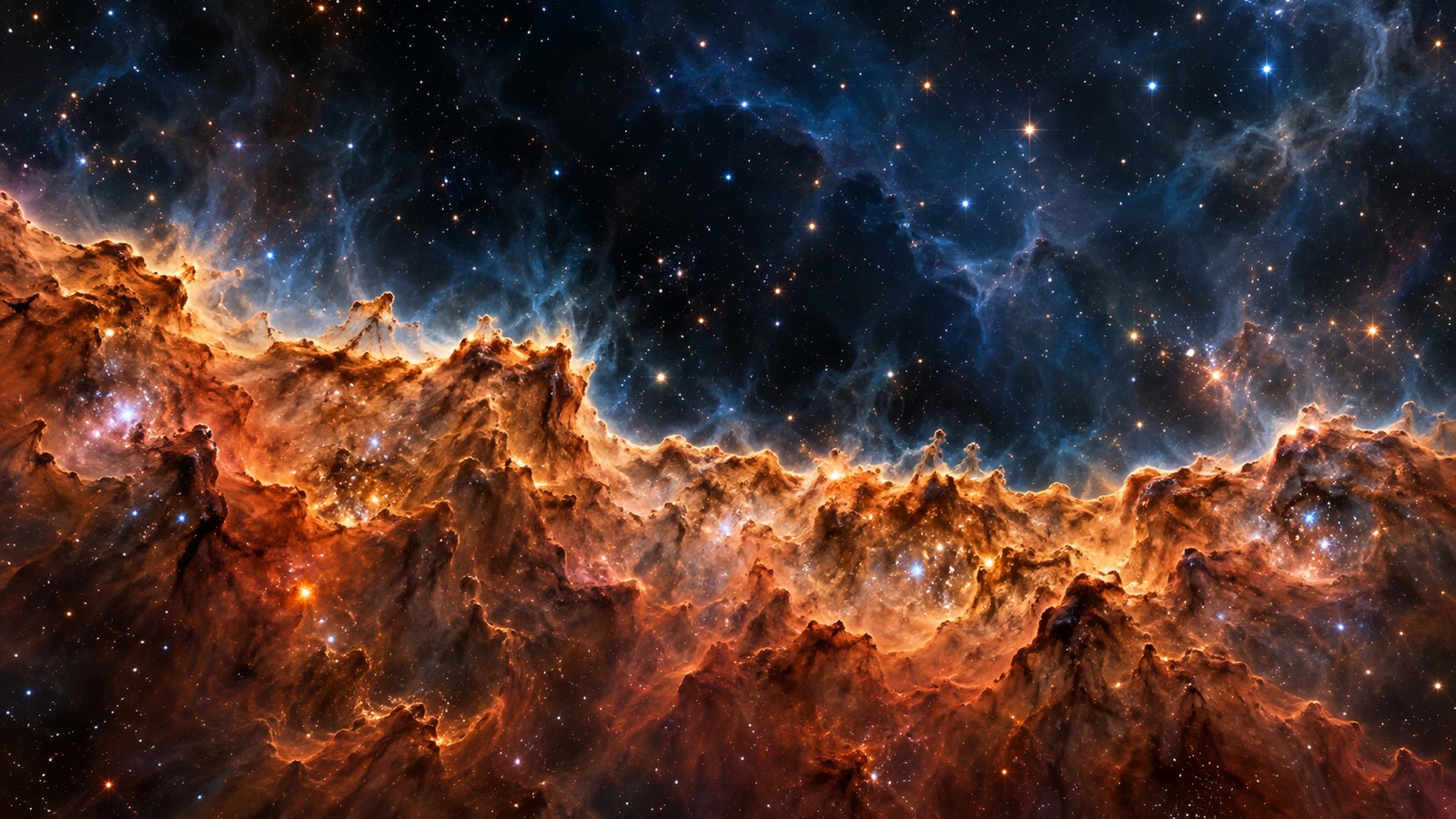
The Cosmic Cliffs entered public view among Webb’s first full-color science releases on July 12, 2022. The striking ridge is associated with NGC 3324 in the Carina-region environment, rather than being a panorama of the entire Carina Nebula. NASA’s original release explains that the mountain-like shapes belong to a star-forming gas and dust region. Their familiar resemblance makes the image accessible, while the correct identification replaces rock and ground with interstellar material.
The bright boundary faces a cavity shaped by energetic stars, some outside the selected frame. This is an important compositional clue: an image can show the consequence of stellar influence without including every source responsible for it. The apparent peaks and valleys mark an uneven interface between the cleared environment and denser cloud material. Viewers can follow that boundary across the frame, noticing protrusions, dark pockets, and luminous edges without assuming that each contour has the same depth or density.
Embedded young objects and outflow-related features add another layer of interest. They reveal that the cloud is not simply a passive screen illuminated from outside. Star formation and stellar influence interact within an irregular environment, although a visually bright knot alone is insufficient to identify a particular evolutionary stage. Researchers combine imaging with spectra and other measurements to investigate those sources. The scene is compelling because it contains several kinds of evidence at once, not because every shining point has the same origin.
A useful viewing habit is to separate the broad ridge from the smaller structures embedded in it. The ridge establishes the cloud boundary, while individual sources or filaments raise more local questions. Cropping tightly around one star may lose the context that explains the surrounding light; staying only with the panoramic impression may conceal the smaller evidence. Moving between those scales helps the image remain a scientific landscape. Its beauty is partly the visible relationship between an expansive environment and processes occurring within specific pockets.
The Southern Ring Changes the Story From Birth to Mass Loss
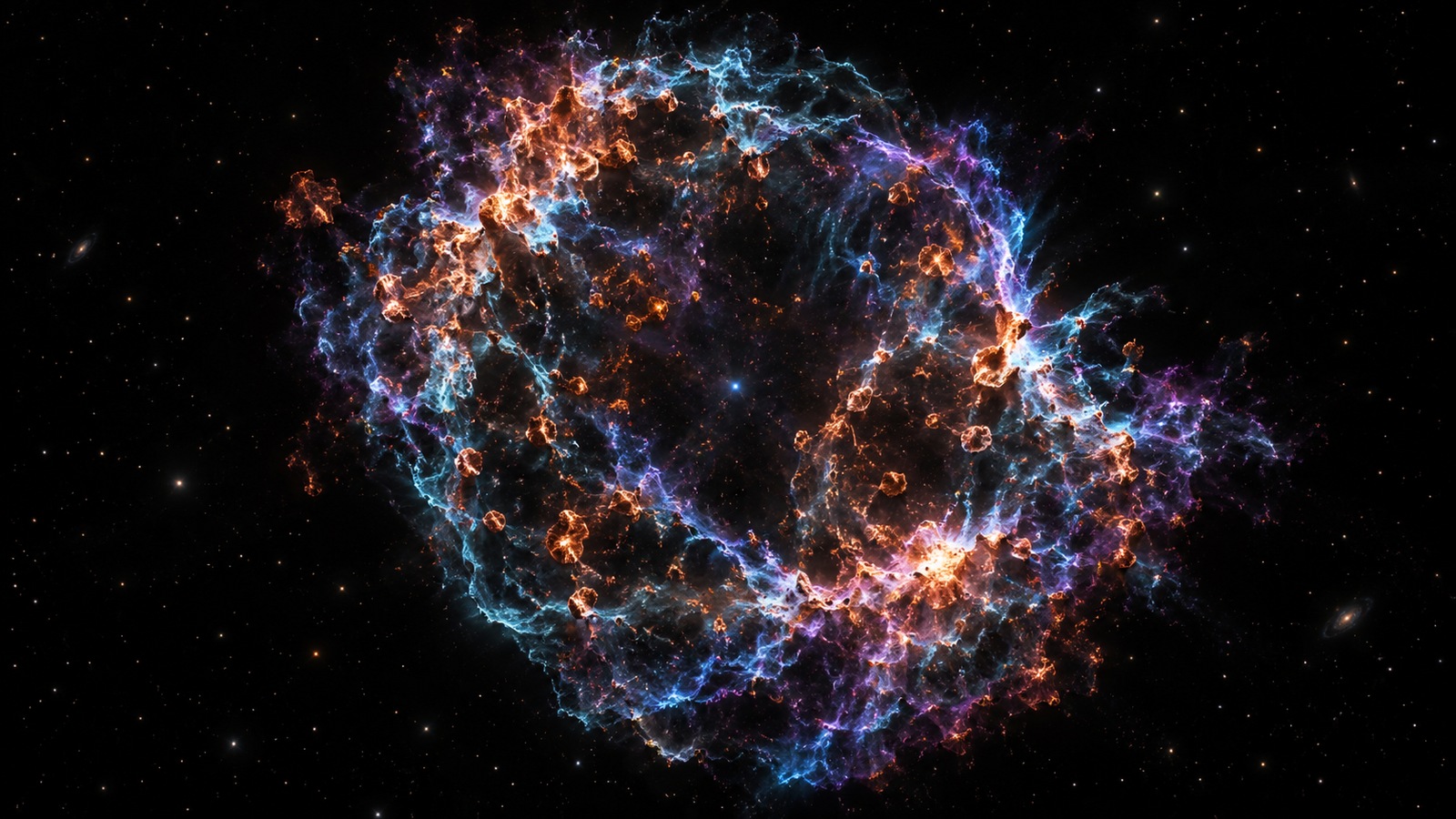
The Southern Ring Nebula, NGC 3132, appeared in Webb’s July 2022 public showcase as a different kind of nebula. It is a planetary nebula formed from material expelled during the late evolution of a lower-mass star, rather than a stellar nursery or a supernova remnant. The historical word planetary describes an early visual resemblance and does not mean the rings surround a newly forming planet. Correctly identifying this class prevents a beautiful circular shape from being folded into the wrong story about stellar birth or explosive death.
The near-infrared and mid-infrared views make a particularly useful pair because their emphasis on stellar sources and dusty material differs. NASA’s near-infrared image description identifies the less conspicuous source associated with the nebula’s expelled material and explains why the brighter central star can attract attention without being the main source. This is a reminder to distinguish apparent prominence from evolutionary responsibility. The brightest point in a processed image is not automatically the star whose history accounts for the surrounding cloud.
Rings and Spokes Preserve a Complicated History
Layered arcs and radial features in the Southern Ring invite questions about how material was released and reshaped. Stellar companions can influence the geometry of expelled gas, making a nebula more complicated than a solitary star surrounded by one smooth sphere. A December 2022 NASA research account described evidence that multiple stars helped shape the region. This later interpretation should be distinguished from the initial image’s immediate visual impact. Science can develop beyond a first release as researchers examine its structures in more detail.
These patterns are not a sequence of photographic rings produced by a camera lens. They belong to the physical distribution of gas and dust, although projection affects how their shapes are perceived. A bright arc may correspond to material at a different depth from an adjacent faint feature. The image provides the starting evidence, while modeling and spectroscopy help reconstruct the history. A convincing account has to match more than the overall symmetry of the published picture.
The Southern Ring is especially captivating because its apparently simple outline becomes complex under close inspection. What first looks like one illuminated shell contains layers, asymmetries, and relationships among central sources. That progression mirrors the work of interpretation itself: begin with the object class, identify the measured components, and then ask which mechanisms could create their arrangement. There is no need to assign a unique cause to every visible wrinkle. The unresolved details are part of the scientific interest rather than a defect in the portrait.
The Ring Nebula Makes a Familiar Oval Intricate
Webb’s images of the Ring Nebula, Messier 57, were released in August 2023. This famous object is another planetary nebula, but it is not the Southern Ring under an alternative name. Its detailed structure includes small dense features and surrounding arcs that different infrared views emphasize in different ways. ESA/Webb’s August 21 release explains the contribution of NIRCam and MIRI. Comparing this object with NGC 3132 shows variety within a single nebular class rather than treating every ring-shaped cloud as one interchangeable example.
A Ring Is a Projection of a Three-Dimensional Structure
The oval appearance of M57 encourages viewers to imagine a flat hoop, but the measured light comes from a structure extending through space. Different sightlines intersect different amounts of emitting material, affecting the contrast between the bright ring and its surroundings. Dense clumps and the outer features further complicate a smooth geometric picture. Researchers use images and physical modeling to connect that projection with the nebula’s spatial arrangement. A recognizable outline is useful for identification, but it should not replace the three-dimensional question.
Fine arcs can also invite interpretations involving interactions with a companion, because a star’s orbital relationships may affect the material it loses. Such interpretations depend on fitting the observations rather than simply finding a suggestive visual pattern. The research paper on Webb’s Ring Nebula imaging investigates the rings, globules, and arcs in that context. Keeping evidence and proposed mechanisms together allows a reader to appreciate the discoveries without turning an inference into a directly photographed orbital history.
The published NIRCam portrait resolves the filamentary ring and roughly 20,000 dense globules rich in molecular hydrogen. Open it alongside the official MIRI portrait, where the surrounding concentric arcs become particularly conspicuous. The small globules show that the shell is not a smooth, uniform wall: dense material survives within a more diffuse environment. The outer arcs add a record of how mass loss varied around the dying star. These linked image pages offer the actual comparison, including each instrument’s filter information, rather than asking the reader to imagine two unseen pictures.
The Orion Bar Turns a Boundary Into a Chemical Environment
The Orion Bar is a selected part of the much larger Orion Nebula, where radiation from massive stars meets denser cloud material. Webb’s NIRCam image released in June 2023 places that boundary beside other features of a young stellar environment. Its fascination lies in the fine layering across a transition rather than in a single grand silhouette. A narrow part of a familiar nebula becomes a setting for studying how radiation affects gas and molecules.
A specific discovery gives this chemistry a concrete scale. Webb spectra detected the methyl cation, CH3+, in the protoplanetary disk d203-506 within the Orion environment, the first detection of this molecule outside the solar system. NASA’s June 2023 account connects the detection with ultraviolet-driven chemistry around the young system. This is an ion involved in building more complicated carbon chemistry, not evidence of organisms. The spectrum supplies the identification; an attractive color in the wide-field image cannot identify CH3+ by itself. A selected nebular landscape thus contains measurable chemical processes occurring around an individual forming star.
Comparisons Work Best When Their Scope Is Clear
The Cosmic Cliffs and Orion Bar probe young-star environments, while the Southern Ring and M57 record the late evolution of lower-mass stars. Their common label nebula does not make their origins identical. Compare like measurements when possible, distinguish selected subregions from entire complexes, and retain the release dates that identify the observations being discussed. Those small habits make the images more informative. They also prevent the visual similarity of dust, rings, or luminous edges from erasing the different physical histories behind them.
The Captivating Detail Is Evidence With Context
Look back across the four scenes and the changes in scale become apparent. NGC 3324 presents a broad cloud edge, NGC 3132 draws attention to a mass-losing stellar system, M57 resolves a familiar ring into thousands of dense structures, and the Orion observations connect a larger radiation boundary with chemistry in a young disk. Each offers a different route from image to physical history. The comparison is most rewarding when a recognizable feature becomes a specific discovery, rather than when every scene receives the same description of infrared colors and hidden dust.
The selection remains personal rather than an objective ranking of cosmic beauty. Another viewer may prefer a different release or find the most compelling detail in a modest portion of the frame. What these images share is their capacity to reveal complexity behind a familiar nebular name. Returning to them with their wavelengths and object classes in mind provides more than a second aesthetic impression. It reveals why Webb’s infrared perspective can make well-known environments scientifically surprising without requiring the published picture to be a complete or literal view of everything present.