A Small Nebular Scene Became a Shared Cosmic Landmark
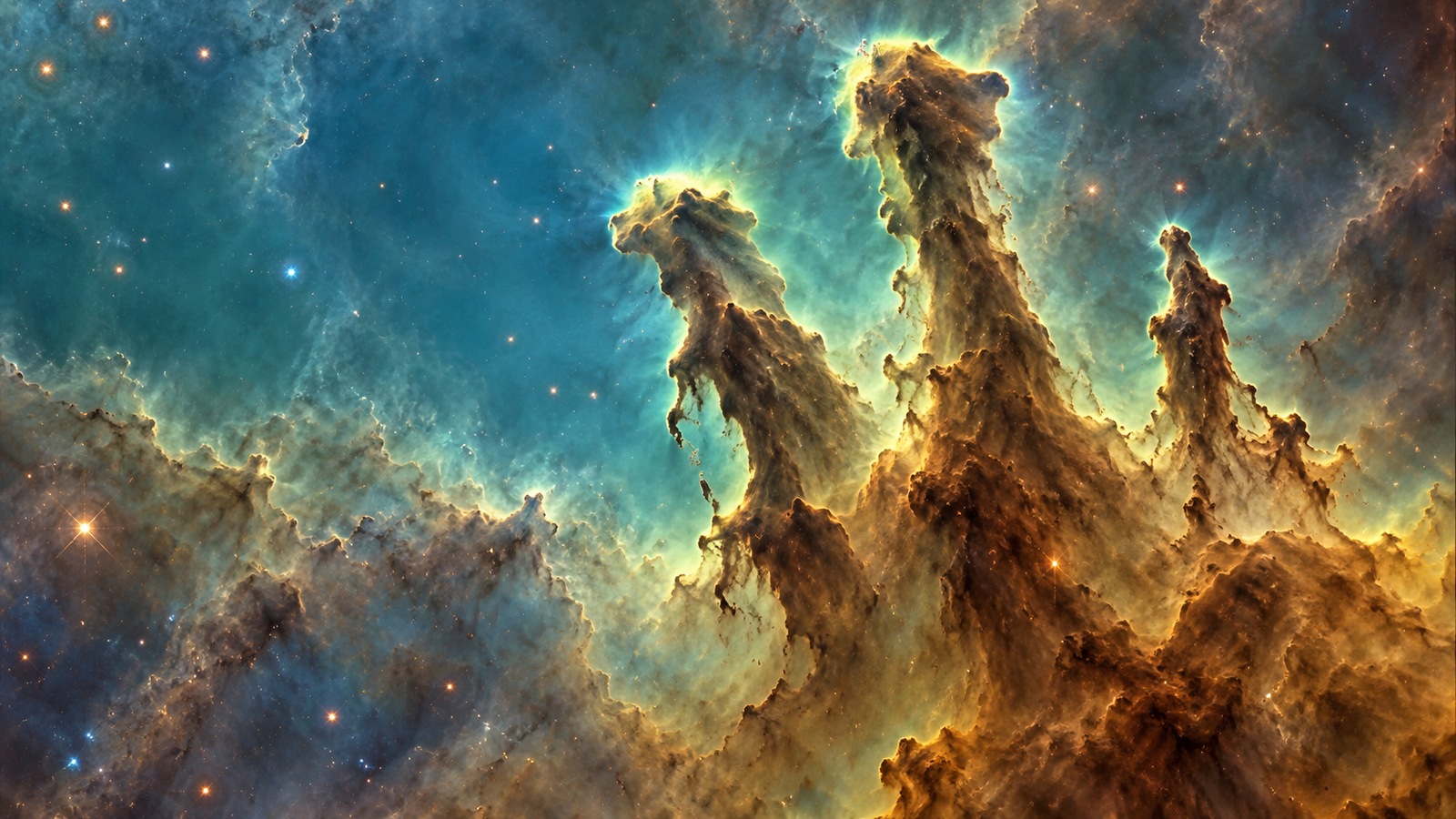
Many people recognize the Pillars of Creation before they know where the pillars are or what they contain. That familiarity began with Hubble’s celebrated 1995 image, which brought towering shapes inside the Eagle Nebula into public view with extraordinary detail. Their appeal came from an unusual combination: the forms looked almost architectural, the scale was difficult to imagine, and the science connected them with young stars. Yet their fame can obscure the physical story. These are cold gas and dust structures exposed to a changing stellar environment, rather than permanent monuments. Following the image from its first release through later observations explains how Hubble made the scene memorable and how that memorable scene continues to help people understand the strengths, limits, and evolving nature of astronomical pictures.
The Place Behind the Familiar Silhouette
The pillars occupy a small region within the Eagle Nebula, also known as Messier 16, in the direction of the constellation Serpens. They are not the entire nebula and do not stand on a planetary surface. Their apparent vertical arrangement belongs to the orientation chosen for a two-dimensional image of enormous interstellar structures. Gas and dust extend through a much larger surrounding environment, including stars whose energetic radiation affects the exposed cloud surfaces. Starting with that context makes the iconic view a selected window into a stellar nursery rather than a complete portrait of an isolated object. The largest column in the original view extends about four light-years from base to tip, according to the original image description. Light itself would take roughly four years to cross that distance. The pillar’s selected apparent shape is therefore only one face of an interstellar structure whose scale greatly exceeds a planetary landscape.
What the 1995 Observation Changed
Hubble did not discover that the Eagle Nebula existed, nor were the pillar-like forms wholly unknown before the famous photograph. Ground-based observations had already shown the region, but Hubble resolved details that gave the structures a new scientific and visual presence. Fine fingers, compact dense features, and luminous boundaries became much easier to investigate. The difference between knowing a formation is present and seeing its surfaces clearly is substantial: improved detail can change which questions an observer is able to ask.
The original observations were made using Hubble’s Wide Field and Planetary Camera 2. The instrument collected measurements through selected filters, providing information about gas emission rather than an ordinary snapshot produced by a handheld camera. Those measurements were combined into the published view. Understanding that construction does not diminish the result. It explains why the photograph could reveal particular physical components while presenting their overlapping distribution in a way that viewers could readily explore.
The release became a public landmark because its forms were legible without prior training. Three uneven columns, bright edges, and dark interiors offered an immediate sense of depth and tension. Someone unfamiliar with spectroscopy could still notice that the surfaces were intricate and that the surrounding light interacted with them. The image therefore invited a question before demanding technical vocabulary. Its fame grew from that invitation as much as from any single measurement, and the scientific explanation supplied meaning to a scene that was already visually arresting.
A Name That Carries a Physical Story
Creation describes the possibility of forming stars inside dense material, while the illuminated edges show that the same material is being removed. The columns have no rigid foundations or local upright direction like towers on Earth. Their dark interiors and irregular protrusions are parts of a cloud exposed to energetic radiation, with some pockets better protected than others. The name makes those competing processes memorable without promising a new star inside every finger. A successful stellar beginning depends on whether a dense pocket can continue gathering material before its surroundings are stripped away.
Why Dense Tips Can Leave Long Columns
Radiation from nearby massive stars acts more strongly on exposed, less protected material than on denser pockets. A dense head can shelter gas behind it, contributing to a long shadowed structure as the surrounding material changes. The result is a sculpted cloud boundary rather than a collection of solid objects inserted into open space. ESA/Hubble’s account of the revisited pillars describes the importance of those dense ends and the material they protect. This mechanism provides a physical reason for the silhouette instead of relying on its resemblance to terrestrial columns.
The 1995 observations gave this competition a distinctive small-scale target: evaporating gaseous globules, abbreviated EGGs. These dense pockets become exposed as radiation removes less protected material around them. Some contain developing stellar objects, making the cloud boundary a place to examine growth while the available reservoir changes. NASA’s original EGG announcement explains how the striking little fingers revealed that interaction. Their scientific value lies in connecting the appearance of the cloud with the conditions around a forming star, rather than assuming a towering silhouette is itself the birth process.
The Colors Separate Signals From Different Gas
The original Hubble palette combines selected gas-emission measurements rather than imitating a handheld color photograph. In the published mapping, sulfur, hydrogen and oxygen signals enter different display channels, revealing spatial differences among the emitting components. A bright edge beside a dark interior then becomes a physical contrast: exposed gas is radiating while denser dusty material blocks much of the visible view. The familiar colors help make those boundaries legible. Their meaning comes from the measured emission lines and the release’s filter mapping, rather than the assumption that a nearby eye would see the same saturation.
The image’s appeal and scientific use meet at that contrast. Viewers can follow an illuminated rim into small protrusions, compare it with the shadowed mass behind it, and identify where a later infrared observation might reveal concealed sources. Spectra supply more detailed temperature, composition and motion information, while the portrait locates structures worth investigating.
Keeping the original release alongside the picture provides the wavelength key without turning every viewing moment into a checklist. A color composite is a useful physical map when the displayed signals remain connected to their gas. The same key also makes a later image comparison meaningful when the observing bands have changed.
A Sharper Hubble Return Marked a New Era
Hubble revisited the region with the Wide Field Camera 3, obtaining observations in 2014 that were presented publicly in January 2015. NASA’s 2015 release compared the sharper, wider view with the original 1995 portrait. The distinction between observation date and release date matters when reconstructing that history. Calling it the 2015 image is understandable in public discussion, provided the underlying measurements are not mistakenly dated to a different observing campaign.
The new view let familiar shapes be examined with improved detail and alongside infrared measurements. It did not make the earlier image scientifically worthless or reveal an entirely different set of pillars. Instead, it showed how an enduring target could benefit from improved instruments and renewed questions. A comparison across releases should account for differences in filters, field of view, and processing before interpreting every visual change as physical evolution. Some differences belong to the observing method rather than to the gas itself.
Infrared Views Changed What Could Be Found
Dust blocks visible light effectively in parts of the pillars, so longer-wavelength observations help investigate material and stars obscured in the original optical portrait. Infrared light does not make every layer perfectly transparent, but it can alter which features dominate the image. A tower that looks dark in one view can become less opaque or reveal embedded objects in another. These comparisons connect the iconic silhouette with questions about what lies within it instead of treating the outline as the only scientifically meaningful feature.
Webb’s near-infrared Pillars image was released in October 2022, extending that investigation with a different observatory. Its view emphasizes many stellar sources and details associated with young objects. The NASA near-infrared image description provides the context for reading those features. The point is not that infrared is always superior to visible light. Each wavelength range supplies a different part of the evidence, and a useful comparison asks what physical component each observation makes accessible.
Webb’s mid-infrared view, released on October 28, 2022, gives dust a much more prominent role and shows fewer of the same obvious stellar points. ESA/Webb’s mid-infrared release explains that change in emphasis. A less star-filled image does not imply that the stars disappeared between releases. It reflects the response of a different instrument to a different wavelength range. The pair offers a practical lesson in why telescope images should be read through their measurements rather than compared only for visual spectacle.
Creation and Erosion Occupy the Same Scene
The pillars’ name emphasizes stellar origins, while the illuminated edges reveal an environment capable of removing material. Dense pockets can persist longer than exposed surroundings, and young stars can appear within some sheltered regions. These processes do not cancel one another. They show that star formation occurs inside a changing cloud rather than in a protected static container. A photograph captures one stage in that evolution, leaving models and additional observations to explore how long particular features may survive and how their surroundings influence them.
Three-Dimensional Tours Add an Interpreted View
A flat image cannot directly establish the depth of every surface or the true separation between projected features. Researchers use spectroscopy and other observational constraints to build three-dimensional interpretations. NASA’s 2024 Hubble and Webb visualization makes those inferred relationships easier to explore. It is useful precisely because it adds a modeled spatial view rather than pretending that the original photograph alone supplied a complete interior map.
A viewer should therefore ask what distinguishes the measured inputs from the constructed presentation. The apparent camera movement in a visualization is a rendering choice, and the spatial model carries assumptions and uncertainties. Those limitations are ordinary parts of scientific interpretation. They do not prevent a reconstruction from clarifying why a protruding finger or a pillar’s orientation matters. They establish how much confidence belongs to each level of the explanation and keep a convincing animation from being mistaken for an actual recorded voyage.
A Familiar Shape Became a Continuing Scientific Record
The 1995 portrait gave the public a recognizable scene and researchers a detailed view of exposed cloud structures. Dense tips, EGGs, bright surfaces and dark reservoirs linked the visual impression to star formation and photoevaporation. The subsequent Hubble revisit made those same structures available to sharper comparison. A familiar outline could therefore become a reference for new investigation instead of an image preserved only for its beauty.
Infrared observations extend that record into different material. Near-infrared views can expose some obscured stellar sources, while mid-infrared observations emphasize dusty structures that may look less star-filled. The differences make the pillars more interesting rather than replacing one supposedly correct portrait with another. Each view follows a component of an environment where dense gas, growing stars and energetic neighbors interact.
Hubble made the scene famous by resolving physical detail within an immediately memorable form. Its lasting power comes from the same relationship: enormous columns contain smaller pockets where stellar growth competes with the removal of gas. The pillars are temporary structures inside an evolving nursery. Their images let people follow that changing material story across decades of improved observations, keeping an iconic silhouette connected to the processes that shaped it.