
A Stellar Remnant Has More Than One Visible Story
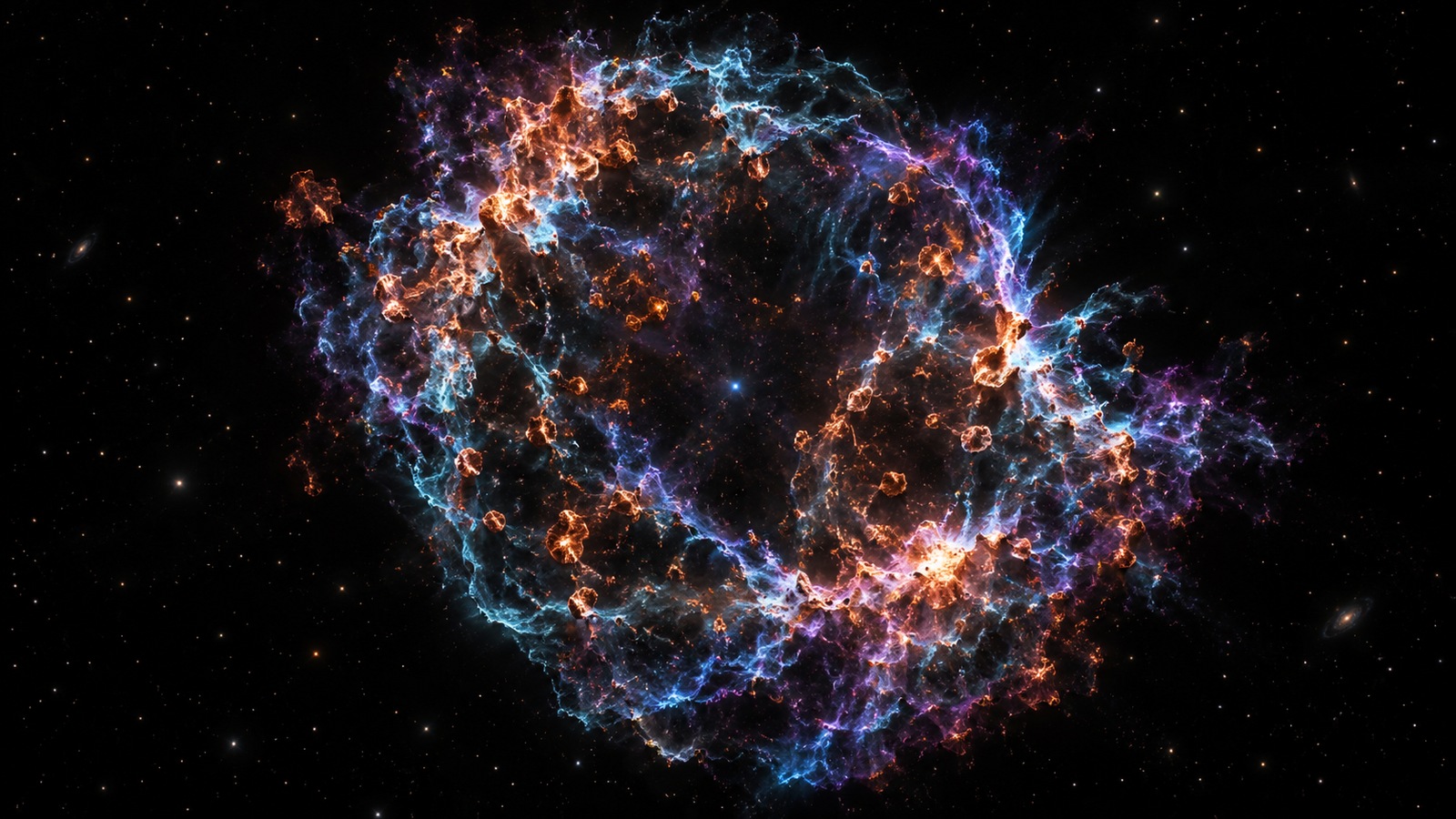
A supernova cloud can look like a delicate web of filaments in visible light and a turbulent shell or concentrated inner structure in X-rays. The difference reveals physical components that an optical portrait alone cannot fully describe. Chandra’s sharp X-ray observations let astronomers separate hot gas, energetic particles, and compact stellar sources within these complicated remnants. Cassiopeia A, Tycho’s remnant, the Crab Nebula, and the remains of Supernova 1987A each demonstrate a different part of that capability. Their published colors translate measurements outside human vision into a display we can inspect. Reading those displays carefully means asking which energies and instruments they represent, then connecting the shapes with spectra and changes over time. The reward is a view of stellar aftermath as an active physical environment rather than a decorative cloud left behind by one ancient flash.
What Makes a Remnant an X-Ray Source
A supernova sends rapidly moving material into its surroundings, generating shocks as the expanding debris encounters other gas. Those shocks can heat plasma to temperatures at which X-ray emission becomes important. The light is not simply the original explosion continuing to shine with unchanged intensity. It is evidence of ongoing interactions that convert motion into particle energy and radiation. A remnant remains physically active long after the supernova’s initial bright phase has faded, and its X-ray structure helps identify where that activity occurs.
Some X-rays also arise from energetic particles moving in magnetic fields. This nonthermal emission differs from radiation produced by a population of particles whose energies reflect a hot plasma temperature. A narrow bright rim might therefore signal efficient particle acceleration rather than merely mark the hottest concentration of ordinary gas. Spectra help distinguish the mechanisms, because line-rich plasma and a smoother high-energy continuum carry different clues. Interpreting a color picture without that distinction can turn separate physical processes into one vague claim that everything shown is extremely hot.
Chandra operates above Earth’s absorbing atmosphere, which prevents these X-rays from reaching ordinary ground-based astronomical detectors. Its mirrors use grazing-incidence geometry rather than reflecting high-energy photons like a conventional visible-light telescope. Sharp imaging allows researchers to locate small structures within a remnant and compare them with other observations. Spectral information then adds the energy distribution of the detected photons. Together, position and energy turn an X-ray image into a tool for investigating what produces each part of the scene.
Cassiopeia A Made First Light Scientifically Memorable
Cassiopeia A was the subject of Chandra’s official first-light image, released on August 26, 1999, following observations made that month. The detailed remnant showed an intricate distribution of debris and a compact source near its center. Chandra’s twentieth-anniversary account of that first light identifies the central object as a neutron star left by the explosion. The historical result illustrates why resolution matters: detecting a small source within a much brighter extended environment can change the interpretation of the entire remnant.
The central object and the surrounding cloud are different products of the stellar event. The neutron star is an extremely compact surviving core, while the remnant includes expelled material and gas affected by shocks. A bright knot in the shell is not another surviving stellar core simply because it appears compact in a display. Researchers separate such structures through their locations, spectra, and other properties. That separation lets one image contribute to several investigations without making every bright feature the same kind of source.
Element Maps Trace What the Explosion Dispersed
X-ray spectra contain lines associated with particular elements and ionization states, allowing researchers to investigate how heated ejecta are distributed. Cassiopeia A offers a richly structured environment for such work, with clumps rather than a uniformly mixed sphere. Element-sensitive images do not provide an ordinary photograph in which each atom has its own natural visible color. They are selected measurements mapped onto a display to reveal where particular signals occur. Temperature, ionization history, and absorption affect those signals, so interpreting a map requires a model as well as an attractive palette.
Tycho Connects a Historical Flash With a Different Explosion
The supernova observed in 1572 left the remnant commonly called Tycho. It belongs to the Type Ia category associated with a thermonuclear explosion of a white dwarf, which distinguishes its origin from the massive-star core collapse behind Cassiopeia A. Both events create expanding remnants, but their progenitors and material histories differ. Keeping the categories separate prevents a general statement about supernova clouds from implying that every one should contain the same compact object or identical elemental pattern.
Tycho’s X-ray image separates the heated ejecta from a sharper outer region associated with highly energetic particles. The Chandra account of its 2011 observations discusses structures used to investigate particle acceleration. The remnant therefore supplies evidence about more than the amount of hot gas present. Its rims and internal features help researchers test how shocks distribute energy among thermal particles, accelerated populations, and the evolving flow of material.
A viewer comparing Tycho with Cassiopeia A should resist interpreting the more rounded outline as a guarantee of uniform conditions. Ambient density, viewing direction, and the explosion’s own structure can all shape a remnant’s appearance. Spectra and motion measurements help determine which explanation fits a particular feature. The visually simple shell is an invitation to investigate asymmetry at smaller scales. A neat circular outline can coexist with complicated knots, varying shock conditions, and a substantial physical history that the outline alone does not disclose.
A Shock System Has More Than One Boundary
The forward shock travels into surrounding material, while a reverse shock propagates back through the expanding ejecta in the appropriate physical frame. The reverse shock can still move outward in an observer’s coordinates, so its name should not be understood as proof of an inward-moving ring in every photograph. Both boundaries affect which gas has been heated and can emit detectably. Separating their roles helps explain why ejecta, outer rims, and intervening regions need not share the same temperatures, spectra, or motions despite belonging to one remnant.
The Crab Adds a Pulsar-Powered Interior
The Crab Nebula is linked to the supernova recorded in 1054, but its high-energy interior is strongly shaped by a surviving pulsar. That rapidly rotating neutron star supplies a flow of energetic particles and electromagnetic energy. The surrounding pulsar wind nebula is therefore not explained solely as a shell of gas heated by a blast wave. Chandra reveals compact inner structures that connect the central source with the energized environment around it. This makes the Crab a useful contrast with images whose strongest emphasis is on an outer shocked shell.
A torus-like structure and jet-related features provide clues about how the pulsar channels energy into its surroundings. Their appearance depends on the physical flow and on the angle from which the system is viewed. They are not jets of ordinary fire or a miniature galaxy embedded in the nebula. Researchers use their morphology, spectra, and changing behavior to study the energetic particle population. The structures become most informative when they are treated as manifestations of the pulsar’s influence rather than as a pattern to be identified by resemblance alone.
Chandra’s 2017 multiwavelength Crab release combines this X-ray perspective with observations across other bands. The optical filaments, radio emission, infrared structures, and X-ray interior do not trace identical material or processes. Their differences show why a composite can communicate a more complete environment than one instrument view. They also demand careful labeling: a color assigned to Chandra data in one composite may represent another observatory’s measurements in a different release.
Repeated observations add time to the spatial picture. Inner structures can change in brightness or position, helping researchers investigate flows rather than relying on one frozen arrangement. The interval between frames and the methods used to align them matter for interpreting any apparent motion. An accelerated animation can make a process visually immediate without showing its real-time pace. Captions that explain dates and scaling preserve the usefulness of the movie and keep its compelling movement tied to the observations that support it.
Supernova 1987A Shows the Surroundings Answer Back
Supernova 1987A occurred in the Large Magellanic Cloud, where material lost before the explosion had already shaped the local environment. The expanding shock encountered a denser circumstellar ring, making the interaction a central part of the remnant’s observable development. Chandra began monitoring the system after its deployment in 1999. The resulting sequence demonstrates that a remnant’s appearance depends not only on what the star expelled during its explosion but also on the material waiting around it.
Chandra’s 2017 account of SN 1987A described the shock moving beyond the dense ring and the changing behavior of the X-ray emission. The ring should not be pictured as something that the 1987 explosion instantly created from nothing. Its earlier origin gives the later shock something structured to encounter. Following that interaction lets researchers investigate the progenitor’s mass-loss history as well as the remnant’s ongoing expansion, with new observations testing the evolving interpretation.
Millions of Degrees Make the X-Ray Physics Tangible
The Cassiopeia A anniversary sequence describes expanding gas at about twenty million degrees Fahrenheit, roughly eleven million degrees Celsius. That is far hotter than the visible surface of an ordinary star. At such temperatures, atoms have lost electrons and the gas is plasma; energetic electrons interacting with ions can produce X-rays. Chandra’s first-light retrospective connects that temperature scale with the remnant’s observed expansion rather than treating the colored shell as ordinary glowing smoke.
A shock produces this heating by converting organized bulk motion into disordered particle motion. Gas traveling together before the shock can emerge compressed and strongly energized. A dense clump and a diffuse neighboring region need not respond identically, which helps explain why the shell contains bright knots instead of one uniformly luminous surface. Spectral lines then supply information about which ions are present and the conditions under which they emit. The measured temperature describes a plasma population; it is not simply the temperature of every solid dust grain occupying the same line of sight.
This thermal picture also explains why X-ray brightness is not a direct weighing scale. A dense heated region can emit strongly, while material that has not yet encountered the appropriate shock may be comparatively inconspicuous. Observers combine spectra with spatial structure to estimate how much emitting material a model requires. Comparing infrared observations adds a view of cooler dust, so the two instruments can examine different products of the same explosion. The missing signal in one band can therefore be part of the physical story rather than proof that the region is empty.
A Rapidly Spinning Core Supplies Another Energy Source
The Crab’s central pulsar rotates approximately thirty times each second. Chandra’s Crab fact sheet links that rapid rotation with the power delivered to the surrounding nebula. Rotational energy is gradually lost as the pulsar drives energetic particles and electromagnetic fields outward. The nebula’s luminous inner structures thus depend on an operating central engine, a different situation from a remnant dominated by shock-heated ejecta. The compact core and the extended cloud are physically connected even though they occupy radically different scales.
A pulse every roughly one-thirtieth of a second is not a fresh supernova repeating at that rate. The beam sweeps through the observer’s direction as the neutron star rotates, while its wind continuously affects the surrounding environment. This distinction makes the Crab especially useful beside Tycho: both began with supernovae, but their subsequent energy supplies differ. Follow the X-ray ring and jet in the Crab, then compare Tycho’s outer rim, and the apparently similar label supernova remnant separates into different mechanisms. Understanding which process supplies the energy gives those shapes a meaning beyond their resemblance to rings or streaks.
One Compact Key for the Published Images
For any of these releases, check which colors represent Chandra X-rays and which belong to another observatory, then read the observing dates if a sequence shows change. Cassiopeia A foregrounds hot ejecta and a compact remnant; Tycho highlights thermonuclear debris and accelerated particles; the Crab shows pulsar power; SN 1987A traces a shock encountering older circumstellar material. Those four physical distinctions are the main guide to the gallery. The palette helps separate measured signals, but the remnant’s history explains why the signals exist and why the selected images reveal different kinds of aftermath.


