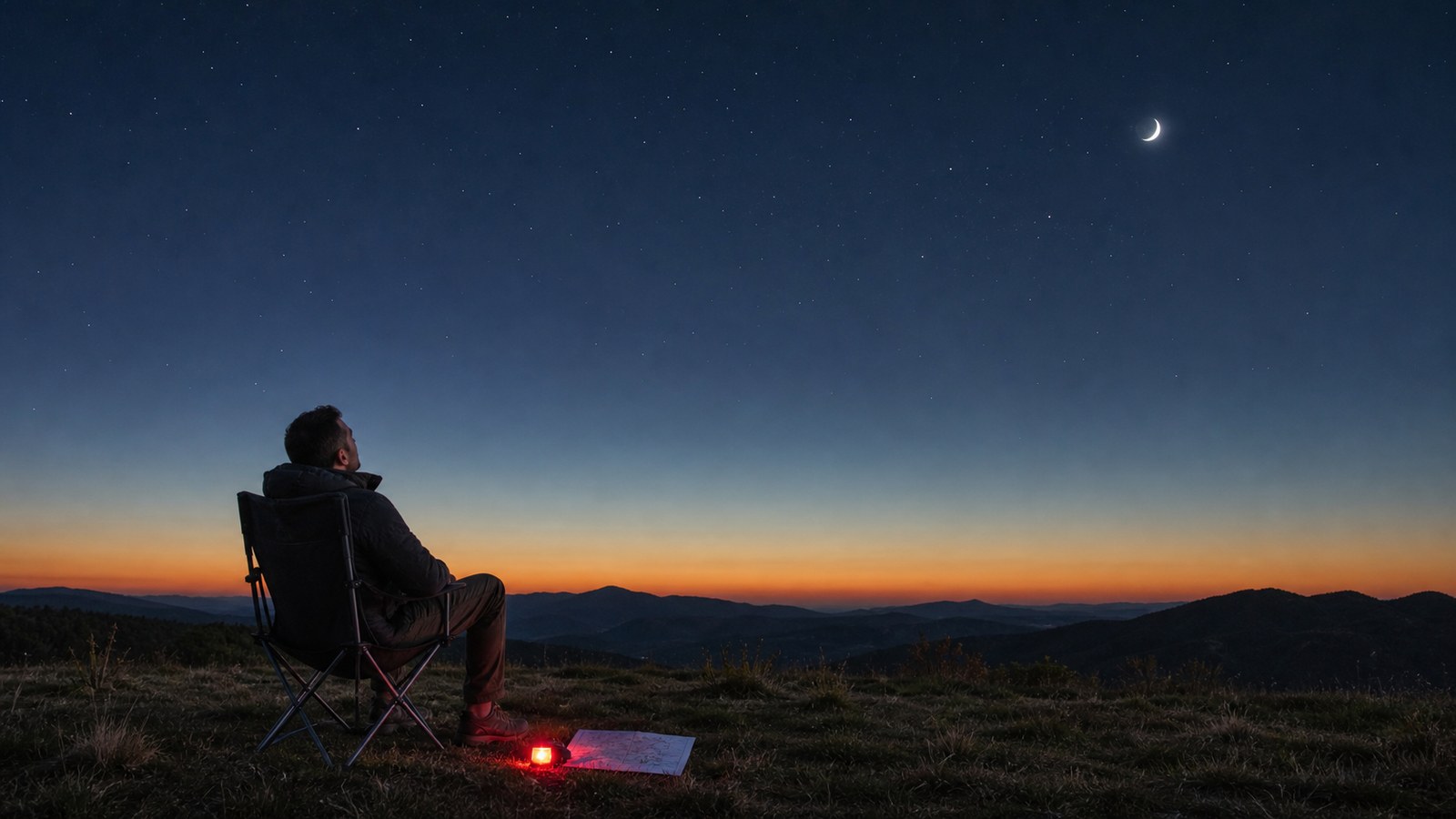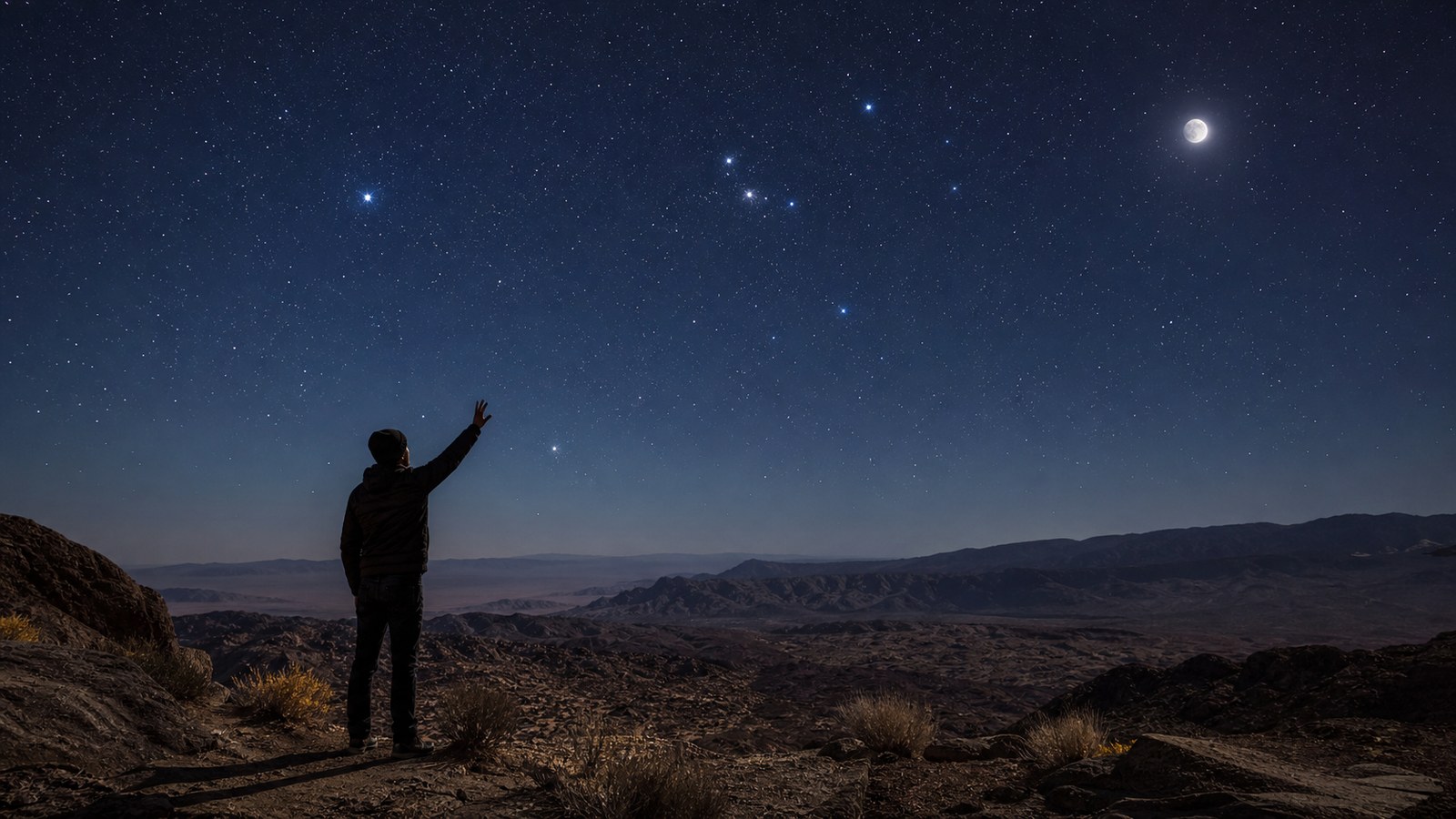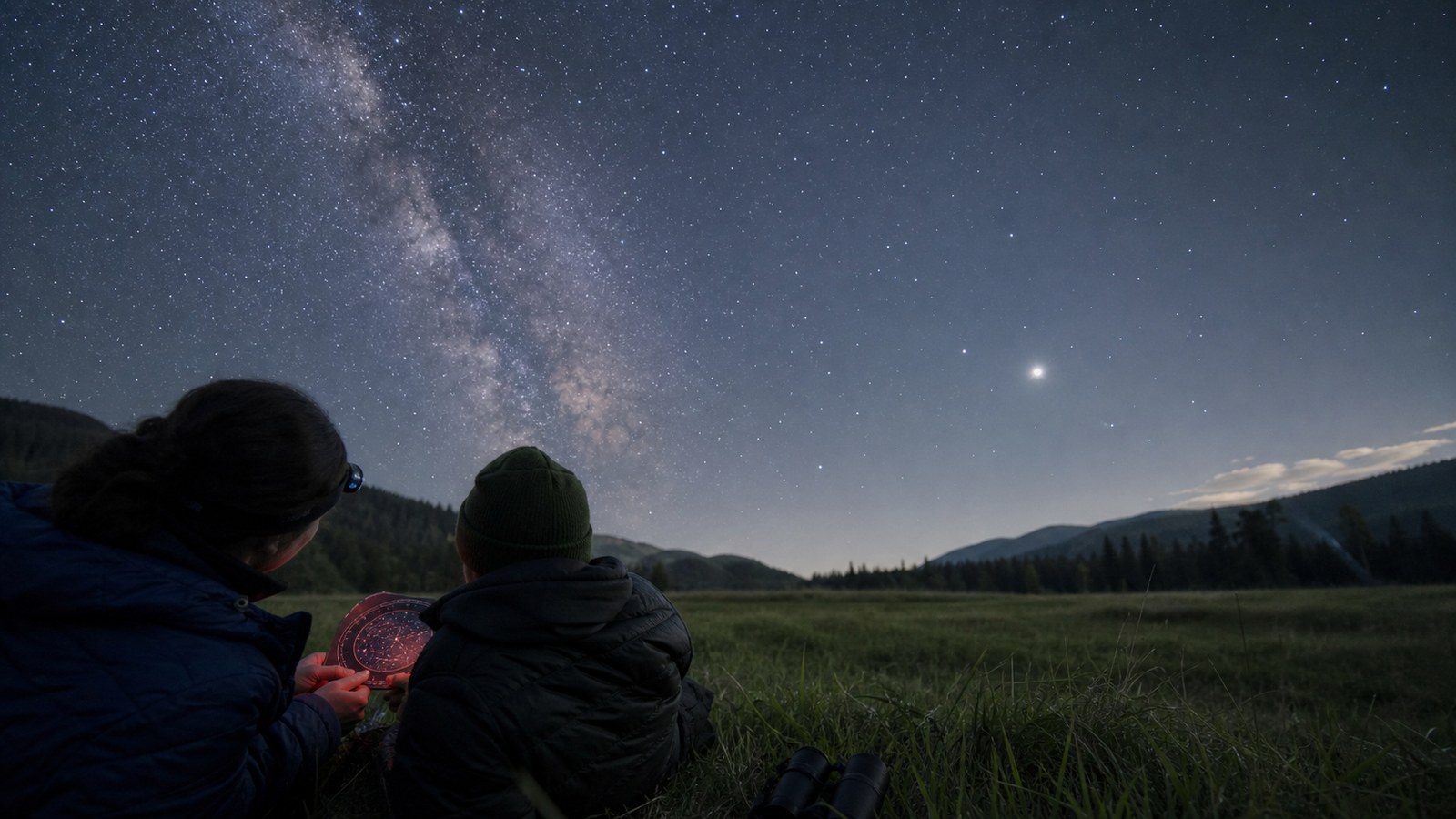
Stargazing becomes much easier once the sky is treated as a moving system rather than a poster of fixed constellations. Earth turns, Earth orbits, the Moon brightens and fades, weather changes transparency, and nearby lights alter contrast. Understanding those interacting conditions helps a beginner make sensible choices before buying equipment or traveling far from home.
Why the Sky Never Repeats Exactly
Earth's rotation moves the sky westward during the night, while Earth's orbit changes which constellations occupy the evening sky through the year. Instead of relying on expectation, use the scene itself as feedback. A star rises about four minutes earlier on successive nights, accumulating into a major seasonal shift. Use a planisphere or sky app set to the correct time and location, then compare it with the real horizon. Screenshots saved weeks earlier can mislead because the same pattern may no longer be above the horizon at that hour. The most useful response is to observe the result, note the conditions, and adjust one variable at a time. Over time, those small checks become automatic and free attention for finer detail.
Use a planisphere or sky app set to the correct time and location, then compare it with the real horizon. Real conditions rarely isolate one factor, so context must remain visible. Screenshots saved weeks earlier can mislead because the same pattern may no longer be above the horizon at that hour. Earth's rotation moves the sky westward during the night, while Earth's orbit changes which constellations occupy the evening sky through the year. A star rises about four minutes earlier on successive nights, accumulating into a major seasonal shift. The most useful response is to observe the result, note the conditions, and adjust one variable at a time. When uncertainty remains, choose the more conservative interpretation and gather another observation.
Reading Weather Beyond Cloud Percentage
Transparency describes how much faint light reaches you, whereas seeing describes how steadily the atmosphere holds an image. Long-term skill develops by noticing this pattern repeatedly. Haze and humidity scatter urban light even under nominally clear skies; turbulent air makes planets and stars quiver. Choose transparent nights for galaxies and the Milky Way, and steady nights for detailed planetary or lunar viewing. A forecast labeled clear does not guarantee a dark or crisp sky, especially near smoke, dust, or city glow. The most useful response is to observe the result, note the conditions, and adjust one variable at a time. The same reasoning can then be applied to more difficult targets or environments.
Choose transparent nights for galaxies and the Milky Way, and steady nights for detailed planetary or lunar viewing. The underlying physics also explains a common surprise. A forecast labeled clear does not guarantee a dark or crisp sky, especially near smoke, dust, or city glow. Transparency describes how much faint light reaches you, whereas seeing describes how steadily the atmosphere holds an image. Haze and humidity scatter urban light even under nominally clear skies; turbulent air makes planets and stars quiver. The most useful response is to observe the result, note the conditions, and adjust one variable at a time. The goal is a repeatable result, not a single lucky success.
Darkness, Moonlight, and Location
A bright Moon can erase faint deep-sky contrast while simultaneously becoming an excellent observing target itself. At night, small operational choices can produce large differences. Artificial skyglow brightens the background, reducing the difference between a faint object and its surroundings. Match the target to conditions: study lunar terrain during bright phases and save dim nebulae for moonless windows. Driving farther is not always productive when clouds, wind, fatigue, or an obstructed site outweigh the darkness gained. The most useful response is to observe the result, note the conditions, and adjust one variable at a time. Keep the observation tied to time, direction, and conditions so it can be compared later.
Match the target to conditions: study lunar terrain during bright phases and save dim nebulae for moonless windows. Seen as a workflow problem, the solution becomes more manageable. Driving farther is not always productive when clouds, wind, fatigue, or an obstructed site outweigh the darkness gained. A bright Moon can erase faint deep-sky contrast while simultaneously becoming an excellent observing target itself. Artificial skyglow brightens the background, reducing the difference between a faint object and its surroundings. The most useful response is to observe the result, note the conditions, and adjust one variable at a time. This approach preserves both accuracy and the enjoyment of discovery.
What Eyes, Binoculars, and Telescopes Do Differently
Unaided eyes show large patterns, binoculars gather more light across a wide field, and telescopes trade field width for magnification and aperture. This is where technique matters more than expensive equipment. Aperture controls light collection and potential resolution, but stability, optical quality, and atmospheric conditions limit usable detail. Start naked-eye, add 7×50 or 10×50 binoculars, and delay a telescope purchase until preferred targets are clear. High advertised magnification is usually a poor buying criterion because empty magnification enlarges blur without revealing detail. The most useful response is to observe the result, note the conditions, and adjust one variable at a time. That record makes the lesson transferable instead of leaving it as a one-night impression.
Start naked-eye, add 7×50 or 10×50 binoculars, and delay a telescope purchase until preferred targets are clear. For an observer, the consequence is immediate. High advertised magnification is usually a poor buying criterion because empty magnification enlarges blur without revealing detail. Unaided eyes show large patterns, binoculars gather more light across a wide field, and telescopes trade field width for magnification and aperture. Aperture controls light collection and potential resolution, but stability, optical quality, and atmospheric conditions limit usable detail. The most useful response is to observe the result, note the conditions, and adjust one variable at a time. Over time, those small checks become automatic and free attention for finer detail.
Finding Objects Without Frustration
Successful navigation begins with bright reference stars and proceeds through measured steps rather than visual guessing. The distinction matters because similar-looking outcomes can have different causes. Charts use angular separation, orientation, and brightness; the eyepiece may rotate or reverse the view depending on the instrument. Confirm the naked-eye anchor, use the lowest magnification, and compare distinctive triangles or curves along the route. Jumping directly to high power narrows the field and makes an otherwise easy target surprisingly difficult to acquire. The most useful response is to observe the result, note the conditions, and adjust one variable at a time. A second attempt under changed conditions will reveal whether the first result was typical.
Confirm the naked-eye anchor, use the lowest magnification, and compare distinctive triangles or curves along the route. The effect may be subtle at first, yet it becomes obvious across several sessions. Jumping directly to high power narrows the field and makes an otherwise easy target surprisingly difficult to acquire. Successful navigation begins with bright reference stars and proceeds through measured steps rather than visual guessing. Charts use angular separation, orientation, and brightness; the eyepiece may rotate or reverse the view depending on the instrument. The most useful response is to observe the result, note the conditions, and adjust one variable at a time. The same reasoning can then be applied to more difficult targets or environments.
A Learning Cycle That Actually Sticks
Observation skill grows when prediction, viewing, notation, and later comparison are repeated as one cycle. Real conditions rarely isolate one factor, so context must remain visible. The brain becomes better at extracting weak contrast after it learns which subtle patterns are meaningful. Set one question for each session, such as whether Jupiter's moons changed position or where the terminator crosses the Moon. Passively touring objects can feel impressive but leaves fewer durable visual memories than focused, repeated examination. The most useful response is to observe the result, note the conditions, and adjust one variable at a time. When uncertainty remains, choose the more conservative interpretation and gather another observation.
Set one question for each session, such as whether Jupiter's moons changed position or where the terminator crosses the Moon. The practical importance of this point appears in the field. Passively touring objects can feel impressive but leaves fewer durable visual memories than focused, repeated examination. Observation skill grows when prediction, viewing, notation, and later comparison are repeated as one cycle. The brain becomes better at extracting weak contrast after it learns which subtle patterns are meaningful. The most useful response is to observe the result, note the conditions, and adjust one variable at a time. Keep the observation tied to time, direction, and conditions so it can be compared later.
Haze and humidity scatter urban light even under nominally clear skies; turbulent air makes planets and stars quiver. This relationship becomes easier to understand when the variables are separated. Choose transparent nights for galaxies and the Milky Way, and steady nights for detailed planetary or lunar viewing. A forecast labeled clear does not guarantee a dark or crisp sky, especially near smoke, dust, or city glow. Transparency describes how much faint light reaches you, whereas seeing describes how steadily the atmosphere holds an image. The most useful response is to observe the result, note the conditions, and adjust one variable at a time. When uncertainty remains, choose the more conservative interpretation and gather another observation.
Artificial skyglow brightens the background, reducing the difference between a faint object and its surroundings. The result is not merely aesthetic; it changes what information can be perceived. Match the target to conditions: study lunar terrain during bright phases and save dim nebulae for moonless windows. Driving farther is not always productive when clouds, wind, fatigue, or an obstructed site outweigh the darkness gained. A bright Moon can erase faint deep-sky contrast while simultaneously becoming an excellent observing target itself. The most useful response is to observe the result, note the conditions, and adjust one variable at a time. The goal is a repeatable result, not a single lucky success.
Charts use angular separation, orientation, and brightness; the eyepiece may rotate or reverse the view depending on the instrument. Instead of relying on expectation, use the scene itself as feedback. Confirm the naked-eye anchor, use the lowest magnification, and compare distinctive triangles or curves along the route. Jumping directly to high power narrows the field and makes an otherwise easy target surprisingly difficult to acquire. Successful navigation begins with bright reference stars and proceeds through measured steps rather than visual guessing. The most useful response is to observe the result, note the conditions, and adjust one variable at a time. Over time, those small checks become automatic and free attention for finer detail.
A Practical Next Session
The ideal beginning setup is a method, not a shopping list. Learn the sky's motion, select targets that fit the Moon and weather, use the widest and simplest view first, and preserve observations in a notebook. Equipment becomes far more useful once it answers questions you already know how to ask.