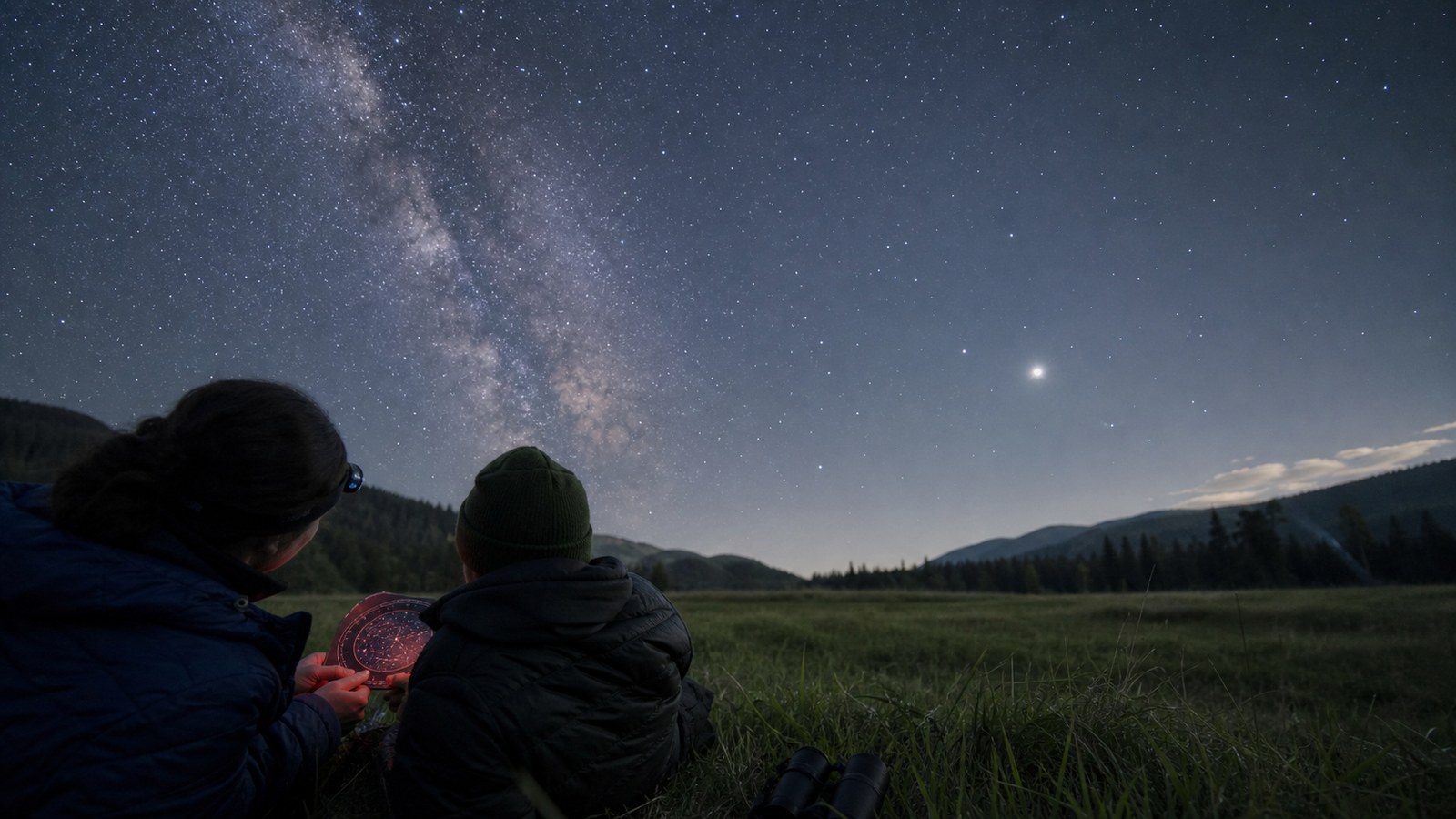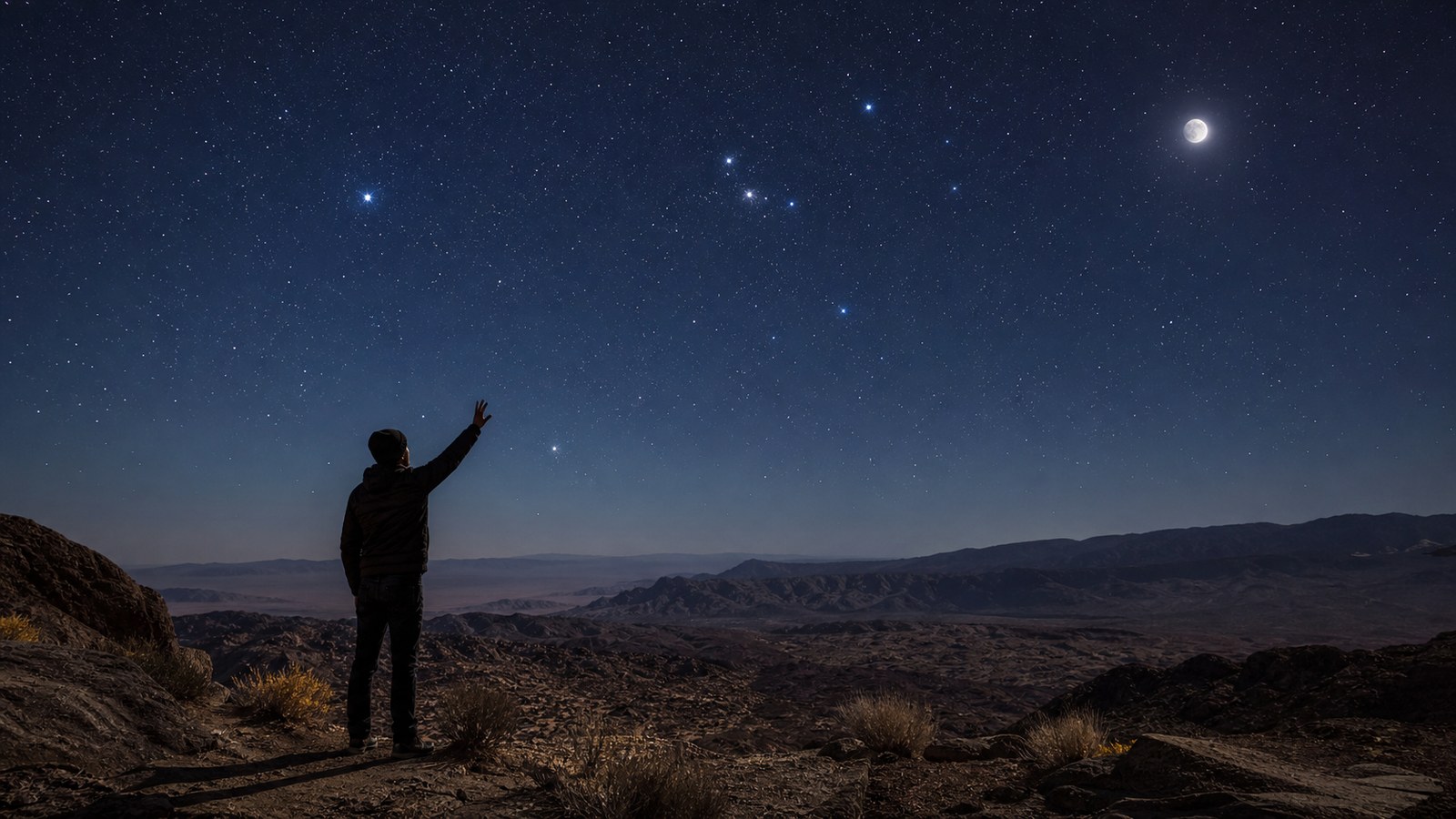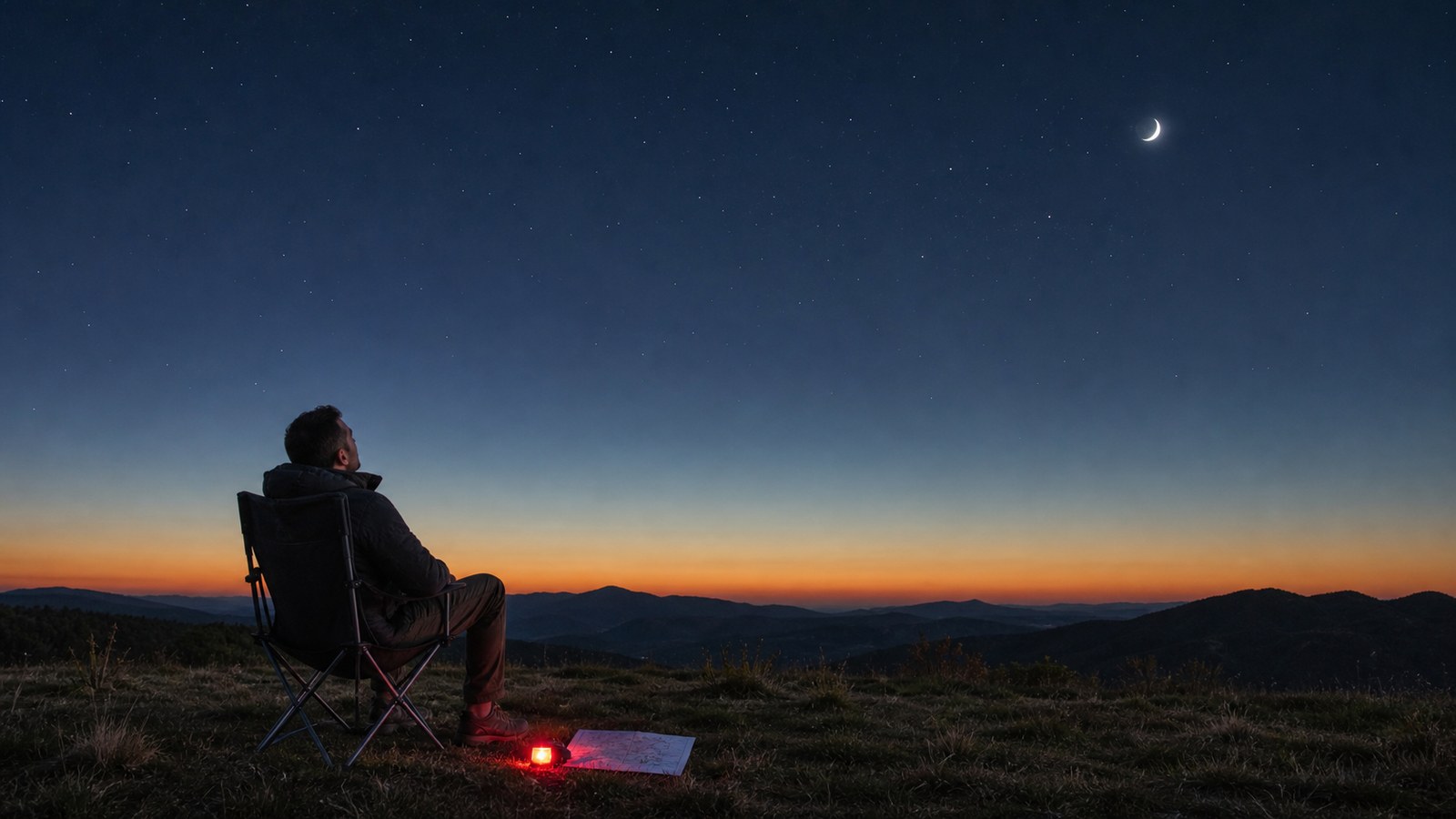
A useful first evening under the stars is not a race to identify everything overhead. It is a controlled introduction to darkness, direction, scale, and patient looking. With a comfortable location and a few deliberate habits, the sky quickly changes from an undifferentiated scatter of light into a place you can navigate.
Prepare Before Twilight
Choose a legal, stable observing spot with a broad view and check cloud cover before leaving. Instead of relying on expectation, use the scene itself as feedback. Arriving in daylight reveals trip hazards, stray sprinklers, traffic patterns, and blocked horizons that darkness conceals. Pack a chair, a warm layer, water, and a dim red light so physical discomfort does not end the session. Avoid treating an isolated dark location as automatically safe; access, weather, and personal security matter more than darkness. The most useful response is to observe the result, note the conditions, and adjust one variable at a time. Over time, those small checks become automatic and free attention for finer detail.
Pack a chair, a warm layer, water, and a dim red light so physical discomfort does not end the session. Real conditions rarely isolate one factor, so context must remain visible. Avoid treating an isolated dark location as automatically safe; access, weather, and personal security matter more than darkness. Choose a legal, stable observing spot with a broad view and check cloud cover before leaving. Arriving in daylight reveals trip hazards, stray sprinklers, traffic patterns, and blocked horizons that darkness conceals. The most useful response is to observe the result, note the conditions, and adjust one variable at a time. When uncertainty remains, choose the more conservative interpretation and gather another observation.
Let Your Eyes Change Gears
Human night vision improves gradually after bright light is removed, with useful gains continuing for roughly twenty to thirty minutes. Long-term skill develops by noticing this pattern repeatedly. Rod cells become more influential in dim conditions, while direct central vision remains less sensitive to faint objects. Keep phone brightness at minimum, use a red screen filter, and cover unexpected white lights quickly. One glance at a bright headlamp can erase much of the faint detail you spent time learning to see. The most useful response is to observe the result, note the conditions, and adjust one variable at a time. The same reasoning can then be applied to more difficult targets or environments.
Keep phone brightness at minimum, use a red screen filter, and cover unexpected white lights quickly. The underlying physics also explains a common surprise. One glance at a bright headlamp can erase much of the faint detail you spent time learning to see. Human night vision improves gradually after bright light is removed, with useful gains continuing for roughly twenty to thirty minutes. Rod cells become more influential in dim conditions, while direct central vision remains less sensitive to faint objects. The most useful response is to observe the result, note the conditions, and adjust one variable at a time. The goal is a repeatable result, not a single lucky success.
Build a Directional Framework
Cardinal directions and the height of objects above the horizon provide a repeatable map even when constellation names are unfamiliar. At night, small operational choices can produce large differences. An outstretched fist spans about ten degrees at arm's length, turning the hand into a rough angular ruler. Locate north, identify the clearest horizon, and describe every target by direction and altitude. Do not rely on an app alone; learning where you are facing prevents the screen from becoming a substitute for the sky. The most useful response is to observe the result, note the conditions, and adjust one variable at a time. Keep the observation tied to time, direction, and conditions so it can be compared later.
Locate north, identify the clearest horizon, and describe every target by direction and altitude. Seen as a workflow problem, the solution becomes more manageable. Do not rely on an app alone; learning where you are facing prevents the screen from becoming a substitute for the sky. Cardinal directions and the height of objects above the horizon provide a repeatable map even when constellation names are unfamiliar. An outstretched fist spans about ten degrees at arm's length, turning the hand into a rough angular ruler. The most useful response is to observe the result, note the conditions, and adjust one variable at a time. This approach preserves both accuracy and the enjoyment of discovery.
Begin With the Moon and Planets
The Moon, Venus, Jupiter, Mars, and Saturn are forgiving targets because they remain visible through moderate urban glow. This is where technique matters more than expensive equipment. Planets generally follow the ecliptic, the same broad path used by the Sun and Moon across the sky. Notice the Moon's phase, compare planetary colors, and watch whether a bright point twinkles strongly or shines steadily. A brilliant object near the horizon may shimmer because its light crosses more atmosphere, so twinkling alone is not a perfect test. The most useful response is to observe the result, note the conditions, and adjust one variable at a time. That record makes the lesson transferable instead of leaving it as a one-night impression.
Notice the Moon's phase, compare planetary colors, and watch whether a bright point twinkles strongly or shines steadily. For an observer, the consequence is immediate. A brilliant object near the horizon may shimmer because its light crosses more atmosphere, so twinkling alone is not a perfect test. The Moon, Venus, Jupiter, Mars, and Saturn are forgiving targets because they remain visible through moderate urban glow. Planets generally follow the ecliptic, the same broad path used by the Sun and Moon across the sky. The most useful response is to observe the result, note the conditions, and adjust one variable at a time. Over time, those small checks become automatic and free attention for finer detail.
Use One Star Pattern as an Anchor
A recognizable pattern such as the Big Dipper, Orion, or the Summer Triangle can unlock neighboring parts of the sky. The distinction matters because similar-looking outcomes can have different causes. Star-hopping works by extending lines and measuring relative distances from a pattern that is already confirmed. Learn one anchor thoroughly, then use it to find a second object instead of collecting disconnected names. Memorizing a chart without matching scale and orientation often causes beginners to choose the wrong bright stars. The most useful response is to observe the result, note the conditions, and adjust one variable at a time. A second attempt under changed conditions will reveal whether the first result was typical.
Learn one anchor thoroughly, then use it to find a second object instead of collecting disconnected names. The effect may be subtle at first, yet it becomes obvious across several sessions. Memorizing a chart without matching scale and orientation often causes beginners to choose the wrong bright stars. A recognizable pattern such as the Big Dipper, Orion, or the Summer Triangle can unlock neighboring parts of the sky. Star-hopping works by extending lines and measuring relative distances from a pattern that is already confirmed. The most useful response is to observe the result, note the conditions, and adjust one variable at a time. The same reasoning can then be applied to more difficult targets or environments.
Finish With an Observer's Record
A short written record turns a pleasant view into evidence of changing skill, weather, and seasonal motion. Real conditions rarely isolate one factor, so context must remain visible. Notes expose which details were genuinely seen rather than added later from memory or an app description. Record time, location, cloud cover, Moon phase, targets, and one visual detail that surprised you. Do not judge a session by the number of objects logged; a careful observation of one target can teach more than a rushed tour. The most useful response is to observe the result, note the conditions, and adjust one variable at a time. When uncertainty remains, choose the more conservative interpretation and gather another observation.
Record time, location, cloud cover, Moon phase, targets, and one visual detail that surprised you. The practical importance of this point appears in the field. Do not judge a session by the number of objects logged; a careful observation of one target can teach more than a rushed tour. A short written record turns a pleasant view into evidence of changing skill, weather, and seasonal motion. Notes expose which details were genuinely seen rather than added later from memory or an app description. The most useful response is to observe the result, note the conditions, and adjust one variable at a time. Keep the observation tied to time, direction, and conditions so it can be compared later.
Rod cells become more influential in dim conditions, while direct central vision remains less sensitive to faint objects. This is where technique matters more than expensive equipment. Keep phone brightness at minimum, use a red screen filter, and cover unexpected white lights quickly. One glance at a bright headlamp can erase much of the faint detail you spent time learning to see. Human night vision improves gradually after bright light is removed, with useful gains continuing for roughly twenty to thirty minutes. The most useful response is to observe the result, note the conditions, and adjust one variable at a time. That record makes the lesson transferable instead of leaving it as a one-night impression.
An outstretched fist spans about ten degrees at arm's length, turning the hand into a rough angular ruler. A careful observer can turn this limitation into a diagnostic tool. Locate north, identify the clearest horizon, and describe every target by direction and altitude. Do not rely on an app alone; learning where you are facing prevents the screen from becoming a substitute for the sky. Cardinal directions and the height of objects above the horizon provide a repeatable map even when constellation names are unfamiliar. The most useful response is to observe the result, note the conditions, and adjust one variable at a time. A second attempt under changed conditions will reveal whether the first result was typical.
An outstretched fist spans about ten degrees at arm's length, turning the hand into a rough angular ruler. A careful observer can turn this limitation into a diagnostic tool. Locate north, identify the clearest horizon, and describe every target by direction and altitude. Do not rely on an app alone; learning where you are facing prevents the screen from becoming a substitute for the sky. Cardinal directions and the height of objects above the horizon provide a repeatable map even when constellation names are unfamiliar. The most useful response is to observe the result, note the conditions, and adjust one variable at a time. A second attempt under changed conditions will reveal whether the first result was typical.
A Practical Next Session
End the first session while curiosity is still high. The most valuable result is not a completed checklist but a dependable routine: arrive safely, protect night vision, establish direction, study a few bright targets, and write down what changed. Repeating that routine under different Moon phases and seasons will build genuine familiarity faster than trying to master the entire sky at once.