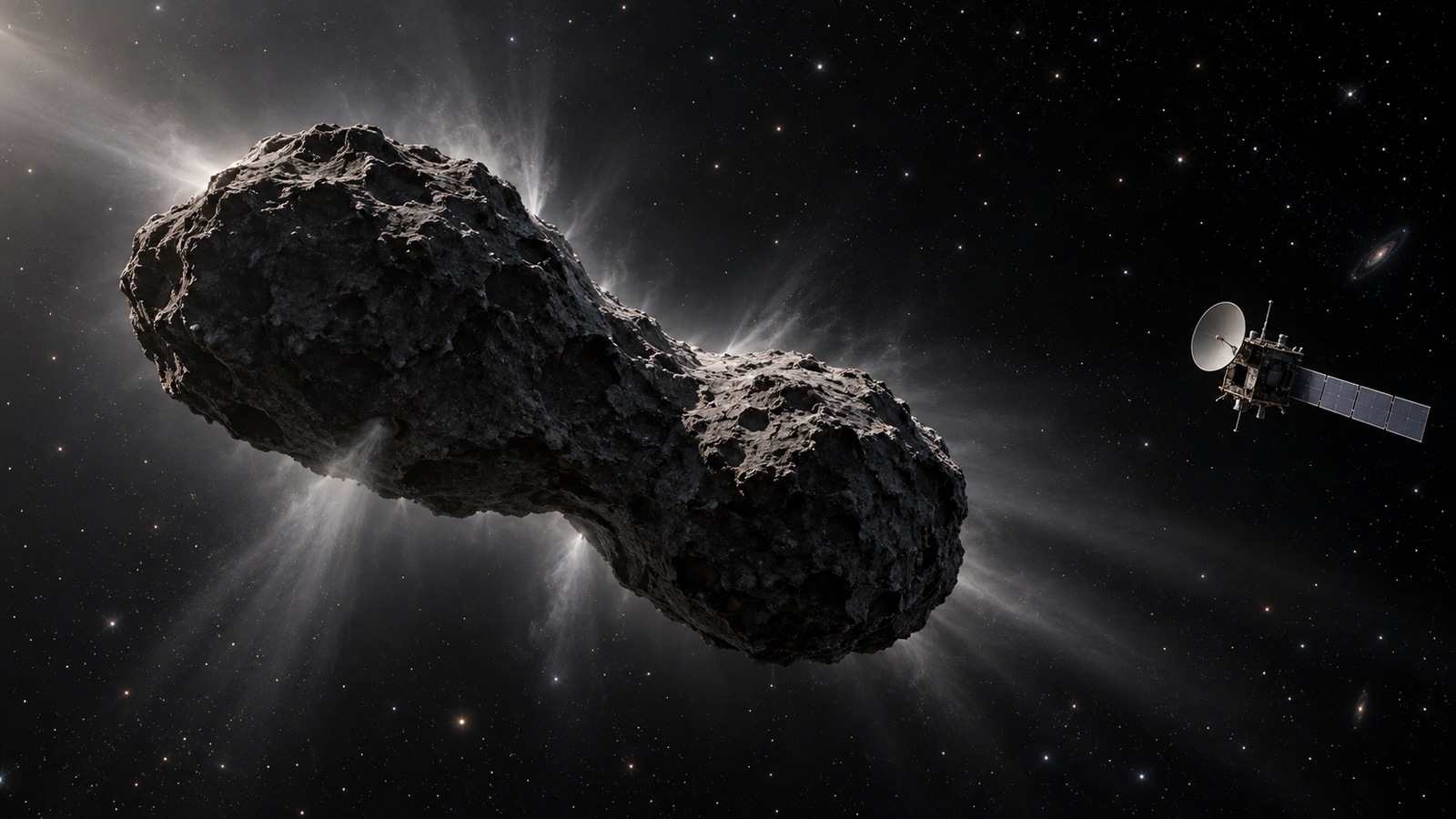
When most people imagine asteroids, they picture small, tumbling rocks drifting harmlessly through space. Yet the truth is far more dramatic. Asteroids can range from pebble-sized fragments to colossal worlds hundreds of miles across — ancient relics from the dawn of the solar system. From tiny meteoroids that burn up in Earth’s atmosphere to massive bodies like (1) Ceres, the largest asteroid known, these rocky wanderers reveal how planets themselves were once formed. But the question remains: just how big can an asteroid get?
A Universe of Space Rocks
Asteroids are officially defined as rocky or metallic objects that orbit the Sun but are too small to be classified as planets. Scientists often refer to them as planetesimals — building blocks left over from the early solar system, over 4.5 billion years old. Most reside within the main asteroid belt, a vast region between Mars and Jupiter filled with millions of these relics.
Despite their ancient origins, asteroids vary widely in shape, size, and composition. Some are solid and spherical; others are jagged and porous, little more than loose rubble held together by weak gravity. Their diversity makes them crucial to understanding the early stages of planetary formation — and how enormous some of them can truly be.
Size Spectrum: From Dust to Dwarf Planets
Asteroids exist across a staggering scale of sizes. At the smallest end, micrometeoroids measure just millimeters across — barely detectable except when they streak through our skies as meteors. Moving upward, there are boulder-sized asteroids a few meters wide, many of which occasionally pass close to Earth.
Then come the mid-sized ones, hundreds of meters to several kilometers across, like (99942) Apophis, a 370-meter-wide near-Earth asteroid that will safely fly past our planet in 2029. But above these lies a league of giants — world-sized asteroids like (4) Vesta, (2) Pallas, and the undisputed champion, (1) Ceres, which stretches nearly 940 kilometers (584 miles) across.
To put that into perspective: if Ceres were placed on Earth, it would span roughly the size of Texas. Beyond this scale, however, a fascinating physical boundary begins to appear — one that defines the upper limit of how big an asteroid can truly become.
Gravity’s Role: The Shape of Growth
The growth of asteroids isn’t limited by a lack of material. The early solar system was filled with dust, rock, and ice colliding and merging under gravity. Instead, what stops an asteroid from becoming larger is gravitational dominance — the point where an object’s gravity becomes strong enough to pull itself into a spherical shape. When an asteroid reaches about 600 kilometers (373 miles) in diameter, its own gravity starts to overcome its rigidity. The object begins to “round out,” becoming nearly spherical. Once this happens, it transitions from being an asteroid to what astronomers call a dwarf planet. That’s why Ceres is unique: it’s big enough for gravity to have shaped it into a sphere, but not big enough to clear its orbital neighborhood. In other words, Ceres sits at the very upper limit of asteroid size — beyond it, objects gain planetary status.
Meet the Giants of the Belt
While millions of asteroids populate the solar system, only a handful are large enough to stand out as true titans. These few dominate the main asteroid belt, holding most of its total mass.
1. Ceres (1 Ceres)
The largest known asteroid and the first ever discovered, Ceres measures 940 km across and makes up about one-third of the asteroid belt’s total mass. It’s so large and spherical that it’s officially classified as both an asteroid and a dwarf planet. Ceres’ surface features include craters, salt deposits, and even cryovolcanoes — suggesting the presence of water ice and internal activity.
2. Vesta (4 Vesta)
Slightly smaller than Ceres, Vesta is about 525 km (326 miles) in diameter. It’s unique because it has a differentiated interior — meaning it once had molten layers like a true planet, with a core, mantle, and crust. NASA’s Dawn spacecraft, which visited Vesta in 2011, revealed a landscape of mountains, troughs, and enormous impact basins.
3. Pallas (2 Pallas)
Pallas, around 512 km (318 miles) wide, is tilted dramatically on its axis — a whopping 34 degrees — making its seasons extreme. Its orbit is also more inclined than most main-belt asteroids, hinting that it might have formed under chaotic early solar system conditions.
4. Hygiea (10 Hygiea)
At about 430 km (267 miles) across, Hygiea is nearly spherical and could be considered the smallest dwarf planet candidate in the solar system. It’s composed mostly of carbonaceous material, giving it a dark, soot-like appearance.
Together, these four bodies account for over half the total mass of the asteroid belt, proving that even among millions of smaller fragments, a few colossal survivors reign supreme.
Why Asteroids Stop Growing
The reason asteroids don’t grow endlessly lies in the balance between collision and cohesion. In the chaotic early solar system, countless rocky fragments smashed together, some sticking and others shattering apart. The largest grew by accreting smaller ones — but once Jupiter formed, its enormous gravity began disrupting the belt, preventing further planetary growth.
This gravitational interference from Jupiter acted like a cosmic gatekeeper, stirring up the asteroid belt and keeping its material from forming a full-fledged planet. Instead of one large world, the region remained a scattered collection of smaller bodies — a failed planet-building zone frozen in time.
If not for Jupiter’s influence, it’s likely that the matter in the asteroid belt could have merged into a planet as large as Mars or even Earth.
The Physics of Asteroid Limits
The theoretical size limit of an asteroid is dictated by self-gravity and material strength. Small asteroids can maintain irregular, jagged shapes because their gravity isn’t strong enough to deform them. But as mass increases, so does gravity — until the rock begins to compress and pull itself into equilibrium. Scientists call this the “hydrostatic equilibrium threshold.” Once an asteroid crosses it, its internal structure adjusts to minimize potential energy, producing a nearly spherical shape. For rocky bodies, this threshold occurs at roughly 600–800 km in diameter; for icy bodies, which are softer, it’s around 400 km. Thus, an asteroid larger than about 1,000 km would no longer be considered an asteroid — it would be a dwarf planet, like Ceres or Pluto.
Asteroids That Almost Became Planets
Not every asteroid stopped growing because of Jupiter’s gravity. Some simply ran out of material nearby. Others collided violently and broke apart, losing mass instead of gaining it. But a few came tantalizingly close to planetary status.
Vesta, for example, once possessed enough internal heat to melt and differentiate, forming layers similar to terrestrial planets. That makes it a protoplanet — a world that began to grow into a planet but never completed the process.
Some scientists even theorize that Mercury-sized bodies may have once formed in the asteroid belt, only to be destroyed in the early solar system’s gravitational chaos. Their remnants could be part of the asteroid population we see today.
Shapes and Spin: When Big Becomes Round
Asteroids display a dazzling variety of shapes. Smaller ones often look like jagged potatoes or flying mountains. But as they grow larger, gravity begins to smooth out their edges.
For instance, Eros, a near-Earth asteroid about 34 km (21 miles) long, has an irregular peanut shape. Ida, at 31 km, has a moon named Dactyl, showing how even medium-sized asteroids can form small satellite systems.
However, once an asteroid surpasses roughly 400 km, it becomes nearly spherical. This self-rounding marks the transition from asteroid to dwarf planet. Ceres, Hygiea, and possibly Pallas all meet this criterion — natural boundaries where size, gravity, and structure converge.
Beyond the Belt: Giant Asteroids Elsewhere
Though the main asteroid belt contains most known large asteroids, the solar system hosts many other rocky and icy bodies that blur classification lines. In the Kuiper Belt, beyond Neptune, enormous objects like Pluto, Eris, Haumea, and Makemake dwarf any main-belt asteroid. These icy giants range between 1,000 and 2,400 kilometers in diameter, showing how much larger “asteroid-like” bodies can grow in colder, outer regions. Meanwhile, Trojan asteroids share Jupiter’s orbit, clustered around its gravitational stable points. Some of these, like (624) Hektor, reach over 225 km (140 miles) — elongated and double-lobed, hinting at complex formation histories. So while Ceres holds the crown within the main belt, the broader solar system features “asteroidal” bodies of all shapes and magnitudes — cosmic stepping-stones between rock and planet.
The Colossal Impacts of Giant Asteroids
The size of an asteroid directly influences its potential for destruction — or discovery. Massive asteroids have occasionally collided with Earth and other planets, leaving behind craters and altering planetary evolution.
The Chicxulub impactor, which struck Earth 66 million years ago and caused the extinction of the dinosaurs, is estimated to have been around 10 km (6 miles) wide — a mere speck compared to Ceres, yet devastating on a global scale.
By contrast, an impact from a 50 km or larger asteroid could sterilize vast regions or even threaten planetary habitability. Fortunately, most of these giants reside safely in the main belt, their stable orbits posing little risk to Earth.
Still, their size underscores a sobering truth: even relatively small asteroids can yield unimaginable energy when colliding at cosmic speeds.
The Biggest of All Time
If we look beyond our solar system, the concept of “asteroids” might stretch even further. Observations of exoplanetary debris disks suggest that planetesimals hundreds or even thousands of kilometers wide exist around other stars — the building blocks of alien worlds still under construction.
In our own solar system, Ceres marks the current natural limit, but during formation billions of years ago, the solar disk could have contained proto-asteroids the size of Mars, which later merged into full planets or were obliterated by collisions.
Some scientists propose that Theia, a Mars-sized proto-planet that collided with Earth to form the Moon, was once akin to a giant asteroid from the inner solar system. In that sense, asteroids can grow as large as planets — if conditions allow.
Measuring the Monsters
Determining the size of asteroids isn’t always straightforward. Unlike planets, most are too small and faint for telescopes to resolve directly. Astronomers use a combination of reflected light (albedo) and infrared radiation to estimate their diameters. Space missions such as NEOWISE, Gaia, and Dawn have refined these measurements with unprecedented precision. Radar imaging, especially from observatories like Arecibo (before its collapse), provided detailed shape models for near-Earth asteroids. Today, with space telescopes and deep-sky surveys, we can estimate asteroid sizes to within a few percent — allowing us to track not only the largest but also the smallest potential threats to Earth.
When Asteroids Mimic Moons and Comets
The boundary between asteroids, moons, and comets often blurs. Some large asteroids are gravitationally captured by planets, becoming natural satellites. For instance, Mars’ moon Phobos may be a captured asteroid, roughly 22 km (14 miles) wide.
Conversely, some asteroids display comet-like behavior, developing tails or halos of dust and gas when their icy components sublimate near the Sun. These are called active asteroids, and they reveal that size alone doesn’t define behavior — composition and orbit matter too.
The larger an asteroid becomes, the more it straddles these definitions, illustrating the continuum that links all small bodies in our solar system.
Asteroids and the Future of Exploration
Understanding asteroid sizes isn’t just an academic pursuit — it’s vital for space exploration and planetary defense. Large asteroids offer potential mining resources, including metals like nickel, cobalt, and platinum. Their mass makes them easier to orbit and study than smaller, tumbling fragments.
Ceres, in particular, has become a focus of interest for future missions and potential human outposts. With its abundant water ice, low gravity, and relative accessibility, it could one day serve as a refueling station for spacecraft venturing deeper into the solar system.
As private companies and space agencies explore asteroid mining and colonization concepts, knowing how big — and how stable — these bodies can be will shape our cosmic ambitions.
Earth’s Guardians: Watching the Giants
Around the world, astronomers continuously track asteroids of all sizes. Programs like NASA’s Planetary Defense Coordination Office and ESA’s Near-Earth Object Coordination Centre monitor potential impact risks using telescopes and radar networks. The DART mission (Double Asteroid Redirection Test) in 2022 marked humanity’s first successful attempt to alter the trajectory of an asteroid — proof that we can protect Earth from smaller threats. Future missions may focus on larger targets, studying how their mass and composition respond to deflection attempts. By understanding the size range of asteroids — from tiny debris to near-dwarf planets — we’re better equipped to safeguard our world and harness the potential of others.
When Size Meets Science Fiction
Asteroids have long captured human imagination. From Hollywood blockbusters like Armageddon and Deep Impact to hard science fiction epics, they symbolize both cosmic danger and opportunity. But the science behind them is just as thrilling as fiction.
The idea that a mountain-sized rock could wipe out civilizations or that a dwarf planet like Ceres could host water and life-like chemistry fuels both storytelling and research. Understanding how big asteroids can get isn’t just about measurement — it’s about placing humanity within a vast, dynamic system of creation and destruction.
Ceres and Beyond: The Ceiling of Size
Ultimately, Ceres represents the ceiling of what we call an asteroid. Beyond its 940-kilometer diameter, gravity asserts itself so strongly that objects enter the realm of dwarf planets. This boundary marks a cosmic tipping point — where small worlds become round, complex, and possibly even geologically active. In essence, the largest asteroids are more than debris; they’re frozen prototypes of planets, snapshots of creation caught between stages of evolution. Studying them reveals not only the upper limits of size but also the processes that govern planetary birth.
The Infinite Middle Ground
So, how big can asteroids get? In our solar system, the answer lies just under 1,000 kilometers — the size of Ceres, the king of asteroids and the smallest of the dwarf planets. Beyond that, nature’s physics take over, shaping worlds rather than rocks.
Asteroids may be the leftovers of creation, but they are far from insignificant. They are storytellers of a time when chaos reigned and planets were still forming. From the tiny pebbles that streak across our skies to the monumental spheres that rival moons, each asteroid tells a tale of gravity, growth, and cosmic balance.
And somewhere out there, in the dark between Mars and Jupiter, Ceres glides through space — a gentle giant marking the very edge of what an asteroid can be.