The Question of Lunar Composition
The Moon has captivated humanity for millennia, but only in the last century have we begun to answer the fundamental question: what is it made of? Known scientifically as Luna (Earth I), our Moon is not only Earth’s closest neighbor but also a window into the early history of the solar system. By examining its rocks, minerals, and chemistry, scientists gain insight into the processes that shaped both the Moon and our planet.
The Moon is not a uniform sphere of rock. Instead, it is layered, with a crust, mantle, and core, each with distinct properties and histories. Surface materials vary between light-colored highlands and dark volcanic plains, revealing a story of impacts, volcanism, and slow cooling. By studying samples brought back by astronauts and meteorites, as well as data from orbiters and landers, scientists have built a detailed picture of the Moon’s makeup. The story of lunar composition is also the story of Earth’s own violent beginnings, since the Moon likely formed from the debris of a massive impact billions of years ago.
Origins and the Giant Impact Hypothesis
To understand what the Moon is made of, scientists begin with its origin. The prevailing explanation is the giant impact hypothesis, which proposes that a Mars-sized body collided with Earth early in its history. The impact ejected material into orbit, which coalesced to form the Moon. This theory explains why lunar rocks closely resemble Earth’s mantle in composition, yet also differ in key ways.
Evidence supporting this includes isotopic similarities between lunar and terrestrial rocks. Oxygen isotopes in particular are nearly identical, indicating a shared origin. At the same time, the Moon is depleted in volatile elements, suggesting that much of its material was heated and vaporized during formation. The impact hypothesis explains the Moon’s relatively small iron core, since the colliding body’s core likely merged with Earth, leaving the Moon composed primarily of lighter silicate material. Thus, the Moon’s composition is both Earth-like and unique, forged in the violence of planetary collisions.
The Lunar Crust
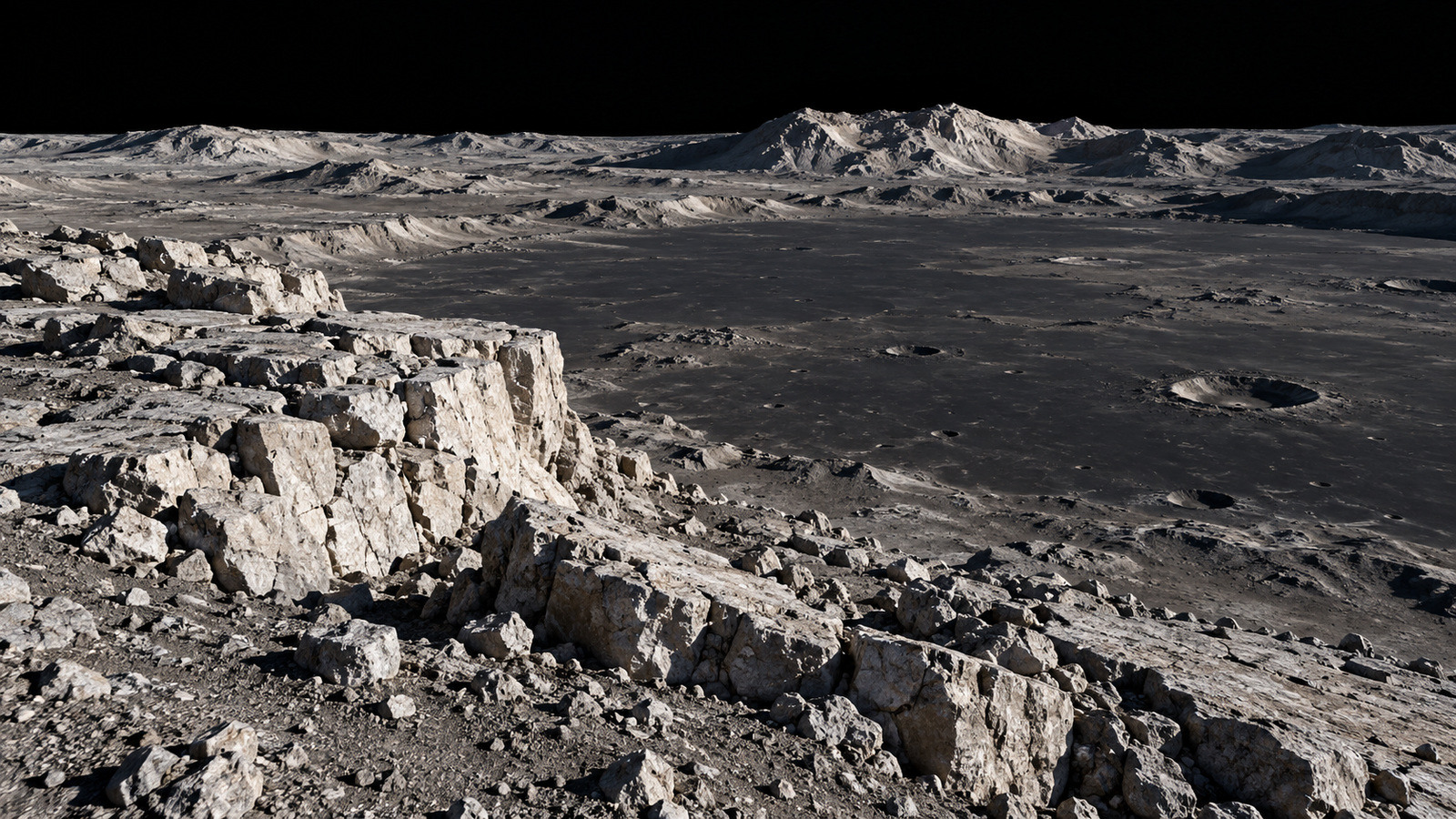
The outermost layer of the Moon is its crust, averaging about 50 kilometers thick but varying between 30 and 80 kilometers depending on location. It is composed primarily of oxygen, silicon, magnesium, iron, calcium, and aluminum. Minerals such as plagioclase feldspar dominate, giving the highlands their bright appearance. These regions are heavily cratered and represent some of the Moon’s oldest surfaces. In contrast, the darker maria, or volcanic plains, are made of basalt formed from ancient lava flows. These areas are rich in iron and magnesium, which make them denser and darker. Samples returned from Apollo missions confirmed the basaltic nature of the maria and revealed the presence of minerals such as pyroxene and olivine. The crust preserves the scars of impacts, the chemistry of volcanism, and the layering of an ancient world. By studying it, scientists uncover not only what the Moon is made of but also how it evolved over time.
The Lunar Mantle
Beneath the crust lies the mantle, which extends roughly 1,000 kilometers deep. Unlike Earth’s mantle, which is still convecting and active, the lunar mantle is largely solidified and inactive. However, it once played a critical role in shaping the Moon’s surface through volcanic eruptions that created the maria. The mantle is thought to be composed of minerals such as olivine, orthopyroxene, and clinopyroxene, with high concentrations of magnesium and iron. Evidence for the mantle’s composition comes from basaltic lava brought to the surface during eruptions, as well as from seismic data recorded by instruments left behind by Apollo astronauts. These studies suggest the mantle may still contain small pockets of partially melted material, but it is far less dynamic than Earth’s. Understanding the lunar mantle helps scientists compare planetary interiors and assess why some worlds remain geologically active while others fall silent.
The Lunar Core
At the heart of the Moon lies its core, a small and partially molten structure only about 350 kilometers in diameter. In contrast to Earth’s massive iron-nickel core, the Moon’s core makes up only about 1 to 2 percent of its mass. It is thought to consist of iron with small amounts of sulfur and nickel.
Despite its modest size, the core plays an important role in the Moon’s history. Paleomagnetic evidence shows that the Moon once had a global magnetic field, suggesting the core was more active in the past. Today, the core is largely inactive, though some seismic and gravitational studies indicate that parts of it may remain molten. By comparing the Moon’s core to Earth’s, scientists learn how size, composition, and cooling influence a world’s ability to sustain magnetism and geologic activity.
Highlands and Maria: Contrasting Surfaces
The Moon’s face presents a striking contrast between the bright highlands and the dark maria. The highlands, which make up about 83 percent of the surface, are composed mainly of anorthosite rich in plagioclase feldspar. These ancient rocks date back over four billion years, representing the earliest solid crust formed after the Moon’s creation. Their high reflectivity gives the Moon its distinctive brightness.
The maria, in contrast, are younger volcanic plains that cover about 17 percent of the surface. They were created by basaltic lava flows that filled large impact basins billions of years ago. These rocks are denser and darker, containing minerals like pyroxene and olivine. The maria reveal a history of volcanic activity, with flows dating from 3.1 to 3.9 billion years ago. Together, the highlands and maria record the interplay of impacts and volcanism that shaped the Moon’s surface and highlight the diversity of its crustal composition.
Regolith: The Moon’s Blanket of Dust
Covering the lunar surface is a layer of loose, fragmented material known as regolith. This blanket of dust and rock fragments formed through billions of years of meteorite impacts and micrometeorite bombardment. Ranging from a few meters to over 20 meters thick in places, the regolith preserves the history of impacts and space weathering. The regolith contains crushed rock, glassy particles created by impacts, and small beads of volcanic glass formed by ancient eruptions. It also traps solar wind particles, including hydrogen and helium, making it a valuable record of solar activity. For future explorers, the regolith poses challenges, as its fine, sharp particles cling to surfaces and equipment. Yet it also offers opportunities, as it may contain resources such as oxygen bound in minerals and even traces of water ice in permanently shadowed regions. The regolith is both a product of the Moon’s composition and a key to its ongoing interaction with space.
Volcanic History and Basaltic Plains
One of the most striking aspects of the Moon’s composition is its volcanic history. Though the Moon is no longer volcanically active, billions of years ago it experienced widespread eruptions that shaped its surface. These eruptions produced the basaltic plains of the maria, rich in iron and magnesium and low in silica compared to Earth’s continental crust. Apollo samples revealed that lunar basalts are diverse, containing varying amounts of titanium. Some are high-titanium basalts with ilmenite, while others are low in titanium. These variations point to differences in the mantle’s composition and melting processes. The presence of volcanic glass beads in Apollo samples also suggests explosive eruptions occurred. The Moon’s volcanic history is written in the rocks of the maria, providing a record of mantle composition, volcanic processes, and the gradual cooling of a once-active world.
Water on the Moon
For decades, the Moon was thought to be completely dry, but recent discoveries have revealed traces of water in various forms. Tiny amounts of water have been found within volcanic glass beads collected by Apollo missions, suggesting water was present in the lunar mantle. Remote sensing has also detected hydroxyl and water molecules on the surface, especially in polar regions. Perhaps most exciting is the discovery of water ice in permanently shadowed craters near the poles. These regions never see sunlight, allowing ice to persist for billions of years. While the amounts are small compared to Earth’s reserves, the presence of water has significant implications for lunar composition and future exploration. It suggests that the Moon is not entirely anhydrous and that volatiles played a role in its history. Water on the Moon adds complexity to our understanding of its makeup and offers hope for in-situ resources for future missions.
Trace Elements and Rare Compounds
Beyond its major components, the Moon contains trace elements and rare compounds that enrich our knowledge of its composition. Elements such as potassium, rare earth elements, and phosphorus are present in small amounts. These are concentrated in unusual rock types such as KREEP basalts, named for potassium (K), rare earth elements (REE), and phosphorus (P).
KREEP basalts are significant because they represent the last dregs of the lunar magma ocean that once covered the Moon. They are enriched in heat-producing elements like uranium and thorium, which may have influenced the Moon’s thermal evolution. These rare rocks reveal the complexity of lunar geochemistry and highlight the differences between the Moon and Earth. While Earth recycled much of its early crust through plate tectonics, the Moon preserved ancient compositions, offering a window into processes long erased from our planet’s surface.
Seismology and the Lunar Interior
Apollo missions deployed seismometers that recorded moonquakes, providing vital clues about the Moon’s internal composition. These instruments detected shallow and deep quakes, meteoroid impacts, and thermal events. The data revealed a crust, mantle, and small core, confirming the Moon’s layered structure. Seismic studies also suggested that parts of the mantle remain partially molten, consistent with the history of volcanic activity. The presence of deep moonquakes indicated that tidal forces from Earth continue to influence the Moon’s interior. By combining seismic data with gravity measurements from later missions, scientists refined their models of the Moon’s composition, offering a clearer picture of its interior structure. These insights make seismology one of the most powerful tools for probing what the Moon is made of.
Comparing the Moon to Earth
The Moon’s composition offers both similarities and contrasts to Earth. Both share silicate-rich crusts and mantles, as well as iron cores. Yet the Moon’s smaller size, lower density, and depletion in volatiles set it apart. Its crust is richer in aluminum and calcium, while Earth’s is more diverse due to plate tectonics and ongoing geologic processes. The absence of a thick atmosphere or active plate tectonics has allowed the Moon to preserve its ancient crust, while Earth has recycled much of its early history. This makes the Moon a time capsule of planetary formation. By comparing lunar and terrestrial rocks, scientists trace the shared origin of the two bodies and learn how size and environment influence planetary evolution. The Moon reflects Earth’s composition but in a stripped-down, simplified form that highlights both common heritage and divergence.
The Moon as a Laboratory for Planetary Science
Studying the Moon’s composition is not only about understanding our satellite—it also informs broader planetary science. The Moon serves as a benchmark for rocky bodies, offering insights into differentiation, volcanism, and crust formation. Because it has preserved ancient rocks, it helps reconstruct the history of the early solar system. The Moon also provides analogs for other airless bodies, such as Mercury and asteroids. Its regolith records space weathering, solar wind implantation, and micrometeorite bombardment, processes that affect surfaces across the solar system. By examining what the Moon is made of, scientists refine their models for how planets and moons evolve under different conditions. In this way, the Moon is not only Earth’s companion but also a natural laboratory for understanding worlds everywhere.
Looking Ahead: Lunar Resources and Exploration
The composition of the Moon is more than academic—it also has practical importance for future exploration. Oxygen bound in minerals, metals in basalts, and water ice in polar craters could all serve as resources for sustaining human presence. Understanding the Moon’s materials is essential for developing technologies to extract and use them. Missions such as Artemis and international lunar projects will continue to explore and sample the Moon, expanding our knowledge of its composition. New instruments may detect trace volatiles, analyze mantle material, and map mineral resources in greater detail. The Moon’s makeup is both a scientific treasure and a practical opportunity, linking its ancient history with humanity’s future in space.
What the Moon Is Made Of: A Shared Story with Earth
At its core, the Moon is made of silicate rocks, iron, and trace elements, organized into crust, mantle, and core. Its highlands, maria, regolith, and rare rock types each tell part of a story that began with a violent impact billions of years ago. The Moon’s composition is Earth-like yet distinct, reflecting a shared origin and divergent evolution. By asking what the Moon is made of, we also ask about our own beginnings. Luna is a fragment of Earth cast into orbit, preserving ancient clues about planetary formation, volcanism, and the role of impacts in shaping worlds. Its makeup explains its brightness, its silence, and its endurance. The Moon remains our closest companion and one of the most revealing mirrors of Earth’s own composition and history.
Space Products Reviews
Blast off with Lyra Street’s ultimate guide to the Top 10 Best Space Products Reviews! From high-powered telescopes to stellar star maps and astronomy gear, we explore the most impressive cosmic tools available today. Dive into detailed reviews and an easy-to-navigate comparison chart to find the perfect gear for your stargazing adventures or space-inspired lifestyle.