A Magnetic Planet With Several Misaligned Directions
Uranus does not have a simple magnetic field neatly centered on its rotation axis. Measurements indicate a strongly tilted large-scale magnetic orientation and an effective dipole offset from the planet’s center, while the field also contains important structure beyond that simplified dipole. Those features are distinct from Uranus’s famous sideways rotational tilt. Together they create a magnetic environment that changes its orientation to the solar wind as the planet spins. The field points toward hidden electrical currents inside Uranus, but its exact dynamo structure remains uncertain. Voyager 2 supplied the only close spacecraft encounter, and later analysis shows that unusual solar-wind conditions affected that visit. Explaining the planet’s magnetic behavior therefore means separating measured geometry, proposed interior physics, and the temporary conditions sampled in 1986.
Begin With Three Different Axes
A planet’s orbital orientation, rotation axis, and magnetic orientation are different properties. Uranus’s rotation axis lies close to its orbital plane, giving it the familiar sideways description. The magnetic dipole direction is then tilted by roughly sixty degrees relative to that rotation axis. These angles use different reference directions and should not be added casually into one headline number. The distinction matters because the rotational tilt shapes seasonal illumination, whereas the magnetic misalignment affects how the surrounding charged-particle environment changes during each spin.
The magnetic axis is also an approximation rather than a physical rod inside the planet. A dipole describes the broad pattern similar to that of a bar magnet, but planetary fields contain additional spatial components. Those higher-order contributions can be important near the source and near the surface. Calling Uranus’s field tilted does not fully describe its complexity. A useful explanation keeps the convenient dipole model while recognizing the observations it leaves out.
Offset Means More Than Tilted
The effective dipole is displaced from the geometric center by about a third of the planetary radius. Tilt concerns direction, while offset concerns the location assigned to the simplified field source. Both can produce unequal field conditions at different locations, but they are not interchangeable. A drawing of a perfectly centered tilted magnet would omit part of Uranus’s observed geometry. NASA’s Uranus facts identifies both the pronounced tilt and the offset, making their separation an essential starting point.
This model does not establish a literal compact magnet floating off-center under the clouds. It summarizes the external measurements with a mathematical representation. Real planetary magnetism arises from electrical currents distributed through conducting material. Several current arrangements can contribute to a field whose best simple description is displaced. The model is valuable because it organizes observations, not because its imaginary source object has been photographed.
A complex field can also include regions with different strengths and directions that a single axis cannot capture. Researchers describe these through additional magnetic components fitted to measurements. The amount of detail justified depends on spacecraft coverage and data quality. A brief trajectory samples only some locations, making reconstruction less complete than a long orbital survey would allow. Uranus’s apparent irregularity therefore combines genuine physical structure with limits on how thoroughly that structure has been mapped.
Higher-order magnetic components generally decline with distance more rapidly than the broad dipole contribution. A spacecraft farther from Uranus can therefore sample a field that looks simpler than the near-planet pattern, even when both observations describe the same underlying current system. Comparing measurements requires their positions as well as their recorded directions and strengths. This relationship also explains why a convenient distant approximation can become inadequate close to the atmosphere. Field complexity is not just a visual impression; it has a distance-dependent mathematical signature that future coverage could test at multiple altitudes.
A Dynamo Creates the Field From Motion
Planetary dynamos involve moving electrically conducting material and the associated electrical currents. Fluid motion, rotation, magnetic induction, and the material’s properties interact to sustain a large-scale field under suitable conditions. The source is not ordinary surface weather acting like a permanent household magnet. It belongs to deeper regions whose pressure and composition permit the necessary conductivity and movement. The general dynamo principle is established physics, while applying it to Uranus requires uncertain information about the planet’s internal state. A mechanism can be broadly understood without every interior layer being uniquely known.
Why Interior Models Remain Important
Uranus is conventionally called an ice giant because models involve heavier volatile-related materials in addition to hydrogen and helium. The label does not mean the field is generated inside a simple frozen shell. Water-bearing and other material can occupy hot, compressed states whose electrical behavior differs greatly from familiar surface substances. Mixtures and gradients affect both density and convection. Researchers must connect laboratory material behavior with plausible planetary pressures and temperatures before assigning a dynamo region.
One thin-shell dynamo model places moving conducting fluid around a deeper region whose stable layering suppresses overturning. Confining the motion changes the arrangement of the electrical currents generating the field; it need not reproduce the same broad, centered pattern as a different conducting interior. The resulting simulations can produce strongly tilted, non-dipolar fields resembling the ice giants’ unusual geometry. That is a possible mechanism, not a spacecraft measurement of an actual shell boundary. Gravity, heat transport and material properties supply additional tests: a model that matches the magnetic outline but conflicts with those constraints would not be a sufficient account of Uranus.
Rotation Changes the Outside Geometry
Because the magnetic and rotation directions differ strongly, the magnetic pattern changes its orientation relative to the incoming solar wind as Uranus rotates. This can alter where external particles approach, how magnetic boundaries respond, and how the tail is organized. The consequences depend on orbital season as well as rotation. The 1986 encounter occurred during a particular seasonal arrangement, not every possible orientation the planet experiences. Describing one configuration as permanently fixed would lose an important part of the dynamics.
The magnetosphere is the region where the planet’s field strongly influences charged particles. Its boundary is shaped by the interaction with the surrounding solar-wind plasma rather than by a rigid spherical shell. Incoming pressure can compress the dayside while a magnetic tail extends away from the Sun. The geometry is both structured and responsive. Field lines in a diagram represent directions and connectivity; they are not visible wires stretched around the planet.
Magnetic reconnection can change which regions are connected and allow exchanges of energy and particles. The effectiveness depends on the relative directions of the relevant fields and the plasma conditions. A tilted geometry can therefore produce behavior that changes over a spin, but the detailed pattern needs modeling and observations. It is too simple to say the field alternately turns entirely on and off. The field persists while its interactions and accessible pathways evolve.
Voyager Supplied a Crucial Snapshot
Voyager 2 measured magnetic fields and particle populations as it passed Uranus in January 1986. Those observations transformed the planet from a distant atmospheric disk into a directly sampled magnetic system. Instruments recorded local signals along a moving trajectory rather than surveying all surrounding space simultaneously. The resulting dataset is extraordinarily valuable, but it remains a snapshot under specific conditions. Later analysis can extract new information without turning that snapshot into complete coverage. The correct comparison is a rich encounter record versus the longer temporal and spatial sampling still missing.
Solar Wind Changed the Encounter Context
A 2024 reanalysis argued that an unusual solar-wind pressure event compressed Uranus’s magnetosphere during the flyby. This helps explain why the observed system appeared depleted in some plasma populations and had striking radiation-belt conditions. The interpretation concerns the external environment at the encounter, not a claim that the tilted magnetic field was an illusion. NASA’s account of the reanalysis emphasizes how the timing affected what Voyager sampled. Geometry and transient state must remain separate parts of the explanation.
The revised context also matters when considering possible material supplied by moons. A depleted local population during a compressed interval need not establish that the moons never contribute particles. At the same time, a reinterpretation does not prove subsurface oceans or identify every source process. It changes which conclusions can reasonably be drawn from the old observations. A careful account distinguishes the measured particle scarcity from a universal statement about the entire system’s ordinary behavior.
An interior model asks how conducting material generates the planet’s field, while a boundary model asks how that field interacts with incoming plasma. A successful explanation of compression during Voyager’s visit does not automatically identify the depth of the dynamo region. Likewise, a dynamo calculation producing an offset pattern does not determine the solar-wind pressure on the encounter date. Treating these as connected but distinct models prevents one convincing result from being stretched into an answer to every magnetic question.
The distinction guides future measurements too. A repeated field survey near the planet would constrain relatively persistent geometry, while simultaneous plasma observations would describe the changing external state. Comparing both through time could reveal which variations follow rotation and which follow incoming disturbances. Researchers would then test a combined account rather than fitting every signal with one cause. Uranus’s unusual system makes this coordinated approach particularly valuable, because its changing orientation and sparse encounter history leave several otherwise entangled explanations to separate.
Magnetic Tails Can Carry Away Material
Later examination of Voyager data identified a signature interpreted as a plasmoid in Uranus’s magnetic tail. A plasmoid is a structure associated with magnetic and plasma dynamics that can transport material and energy. It offers a clue to how the planet’s magnetosphere may release part of its contents. NASA’s description of that analysis explains why a small feature in an old record can add a new pathway to the picture. One event, however, does not establish the total long-term loss rate or uniquely determine the contents of every escaping structure.
Auroras Trace Interactions, Not the Whole Field
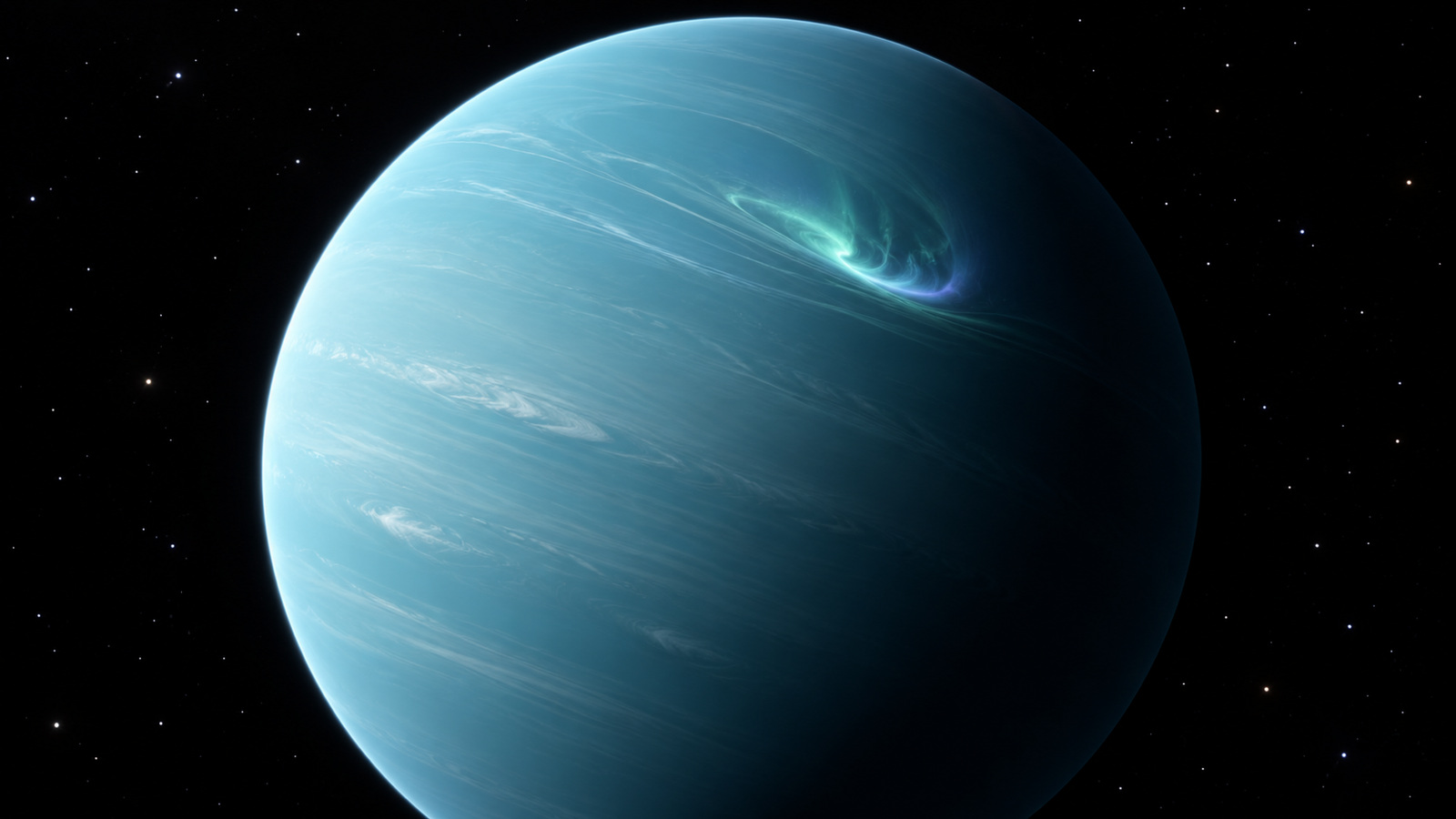
Auroral emissions arise when energetic particles interact with atmospheric material. Observations of where and when emissions appear can help constrain magnetic connections and particle access. Their locations need not match an Earth-like expectation of neat circles centered on rotational poles. That makes Uranus especially useful for examining how unusual geometry affects atmospheric energy deposition. An auroral feature is a diagnostic signal, but it is not a direct photograph of the entire magnetic field.
A Webb study reported in February 2026 followed Uranus for nearly a full rotation and mapped temperature and ion density in its upper atmosphere. Its infrared measurements linked atmospheric structure with the planet’s unusual magnetic environment, offering a more specific picture than a single artist’s auroral glow. The measured region extended thousands of kilometers above the clouds, rather than into the unseen dynamo. Following a rotating atmosphere helps researchers compare where emissions and charged particles appear as the geometry changes. The result adds an atmospheric diagnostic to the magnetic story without substituting that diagnostic for a survey of the conducting interior.
Monitoring over time is particularly important because an emission feature can depend on solar-wind conditions and viewing geometry. A missing aurora in one observation does not establish a missing magnetic field. Conversely, a bright patch does not define an unchanging pole location without an appropriate model. Repeated observations can test whether predicted rotational or seasonal patterns persist. The same planet can display different activity while retaining its underlying internal dynamo.
What Would Resolve the Remaining Questions
An orbiter could sample the field across many locations and changing external conditions, greatly improving on a single flyby. Gravity measurements would help constrain the interior, while particle and plasma instruments would connect the field geometry with its effects. Atmospheric and thermal observations would add further context to dynamo models. The goal would be to join internal structure with repeated magnetic behavior. One spectacular new image would be useful, but the strongest advance would come from coordinated measurements over time.
Uranus’s magnetic field is unusual for several established reasons: strong tilt, effective offset, and substantial complexity beyond a simple centered dipole. Its exact interior cause remains a subject of model comparison, and some encounter-era mysteries now have plausible external explanations. Those uncertainties are compatible with the quality of the observations rather than evidence that nothing is understood. The planet shows why magnetic science must connect conducting interiors, rotational geometry, and changing space conditions. Its weirdness is a structured physical problem, not a single mysterious angle.