
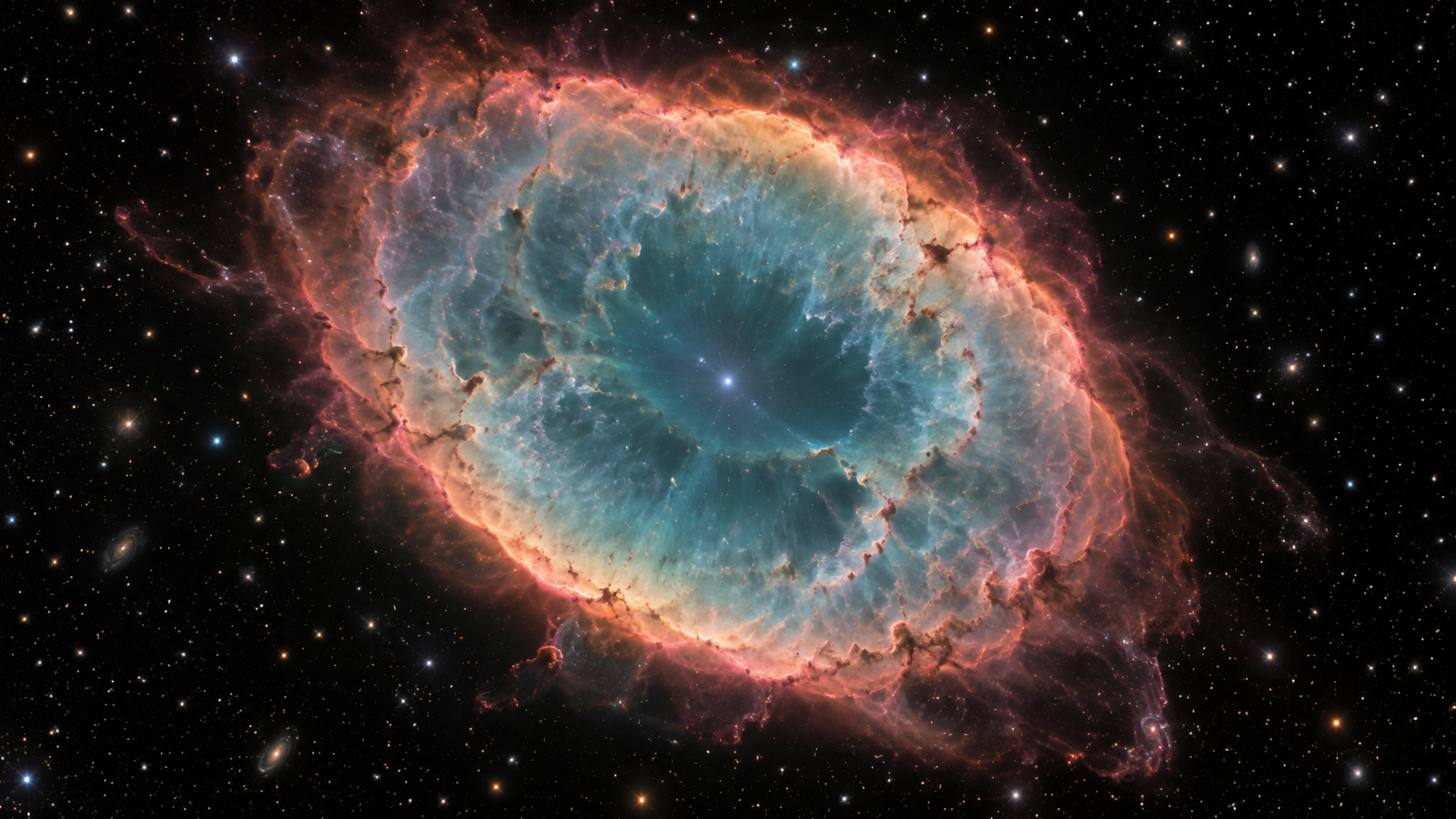
Ten Glowing Landscapes With Different Stellar Stories
Emission nebulae make some of astronomy’s most memorable pictures because their gas produces light, while dust, stars, and viewing geometry give that light a recognizable shape. Beauty remains a personal judgment, so this selection is a tour of ten well-studied examples rather than an objective ranking of every nebula in the universe. Most entries are regions where young stars illuminate surrounding interstellar gas; the Ring and Helix instead display material shed by aging stars. Looking past the names reveals a richer collection: stellar nurseries, carved cavities, eroding dust structures, and expanding shells. Each example rewards a different kind of attention, from the placement of a cluster to the small knots hidden along a bright rim.
1. Orion: A Nearby Window Into Star Formation
The Orion Nebula, Messier 42, turns a familiar constellation into a laboratory for stellar birth. Its bright central region surrounds the Trapezium stars, whose energetic radiation helps illuminate the gas. Wider views show an irregular luminous cloud rather than a neatly bounded object, with dust obscuring some areas and neighboring structures extending beyond the brightest patch. NASA’s Orion overview places the detailed telescope images in that larger setting. The appeal is partly this combination of accessibility and depth: a small patch noticed in the sky contains an extraordinary variety of structures under closer examination.
High-resolution observations reveal disks around young stars, including objects exposed to the radiation of nearby massive neighbors. These disks are not miniature copies of the entire nebula; they are much smaller environments where planetary systems may develop. A photograph can show both enormous glowing gas structures and small dark silhouettes, but their apparent proximity on the image should not erase their different physical scales. Orion’s beauty therefore includes a relationship between the collective nursery and individual emerging systems. It offers a reminder that star formation changes the surroundings in which subsequent generations and their disks must evolve.
2. Lagoon: A Bright Nursery Interrupted by Darkness
The Lagoon Nebula, Messier 8, is striking because luminous gas and obscuring dust share the same scene. Its broad appearance includes a dark lane that contributes to the lagoon-like name, while close views resolve ridges, compact clouds, and stars embedded in a complicated environment. Young stellar radiation energizes portions of the gas, but not every dark patch is an empty hole. Dust can block background emission and hide activity farther inside the cloud. A useful first look follows the boundary between brightness and shadow rather than treating the entire nebula as one smooth wash of color.
NASA’s Lagoon account connects this glowing landscape to active star formation. That connection does not mean every visible knot contains a newborn star, or that all parts of the cloud formed simultaneously. Different densities, radiation exposures, and lines of sight contribute to the pattern. In a carefully framed image, a compact intensely illuminated region may dominate the composition while representing only a portion of Messier 8. Checking the field of view helps keep an impressive closeup attached to its much larger physical setting.
The Lagoon also rewards comparison with Orion because both are nurseries without looking interchangeable. Orion’s familiar central stellar grouping organizes many views, whereas Lagoon images often emphasize a broader contrast between dark material and the bright interior. That visual distinction supplies a different route into the same general process. Neither is a complete inventory of the stars or gas present, and their shared classification does not imply identical histories.
3. Carina: A Landscape Too Large for One Iconic Crop
The Carina Nebula contains an immense and varied environment shaped by massive stars, energetic radiation, and stellar winds. Its visual reputation often rests on mountain-like dust ridges, yet those ridges are selected boundaries within a larger complex rather than the whole nebula. NASA’s wide Carina view reveals multiple cavities, concentrations, and streams of illuminated material. A successful tour begins with that broad context and then moves toward smaller sculpted features. The apparent cliffs are dense interstellar material seen against or beside emitting gas, not solid mountains with terrestrial surfaces. Their grandeur comes from scale, illumination, and the changing interaction between stars and their surroundings, while their long-term evolution requires more than a single beautiful exposure to reconstruct.
4. Eagle: Pillars Within a Larger Nebula
The Eagle Nebula, associated with Messier 16, contains the famous Pillars of Creation, but the pillars are a small region within a wider stellar nursery. Dense dusty columns survive differently from the more diffuse material around them, producing silhouettes and illuminated edges with exceptional visual impact. The surrounding stars and ionized gas are part of the explanation for those edges. NASA’s Eagle guide helps restore the larger scene. A tight composition can make the columns look isolated, even though their shape depends on the environment from which the image has cropped most of the context.
The pillar resemblance should not be read as a static architectural structure. Radiation and flows interact with uneven material, and dense regions can shield gas behind them while exposed surfaces are altered. Optical and infrared observations emphasize different aspects of that arrangement because dust blocks and transmits wavelengths differently. Comparing such views can reveal stars or structures obscured in one band without making either image a false version of the nebula. The Eagle’s distinctive beauty lies in the tension between substantial-looking forms and the physical processes gradually reshaping them.
5. Tarantula: A Nursery in Another Galaxy
The Tarantula Nebula, also called 30 Doradus, lies in the Large Magellanic Cloud rather than within the Milky Way’s disk. Its sprawling filaments and cavities surround an exceptional concentration of young stars, placing stellar feedback on a scale that differs from a small local nursery. The spider-like name is a visual analogy for a complicated network, not a description of one coherent object. ESA’s Webb view of the Tarantula highlights luminous structures and regions of dusty material.
A dense stellar concentration can make the central scene look crowded, while adjacent cavities appear comparatively open. Those cavities still contain material and radiation; their relative darkness or transparency does not establish a perfect vacuum. Massive stars influence gas through both radiation and outflows, and the resulting forms depend on the material they encounter. The appeal of the Tarantula comes from that interplay between a rich stellar population and the surrounding structure.
Its location in another galaxy adds perspective to the selection. Orion, Lagoon, and Eagle are familiar Milky Way examples, but the Tarantula shows that studying emission nebulae also involves comparing star formation across galactic environments. Such comparisons require attention to resolution, distance, and the properties being measured. A distant object photographed with an advanced instrument may display fine detail without being physically closer or easier to reach. Its visual splendor can open the comparison, while measurements establish which similarities and differences actually matter to stellar physics.
6. Rosette: A Cluster Framed by a Broad Cavity
The Rosette Nebula earns its floral name from a broad ring-like appearance around a central stellar cluster, but it is an interstellar nursery rather than the expelled shell of one dying star. Radiation and winds from massive cluster members influence the surrounding cloud, creating a cavity and an irregular luminous boundary. NASA’s infrared Rosette portrait demonstrates that different wavelengths reveal different components of the region. Small dense features and dark material complicate any perfectly symmetrical flower analogy. Its strongest visual lesson is the relationship between an exposed cluster and its remaining surroundings: the bright center and surrounding gas are physically connected, although projection makes the scene look more orderly than a full three-dimensional reconstruction would be.
7. Bubble: A Stellar Wind Made Visually Memorable
The Bubble Nebula, NGC 7635, has an unusually recognizable curved boundary shaped by the wind of a massive star interacting with surrounding material. Its apparent delicacy is misleading if it suggests a soap bubble with a liquid membrane. The luminous structure is gas organized by pressure, motion, and the environment around the star. NASA’s Bubble overview explains the conspicuously off-center star in a familiar Hubble view. An uneven surrounding cloud means that the system need not expand as a perfectly centered, isolated sphere, despite the simple impression given by its name.
The Bubble is particularly rewarding when viewed beside the Rosette. Both involve massive stars affecting ambient material, but their stellar arrangements and visible structures differ. One compelling shell does not imply that all stellar winds create equally clean circles, and a round projection need not specify the full geometry. Bright nearby gas outside the apparent bubble belongs to the broader environment rather than an accidental decorative background. The image therefore works as a lesson in boundaries: a visually clear outline can mark an interaction zone without enclosing an independent little universe.
8. Omega: A Bright Ridge With Several Familiar Names
The Omega Nebula, Messier 17, is also known as the Swan Nebula, reflecting the way observers interpret its bright form. Its illuminated gas and darker clouds create a curved shape that can seem almost figurative in a small telescope or a carefully framed photograph. NASA’s Messier 17 account describes an active star-forming environment behind that recognizable outline. The nebula’s several names are useful cultural cues, but they should not be mistaken for separate objects. Catalogue designations provide a stable way to connect views whose orientation or crop makes the resemblance change.
Close observations reveal much more structure than the familiar swan outline suggests. Rippling boundaries, obscured areas, and illuminated surfaces depend on where energetic radiation meets denser material. The stars responsible for a region’s appearance may be partly hidden rather than neatly positioned beside every bright feature. This makes Omega a good selection for readers learning to move between an overview and a detailed field. Recognizing the whole object first can prevent a spectacular small-scale texture from being interpreted as the entire nebula or as a disconnected cloud elsewhere.
Omega also supplies a striking timescale. NASA’s account places its young stellar cluster at about one million years old, with many members still hidden by surrounding gas and dust. Strong radiation from massive members erodes exposed cold clouds while dense pockets retain material deeper inside. This combination makes the ridge a boundary between stellar influence and surviving nursery material. The stars need not all appear as obvious bright points for their presence to shape the luminous scene we see.
9. Ring: A Stellar Ending Framed as an Oval
The Ring Nebula, Messier 57, represents a different stage of stellar evolution from the young-star regions above. It is a planetary nebula: material lost by an aging star glows around its hot remnant. The historical term does not mean that planets created the ring or that the visible shell is a planetary orbit. NASA’s Webb study of the Ring reveals fine structures that complicate its simple oval appearance. Its familiar shape makes it approachable, while the detailed observations show that an apparently smooth outline can hide considerable complexity.
Webb’s study describes roughly 20,000 dense molecular-hydrogen clumps in the Ring and faint outer arcs associated with its mass-loss history. The bright oval therefore contains small-scale structure rather than one smooth band. Its hot remnant energizes expelled material, contrasting with the Rosette’s young cluster illuminating an interstellar cloud. Similar broad outlines conceal different origins and different distributions of gas.
10. Helix: Fine Knots in an Expanding Stellar Remnant
The Helix Nebula, NGC 7293, is another planetary nebula, distinguished by its broad appearance and the rich small structures seen in detailed observations. Its hot white dwarf lies within gas shed during the star’s earlier evolution, and dense knots develop conspicuous heads and tails under the central radiation field. NASA’s Webb examination of Helix structures emphasizes this layered environment. An eye-like likeness makes the nebula memorable, but the shapes are physical ejecta viewed in projection rather than an anatomical object. Ending the tour here links large-scale beauty with small-scale evidence: a broad glowing shell contains details that help astronomers reconstruct how a star returns material to its surroundings.


