
A Stellar Light Reaches Beyond Its Source
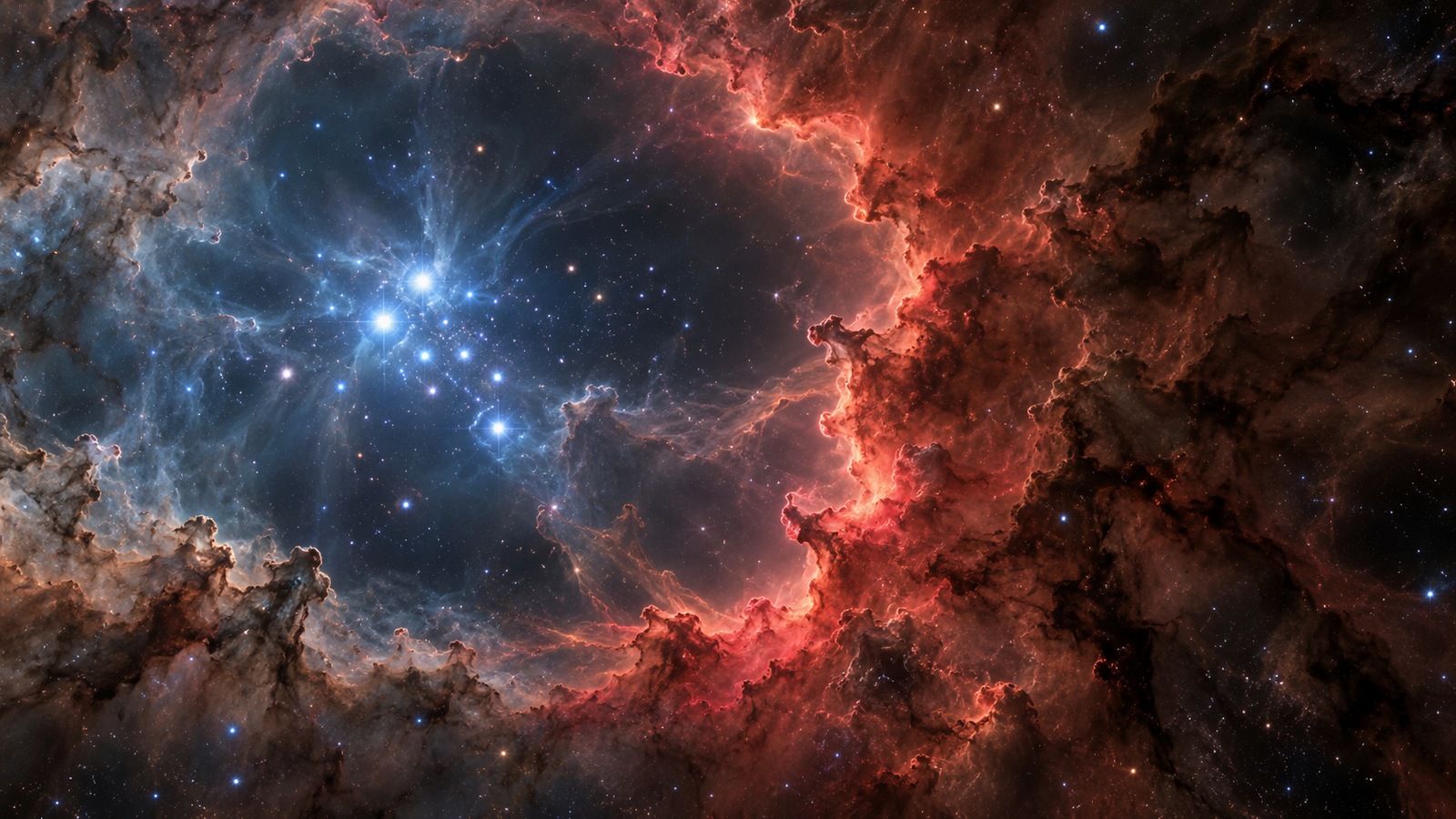
A bright star in a nebula photograph draws attention immediately, but the cloud around it tells a larger story. Its glowing edges reveal where energetic radiation encounters gas, where dust blocks the route, and where a young stellar group has opened space around itself. Calling these stars cosmic lanterns captures the sense of illumination, provided we remember that the cloud does more than reflect their beams. In an emission nebula, radiation transfers energy to the gas, which produces light of its own. The resulting landscape depends on the stars’ temperatures and positions as well as the cloud’s uneven structure. Learning to follow that relationship turns a beautiful patch of color into a map of stellar influence, with dark pockets and bright rims contributing just as much information as the luminous stars.
The Stars That Can Reach Into the Gas
Stars differ in more than how bright they look from Earth. Their surface temperatures determine the distribution of energy among wavelengths, including the ultraviolet photons capable of ionizing hydrogen. A hot, massive young star can supply a powerful ionizing field even when surrounding dust makes it difficult to see in visible light. A cooler star may be conspicuous nearby without providing the energy that sustains the larger nebula. Identifying the illuminating population therefore requires measurements of stellar spectra and locations rather than choosing the most impressive point in a photograph.
The familiar stellar classifications help describe that difference. O stars and the hotter B stars are especially important in many young ionized regions because their radiation includes substantial ionizing output. Their relatively short lives also connect a bright emission cloud to a young stellar population. There is no need to imagine that every star inside the cloud contributes equally. A cluster may contain many faint low-mass members while only a few massive members dominate its energetic relationship with the surrounding gas.
A Cluster Can Share the Work Unevenly
A nebula’s illumination is often a group activity with unequal contributions. Several massive stars can produce overlapping radiation fields, and their relative importance changes across the cloud. A star near one exposed wall may dominate that wall even if another star supplies more of the region’s overall ionizing energy. Distance, intervening material, and the direction in which the cloud opens all affect which source reaches a particular location. This makes a nebula more like an unevenly lit neighborhood than a room served by one central bulb.
Orion offers an unusually accessible example of this spatial distinction. The massive star Theta 1 Orionis C is central to the bright inner nebula, while the importance of other stars becomes clearer farther away. A study of Orion’s ionizing sources examined how Theta 2 Orionis A contributes beyond the Bright Bar toward the extended region. The lesson is broader than the individual names: assigning one illuminating star to an entire complex can hide meaningful changes in the local radiation field.
Astronomers test these assignments by combining the stars’ properties with the gas response. If the inferred stellar radiation cannot explain the observed ionization at a boundary, the geometry or source inventory may need revision. Dust-obscured massive stars, scattered radiation, and uncertain distances within the cloud are possible complications. A satisfying interpretation has to account for the energy arriving at the gas, not simply place a plausible star somewhere in the same image.
The Cloud Is a Landscape With Openings
Interstellar clouds contain sheets, clumps, filaments, and relatively empty channels rather than uniform fog. Energetic photons travel farther through low-density openings and are absorbed sooner where sufficient gas or dust blocks their path. A dense knot may shelter material behind it, while a neighboring gap exposes a deeper surface. The visible nebula selectively highlights places that can both receive energy and send detectable light toward us.
This selection can favor a small exposed surface over a larger reservoir concealed farther back. Comparing the bright gas with measurements of the cold cloud helps establish the region’s actual extent. The illuminated part reveals an accessible interaction, while unilluminated material may still contain much of the mass. Darkness can therefore identify an important part of the cloud’s arrangement rather than an absence of material.
How a Bright Boundary Takes Shape
An ionization front marks the transition between strongly ionized gas and material that remains mostly neutral. Its position depends on the supply of ionizing photons and the rate at which ionized atoms recombine, alongside the evolving gas distribution. At an exposed cloud edge, a thin illuminated layer can appear particularly bright because our line of sight runs through a substantial length of that layer. The luminous rim is therefore not necessarily a dense solid ridge. It can be a viewing effect combined with a real change in the gas state.
A useful comparison is looking along a thin sheet’s edge rather than straight through it. The sideways sightline crosses more material, making the emission more prominent. A bright rim can result from that longer emitting path without requiring a proportionately denser gas.
Real nebular surfaces are curved and broken, and several layers may overlap. Their projected contours therefore combine the gas distribution with our viewing direction. Spectral velocities and other observations help reconstruct which surfaces actually meet and which merely lie along the same sightline.
Heating Changes the Neighborhood Around Young Stars
Radiation does more than make a passive outline shine. Ionized gas is warmer than much of the neighboring molecular material, and the pressure difference can help drive expansion. A young stellar group may consequently develop an ionized cavity bordered by denser cloud material. As the boundary moves, it changes the paths available to radiation and exposes new surfaces. Illumination and structure influence one another over time, so the cloud cannot be understood as scenery that remains fixed while the stars simply switch on.
Stellar winds add another influence. Massive stars expel material that can contribute to cavities and shocks, alongside the effect of radiation heating. These processes are related but have different physical roles, and a photograph alone may not reveal how much each contributes. An observer should not assign every hollow-looking feature to a wind-blown bubble without checking the gas motions and temperatures. A cavity can reflect the combined history of radiation, winds, and the cloud’s original arrangement.
The Orion Nebula is often described using a blister-like geometry: ionized material lies near the exposed face of a larger molecular cloud. NASA’s visible and infrared visualization of Orion helps explain why a cavity can look very different from a closed sphere. The visualization is a reconstruction informed by observations rather than a spacecraft flight through the region. That distinction preserves its usefulness while keeping the underlying uncertainties visible.
Expansion can also reduce the amount of material close to the stars, allowing radiation to reach previously sheltered locations. Whether a particular dense pocket survives, evaporates, or collapses depends on its own mass, pressure, and surroundings. A bright edge does not establish that a new star will form behind it. It establishes an interaction that deserves closer investigation, especially when motion measurements can show whether the gas is being compressed or dispersed.
Dark Features Can Explain the Light
Dust absorbs and scatters radiation, so it can obscure both the illuminating stars and the emission from gas behind it. A dark lane may be a foreground obstruction rather than an empty channel. Conversely, an apparent gap between bright features may really provide an escape route for energetic photons. Distinguishing these possibilities requires observations at additional wavelengths and attention to the surrounding structure. Darkness becomes informative when it is treated as a clue about material placement rather than as a failure of the camera to find something interesting.
Different Views Reveal Different Parts of the Relationship
Visible images emphasize particular glowing gas components and stars that are not heavily obscured. Infrared observations can reveal embedded stellar populations or dust emission that changes the interpretation of a dark patch. Radio measurements offer another way to investigate ionized gas and its motions. Each view samples a different physical process, so combining them can show which stars are present, where their radiation travels, and how the cloud responds. The strongest explanation usually comes from their agreement rather than from the most dramatic color image.
A nebular spectrum helps distinguish an energetic radiation field from a merely bright one. Different ions respond to photons of different energies, while measured line ratios depend on conditions such as temperature and density. These diagnostics let astronomers compare the gas state with the likely stellar population. They must still account for extinction and geometry, because the observed spectrum is filtered by the path to Earth. A well-resolved image and a careful spectrum answer complementary parts of the same physical puzzle.
The timing of stellar evolution matters as well. A cloud illuminated by an extremely hot star may retain a different ionization structure as that star evolves or disappears. The gas response is governed by its physical conditions rather than by an instantaneous visual switch everywhere at once. Reconstructing the history can therefore require more than a present-day inventory of bright stars. The nebula contains both an ongoing interaction and traces of how the neighborhood reached its current state.
What the Lantern Comparison Gets Right
The lantern comparison usefully emphasizes reach and obstruction. Nearby exposed surfaces receive more stellar radiation, while dense structures shelter material behind them. Those unequal paths help connect the visible texture with the relative positions of stars and gas.
The glowing gas also produces its own photons after receiving stellar energy. That distinguishes emission from a dust cloud primarily scattering starlight. Both can occur in one complex, so their locations reveal different interactions even when a finished picture blends them together.
Reading a Nebula Without Inventing Its Interior
A physical reconstruction begins by comparing the identified stars’ spectra with the exposed boundaries, obscuring lanes, and measured gas motions. Longer-wavelength observations can reveal a source hidden from visible-light images. The aim is to trace an actual energy path through the cloud, rather than assign every bright rim to whichever star looks closest in projection.
The Glow Records a Stellar Population in Action
Emission nebulae are useful precisely because stars and gas leave related clues. A hot stellar population supplies energetic radiation, an uneven cloud determines where that energy is absorbed, and the resulting light identifies regions where the interaction can be observed. Geometry, pressure, dust, and stellar evolution modify the pattern. None of these ingredients alone explains the entire image, but together they turn an apparently decorative cloud into a measurable environment.
Orion makes that relationship specific. Theta 1 Orionis C dominates the bright inner region, while Theta 2 Orionis A becomes important in parts of the extended environment beyond the Bright Bar. Their different local roles show why one central-bulb picture is incomplete. A star’s total energetic output and its influence on one surface are different quantities: distance and intervening material change how much radiation arrives. Mapping that local response tests the cloud’s arrangement as well as the inventory of its stars. Following the glow reveals a changing neighborhood in which a few powerful sources influence much more material than their own visible points suggest.


