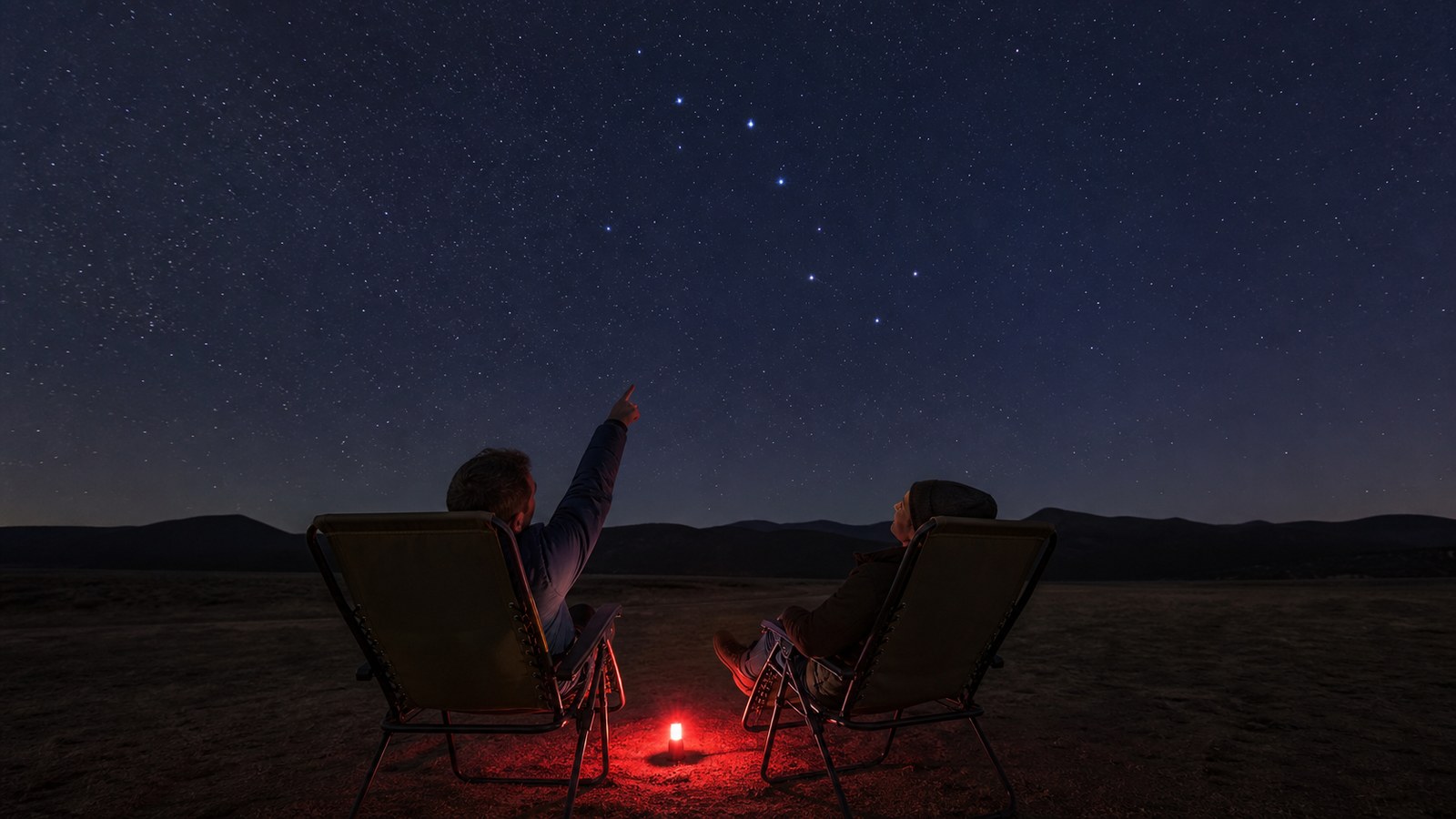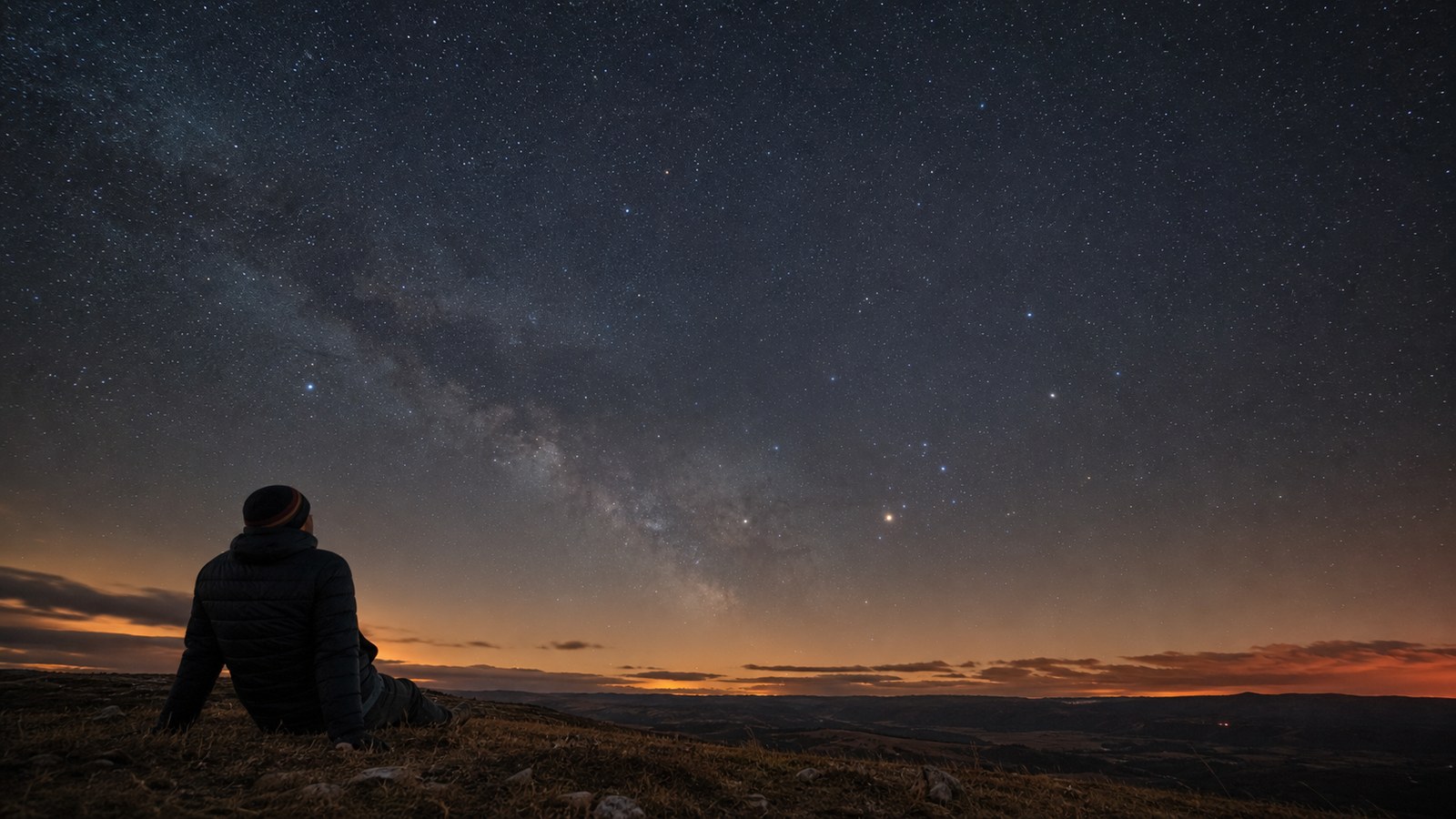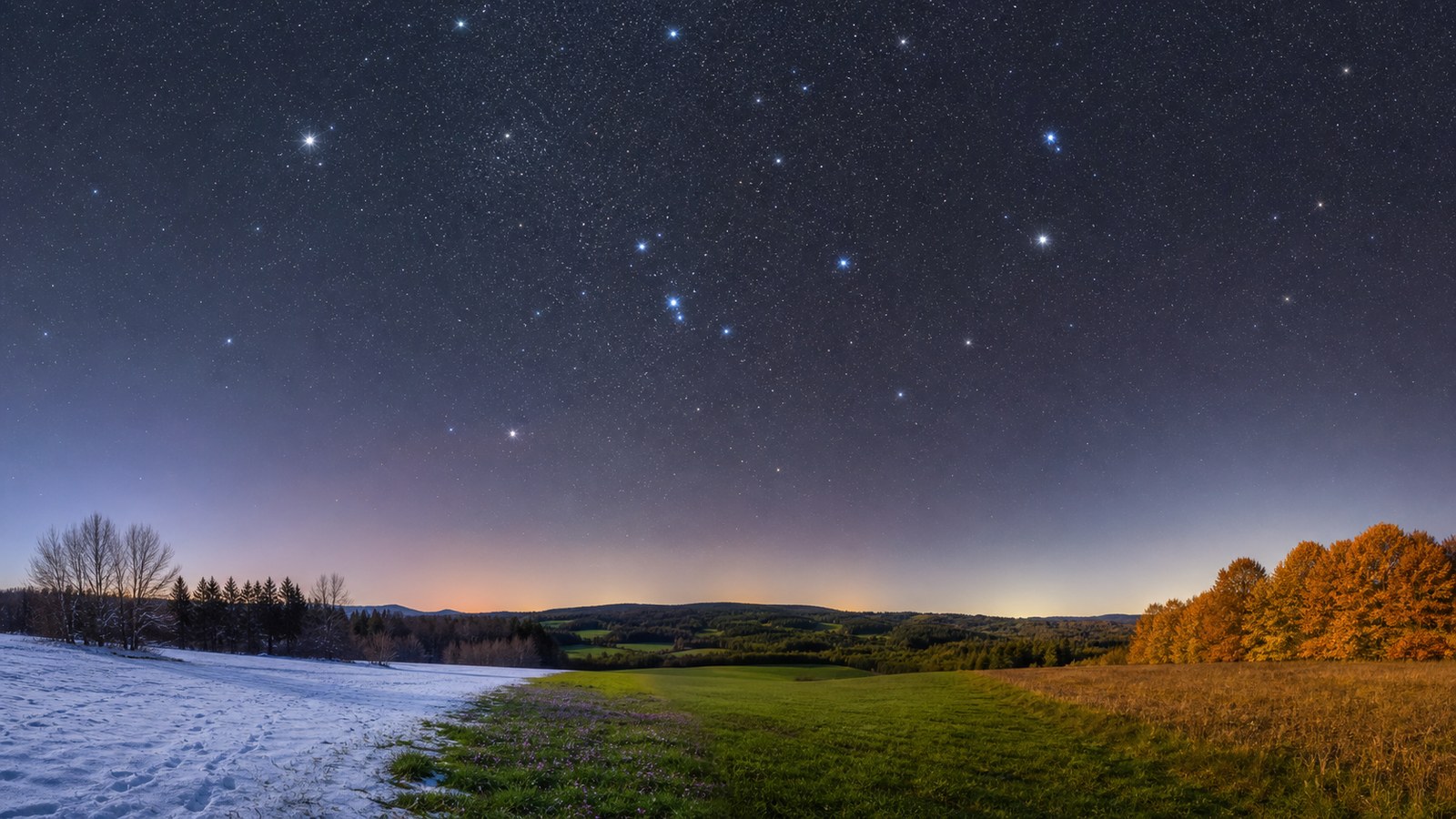
Seasonal constellations are a consequence of Earth's orbit. As our planet moves around the Sun, the nighttime side faces different directions into space, bringing new star fields into the evening sky. Circumpolar patterns remain available from many latitudes, while other constellations rise, dominate, and disappear on a yearly schedule.
Winter: Orion as a Navigation Hub
Orion's bright rectangle and three-star belt make it one of the easiest northern-sky patterns to confirm. This is less a rule to memorize than a relationship to observe. Extending the belt points roughly toward Sirius in one direction and Aldebaran and the Hyades in the other. Use Orion to locate Canis Major, Taurus, Gemini, and the bright winter hexagon. The constellation rises sideways and rotates through the night, so a fixed upright diagram may not match its orientation. The most useful response is to observe the result, note the conditions, and adjust one variable at a time. That record makes the lesson transferable instead of leaving it as a one-night impression.
Use Orion to locate Canis Major, Taurus, Gemini, and the bright winter hexagon. A simple check before the session prevents a much harder correction later. The constellation rises sideways and rotates through the night, so a fixed upright diagram may not match its orientation. Orion's bright rectangle and three-star belt make it one of the easiest northern-sky patterns to confirm. Extending the belt points roughly toward Sirius in one direction and Aldebaran and the Hyades in the other. The most useful response is to observe the result, note the conditions, and adjust one variable at a time. Over time, those small checks become automatic and free attention for finer detail.
Spring: Follow the Arc
The Big Dipper's handle supports the mnemonic arc to Arcturus and speed on to Spica. The safest assumption is that conditions will vary and the plan must adapt. This long curve links an easy circumpolar pattern to Boötes and Virgo as spring galaxies occupy darker surrounding fields. Confirm Arcturus by its warm color, then continue the same curve toward blue-white Spica. The Big Dipper is an asterism within Ursa Major, not a complete constellation by itself. The most useful response is to observe the result, note the conditions, and adjust one variable at a time. A second attempt under changed conditions will reveal whether the first result was typical.
Confirm Arcturus by its warm color, then continue the same curve toward blue-white Spica. Planning improves once this constraint is treated as part of the system. The Big Dipper is an asterism within Ursa Major, not a complete constellation by itself. The Big Dipper's handle supports the mnemonic arc to Arcturus and speed on to Spica. This long curve links an easy circumpolar pattern to Boötes and Virgo as spring galaxies occupy darker surrounding fields. The most useful response is to observe the result, note the conditions, and adjust one variable at a time. The same reasoning can then be applied to more difficult targets or environments.
Summer: The Triangle and the Milky Way
Vega, Deneb, and Altair form the large Summer Triangle across Lyra, Cygnus, and Aquila. The strongest evidence comes from what changes when one condition is altered. The Milky Way passes through this region, with Cygnus aligned along a rich band of stars and dark dust. Start with brilliant Vega, identify cross-shaped Cygnus, and then close the triangle at Altair. Urban skyglow can hide the Milky Way while leaving all three triangle stars plainly visible. The most useful response is to observe the result, note the conditions, and adjust one variable at a time. When uncertainty remains, choose the more conservative interpretation and gather another observation.
Start with brilliant Vega, identify cross-shaped Cygnus, and then close the triangle at Altair. The concept gains value when it leads to a specific decision. Urban skyglow can hide the Milky Way while leaving all three triangle stars plainly visible. Vega, Deneb, and Altair form the large Summer Triangle across Lyra, Cygnus, and Aquila. The Milky Way passes through this region, with Cygnus aligned along a rich band of stars and dark dust. The most useful response is to observe the result, note the conditions, and adjust one variable at a time. Keep the observation tied to time, direction, and conditions so it can be compared later.
Autumn: The Great Square
The Great Square of Pegasus provides a large geometric anchor in a season with fewer extremely bright stars. The result is not merely aesthetic; it changes what information can be perceived. A chain extending from one corner leads through Andromeda toward the naked-eye region of the Andromeda Galaxy. Check that the square is truly large, then trace Andromeda's curved chain away from Alpheratz. Beginners often select a smaller quadrilateral because charts compress angular scale. The most useful response is to observe the result, note the conditions, and adjust one variable at a time. The goal is a repeatable result, not a single lucky success.
Check that the square is truly large, then trace Andromeda's curved chain away from Alpheratz. A useful way to test the idea is through repeated comparison. Beginners often select a smaller quadrilateral because charts compress angular scale. The Great Square of Pegasus provides a large geometric anchor in a season with fewer extremely bright stars. A chain extending from one corner leads through Andromeda toward the naked-eye region of the Andromeda Galaxy. The most useful response is to observe the result, note the conditions, and adjust one variable at a time. That record makes the lesson transferable instead of leaving it as a one-night impression.
Circumpolar Guides
From mid-northern latitudes, Ursa Major, Ursa Minor, Cassiopeia, Cepheus, and Draco circle the north celestial pole without setting. Experience tends to confirm the value of a controlled approach. Their orientation changes hourly and seasonally as Earth rotates, but their relationship to Polaris remains stable. Use the Big Dipper's pointer stars or Cassiopeia's shape to estimate the direction of Polaris. Polaris is useful because of its position near the pole, not because it is the brightest star in the sky. The most useful response is to observe the result, note the conditions, and adjust one variable at a time. This approach preserves both accuracy and the enjoyment of discovery.
Use the Big Dipper's pointer stars or Cassiopeia's shape to estimate the direction of Polaris. A careful observer can turn this limitation into a diagnostic tool. Polaris is useful because of its position near the pole, not because it is the brightest star in the sky. From mid-northern latitudes, Ursa Major, Ursa Minor, Cassiopeia, Cepheus, and Draco circle the north celestial pole without setting. Their orientation changes hourly and seasonally as Earth rotates, but their relationship to Polaris remains stable. The most useful response is to observe the result, note the conditions, and adjust one variable at a time. A second attempt under changed conditions will reveal whether the first result was typical.
Southern-Hemisphere Reversal
Seasonal labels and poleward directions reverse across hemispheres, and many northern guide stars disappear below the horizon. A simple check before the session prevents a much harder correction later. Observers at southern latitudes use patterns such as Crux and the Southern Pointers for orientation. Set charts to exact latitude and avoid assuming that a northern seasonal guide applies worldwide. A constellation visible from both hemispheres may appear inverted, which changes familiar tracing directions. The most useful response is to observe the result, note the conditions, and adjust one variable at a time. Over time, those small checks become automatic and free attention for finer detail.
Set charts to exact latitude and avoid assuming that a northern seasonal guide applies worldwide. This relationship becomes easier to understand when the variables are separated. A constellation visible from both hemispheres may appear inverted, which changes familiar tracing directions. Seasonal labels and poleward directions reverse across hemispheres, and many northern guide stars disappear below the horizon. Observers at southern latitudes use patterns such as Crux and the Southern Pointers for orientation. The most useful response is to observe the result, note the conditions, and adjust one variable at a time. When uncertainty remains, choose the more conservative interpretation and gather another observation.
A chain extending from one corner leads through Andromeda toward the naked-eye region of the Andromeda Galaxy. Long-term skill develops by noticing this pattern repeatedly. Check that the square is truly large, then trace Andromeda's curved chain away from Alpheratz. Beginners often select a smaller quadrilateral because charts compress angular scale. The Great Square of Pegasus provides a large geometric anchor in a season with fewer extremely bright stars. The most useful response is to observe the result, note the conditions, and adjust one variable at a time. The same reasoning can then be applied to more difficult targets or environments.
Their orientation changes hourly and seasonally as Earth rotates, but their relationship to Polaris remains stable. The underlying physics also explains a common surprise. Use the Big Dipper's pointer stars or Cassiopeia's shape to estimate the direction of Polaris. Polaris is useful because of its position near the pole, not because it is the brightest star in the sky. From mid-northern latitudes, Ursa Major, Ursa Minor, Cassiopeia, Cepheus, and Draco circle the north celestial pole without setting. The most useful response is to observe the result, note the conditions, and adjust one variable at a time. The goal is a repeatable result, not a single lucky success.
This long curve links an easy circumpolar pattern to Boötes and Virgo as spring galaxies occupy darker surrounding fields. This is where technique matters more than expensive equipment. Confirm Arcturus by its warm color, then continue the same curve toward blue-white Spica. The Big Dipper is an asterism within Ursa Major, not a complete constellation by itself. The Big Dipper's handle supports the mnemonic arc to Arcturus and speed on to Spica. The most useful response is to observe the result, note the conditions, and adjust one variable at a time. That record makes the lesson transferable instead of leaving it as a one-night impression.
Extending the belt points roughly toward Sirius in one direction and Aldebaran and the Hyades in the other. The distinction matters because similar-looking outcomes can have different causes. Use Orion to locate Canis Major, Taurus, Gemini, and the bright winter hexagon. The constellation rises sideways and rotates through the night, so a fixed upright diagram may not match its orientation. Orion's bright rectangle and three-star belt make it one of the easiest northern-sky patterns to confirm. The most useful response is to observe the result, note the conditions, and adjust one variable at a time. A second attempt under changed conditions will reveal whether the first result was typical.
A Practical Next Session
Learn each season through one anchor: Orion in winter, the Big Dipper's arc in spring, the Summer Triangle, and the Great Square in autumn. Connect those shapes to neighboring constellations while remembering that orientation changes through the night. After one year, the returning patterns become a visible calendar.