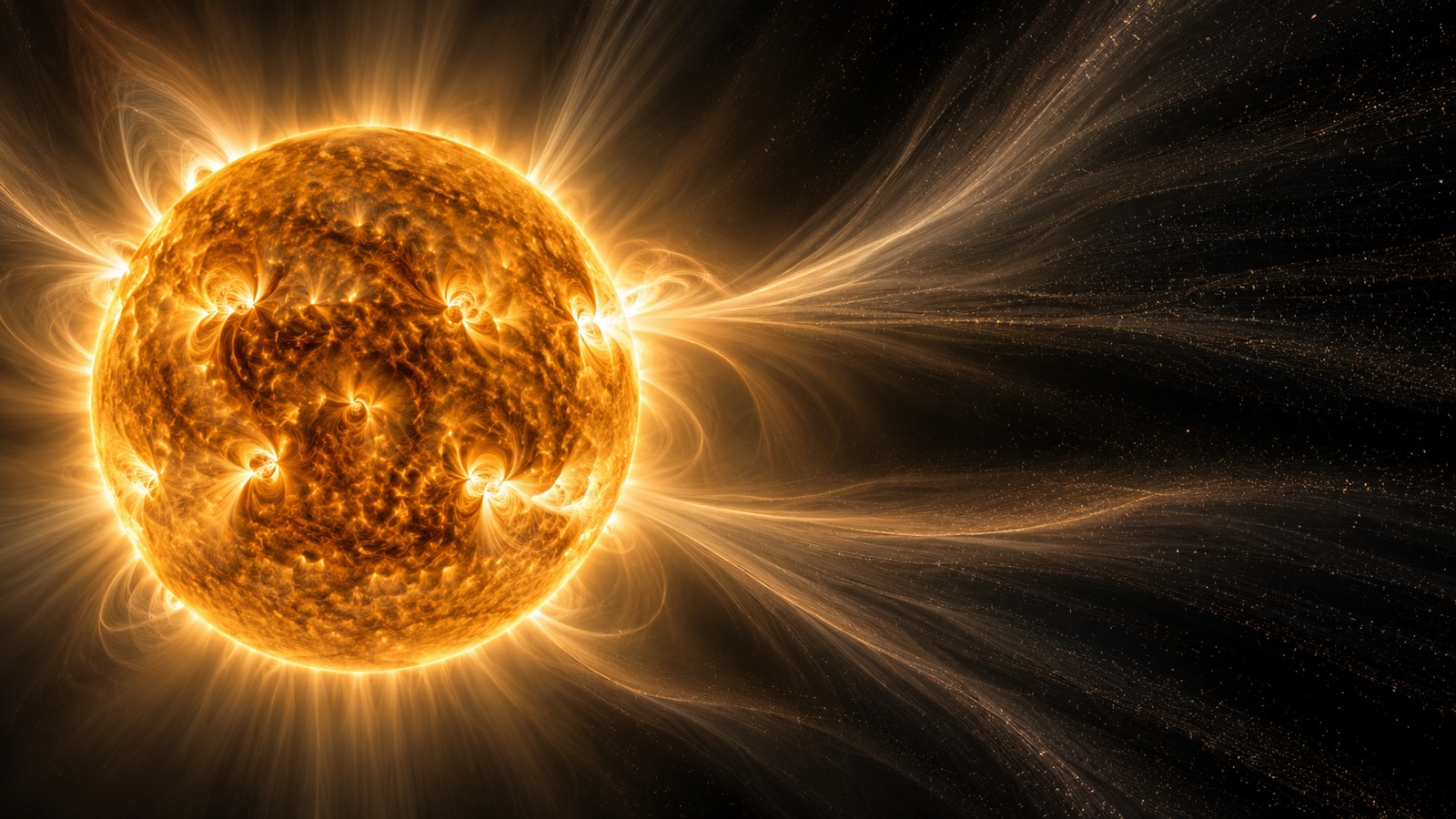
In a feat that once belonged to the realm of science fiction, NASA’s Parker Solar Probe — officially known as PSP (Parker Solar Probe) — has achieved the impossible: flying directly into the Sun’s atmosphere. This pioneering spacecraft, named after solar physicist Dr. Eugene Parker, is rewriting what humanity knows about our nearest star and the forces that govern the solar system. Since its launch in 2018, the Parker Solar Probe has been on a daring journey to “touch the Sun,” skimming through the blazing outer layers of the Sun’s atmosphere — the corona — to uncover the mysteries of solar wind, magnetism, and energetic particles. Its mission is as ambitious as it is dangerous, and its discoveries are transforming how scientists understand space weather and the Sun’s fundamental behavior.
A Mission That Dared to Defy the Impossible
For decades, scientists dreamed of sending a spacecraft close enough to study the Sun directly. But there was always one enormous challenge: heat. Temperatures near the Sun can soar to more than 2,500°F (1,377°C) — hot enough to melt most metals. Getting anywhere near that inferno seemed impossible. Then, in the early 2000s, new materials and mission designs reignited the dream. NASA engineers realized they could build a heat shield capable of protecting instruments from the Sun’s extreme radiation. This breakthrough paved the way for one of the boldest missions in human history. Launched on August 12, 2018, from Cape Canaveral aboard a Delta IV Heavy rocket, the Parker Solar Probe began its journey inward, using a series of gravity assists from Venus to gradually tighten its orbit around the Sun. Over the course of seven years, it will complete 24 close passes, coming within just 3.83 million miles (6.16 million kilometers) of the solar surface — closer than any spacecraft before or since.
Why the Sun Matters More Than Ever
The Sun isn’t just a fiery ball of gas lighting up our sky — it’s the dynamic engine that powers every process in the solar system. Its radiation, solar winds, and magnetic storms influence everything from satellite operations to power grids on Earth.
Understanding the Sun’s behavior isn’t just scientific curiosity — it’s essential for modern civilization. Solar flares and coronal mass ejections (CMEs) can disrupt GPS systems, radio communications, and even electrical infrastructure. The more we understand these phenomena, the better we can predict and protect against them.
The Parker Solar Probe was designed to study precisely these processes — to explore how the solar wind forms, how the corona heats up to millions of degrees, and how magnetic fields accelerate particles across the solar system. These are not just academic questions; their answers will help build a safer technological future on Earth and beyond.
Dr. Eugene Parker: The Visionary Behind the Mission
It’s rare for NASA to name a mission after a living person, but Dr. Eugene Parker earned that distinction through his groundbreaking work in solar physics. In 1958, Parker proposed the theory of the solar wind — a continuous stream of charged particles flowing outward from the Sun.
At the time, his theory was met with skepticism. Many scientists dismissed the idea that the Sun could continuously blow material into space. But observations soon confirmed Parker’s predictions, forever changing our understanding of the Sun and its influence on planets.
By naming the spacecraft after him, NASA honored not only Parker’s scientific legacy but also his spirit of daring innovation — the same spirit that now propels the probe bearing his name directly into the Sun’s fiery domain.
Engineering a Spacecraft for the Inferno
The Parker Solar Probe is an engineering marvel. Every component was meticulously designed to survive — and thrive — in an environment no spacecraft had ever faced before. Its most vital piece is the Thermal Protection System (TPS) — an 8-foot-wide, 4.5-inch-thick carbon-composite shield capable of withstanding temperatures up to 2,500°F (1,377°C) while keeping the spacecraft’s instruments at a comfortable 85°F (29°C). This heat shield, built from carbon-carbon foam sandwiched between carbon plates, is both lightweight and incredibly resilient. It reflects most of the Sun’s energy, while radiators and insulation help regulate internal temperatures. Behind this protective barrier, a suite of instruments gathers priceless data — measuring magnetic fields, solar particles, and plasma waves while taking images of the corona. Every second of operation requires flawless precision. If the spacecraft tilts even slightly, its instruments could be destroyed by direct solar radiation. To prevent that, the probe’s autonomous navigation system continuously adjusts its orientation using tiny thrusters, ensuring the heat shield always faces the Sun. It’s a ballet of engineering, performed in one of the harshest environments imaginable.
Venus: The Silent Partner in Solar Exploration
To reach its ultimate goal, Parker couldn’t just dive straight toward the Sun. Doing so would require enormous energy — far more than any rocket could provide. Instead, the mission uses a clever celestial trick: gravity assists from Venus.
By flying close to Venus multiple times, the probe uses the planet’s gravity to slow down its orbital speed, allowing it to spiral closer to the Sun with each pass.
Over the course of its seven-year journey, Parker will make seven Venus flybys, each one tightening its orbit and bringing it deeper into the corona. These gravitational slingshots are carefully timed and precisely calculated — a dance between two worlds that allows humanity to approach the Sun safely for the first time.
Touching the Sun: A Historic Milestone
In December 2021, the Parker Solar Probe achieved what no other spacecraft had ever done: it entered the Sun’s atmosphere. Crossing the Alfvén critical surface, the boundary where solar material transitions from being magnetically bound to freely streaming outward as solar wind, Parker effectively “touched” the Sun. Inside the corona, the probe directly sampled solar plasma and magnetic fields, providing the first-ever in situ data from this region. Scientists detected switchbacks — rapid reversals in the Sun’s magnetic field — and unexpected particle behaviors, offering tantalizing clues about how solar wind is generated. This moment marked a turning point in solar science. For the first time, humanity wasn’t just observing the Sun from afar; we were flying through its atmosphere, collecting data from the source.
What We’re Learning About the Solar Wind
Before Parker, the solar wind was one of the Sun’s greatest mysteries. Scientists knew it originated in the corona, but not exactly how or why it accelerated to supersonic speeds.
The probe’s measurements have revealed that the solar wind isn’t uniform — it’s turbulent, filled with swirls, waves, and magnetic kinks. These switchbacks seem to play a key role in transporting energy and momentum away from the Sun.
By tracing these features back to their origins, Parker is helping scientists understand how the solar wind escapes the Sun’s magnetic grip, shaping the space environment around every planet, including Earth.
This information is vital for predicting space weather, the stream of energetic particles that can interfere with satellites, astronauts, and even terrestrial technologies. Parker’s insights are literally helping to build a shield for our civilization.
Unraveling the Mystery of the Superheated Corona
One of the oldest puzzles in solar physics is why the corona — the Sun’s outer atmosphere — is so much hotter than the surface below it. The Sun’s surface, or photosphere, measures about 10,000°F (5,500°C), but the corona can reach over 2 million°F (1.1 million°C). That seems backward. Normally, the farther from a heat source, the cooler it should get. Yet the Sun defies that logic. Parker’s close encounters are shedding light on this enigma. Data suggest that magnetic waves and reconnection events — where magnetic field lines break and reconnect — release vast amounts of energy into the corona, heating it from within. By directly sampling these regions, the probe is helping to confirm decades of theory, revealing how chaotic magnetic processes drive one of the most extreme environments in the solar system.
Riding the Solar Storms
Solar storms are among the most powerful forces in nature. When magnetic fields on the Sun twist and snap, they release coronal mass ejections (CMEs) — colossal bursts of plasma that can carry billions of tons of material traveling at millions of miles per hour.
Parker has flown through several of these storms, capturing unprecedented data. It has measured how CMEs evolve near their origin, how magnetic fields twist through space, and how shock waves accelerate particles to nearly the speed of light.
By studying these storms up close, scientists can better forecast how such eruptions might affect Earth. The goal is to develop early-warning systems for solar weather, protecting satellites, astronauts, and even power grids from dangerous surges of radiation.
The Role of Dust: A Hidden Story
One of Parker’s unexpected findings involves cosmic dust — tiny grains left over from comets, asteroids, and planetary formation. Near the Sun, dust doesn’t behave as it does elsewhere. The intense radiation causes it to vaporize, creating a “dust-free zone” around the star. Parker’s instruments have detected signs of this region, helping confirm long-standing predictions. Understanding this dust environment matters because it influences everything from how light scatters around the Sun to how solar wind interacts with interplanetary particles. It’s a small detail with big implications for solar system science.
Autonomy Under Fire: The Probe That Flies Itself
Because Parker operates so close to the Sun, communication delays make real-time control impossible. Commands from Earth can take up to 16 minutes to reach the spacecraft. During that time, conditions can change dramatically. To survive, Parker is equipped with advanced autonomous systems that monitor its health and adjust orientation without human input. If the spacecraft senses that its instruments are exposed to direct sunlight, it can instantly correct its position — all while continuing to collect data. This self-reliance marks a new era in spacecraft design, paving the way for future missions to other extreme environments, from Mercury to exoplanetary systems.
Living on the Edge: Extreme Science in Action
Every orbit brings Parker closer to the Sun — and greater peril. During its final planned orbits, it will travel at an astonishing 430,000 miles per hour (700,000 kilometers per hour), making it the fastest human-made object ever built.
At that speed, it could fly from New York to Tokyo in under a minute. Yet even at such velocities, it must maintain precise alignment and continuous observation. The margin for error is virtually zero.
Each pass through the corona provides new opportunities — and new dangers. Microscopic dust particles can strike with immense energy, while radiation continuously bombards its instruments. But Parker endures, a shining testament to human ingenuity and resilience.
Venus’ Unexpected Gift: A Bonus Discovery
While Parker’s main mission focuses on the Sun, its Venus flybys have also delivered surprises. During one close pass, the probe detected radio emissions from Venus’ upper atmosphere — the first direct measurement of this region in nearly 30 years. This data helped scientists map how Venus’ atmosphere changes over time, especially as solar activity fluctuates. It’s a reminder that every journey through space can yield discoveries beyond its original mission goals. Venus, often seen as Earth’s twin gone wrong, continues to offer valuable insights into planetary evolution — and Parker, while chasing the Sun, has become an unexpected planetary explorer as well.
Transforming Solar Science: A Legacy of Discovery
The Parker Solar Probe isn’t just collecting data — it’s revolutionizing an entire field. Its measurements have already led to hundreds of scientific papers, reshaping theories about solar wind, plasma physics, and magnetic turbulence.
Each discovery builds a more complete picture of how the Sun influences every corner of the solar system. From auroras on Earth to radiation hazards for Mars-bound astronauts, Parker’s insights are foundational to space exploration’s future.
It’s no exaggeration to say that Parker is the most important solar mission ever launched. It’s not only expanding our scientific understanding but also demonstrating that humanity can design machines capable of enduring conditions once thought unsurvivable.
The Human Story: Courage and Curiosity
Behind the gleaming technology and groundbreaking science lies a human story — one of vision, persistence, and courage. Engineers and scientists spent decades turning an impossible idea into reality. They had to invent materials, reimagine spacecraft control, and overcome countless setbacks.
When Dr. Eugene Parker himself attended the 2018 launch, he watched in awe as the spacecraft bearing his name ascended toward the Sun. It was a poetic full circle: the scientist who first imagined solar wind witnessing humanity’s attempt to chase its source.
In 2022, after Dr. Parker’s passing, the spacecraft continued its mission — a living tribute to his legacy and the spirit of exploration that defines human achievement.
The Future of Solar Exploration
The Parker Solar Probe’s mission is far from over. It will continue its series of close passes through 2025, with each orbit tightening and temperatures increasing. Its data will inform future missions, such as the European Space Agency’s Solar Orbiter, which complements Parker’s work with imaging and remote sensing from a safer distance. Together, these missions represent a golden era of heliophysics — the study of the Sun and its influence throughout space. Future explorers may one day send probes even deeper into the corona, or deploy fleets of miniaturized spacecraft to map the solar environment in three dimensions. Each new mission will stand on the foundation Parker has built.
Why Parker’s Mission Matters for Earth’s Future
In an age when our world depends on technology, understanding the Sun is no longer optional — it’s critical. The Parker Solar Probe’s data helps us anticipate and mitigate solar storms that could threaten satellites, aviation, and even electrical grids.
It also helps scientists refine climate models by improving our understanding of solar variability — how the Sun’s changing energy output affects Earth’s atmosphere and climate.
And beyond practical concerns, Parker’s mission speaks to something deeper: the human drive to confront danger and seek knowledge. To fly into the Sun is to face the very source of life — and to come away enlightened.
The Fastest, Hottest, Most Daring Mission Ever
The Parker Solar Probe’s achievements can be summed up by its records:
- Closest approach to the Sun: Within 3.83 million miles of the surface.
- Fastest human-made object: 430,000 mph (700,000 km/h).
- First spacecraft to enter the Sun’s atmosphere.
But its true legacy lies not in numbers, but in understanding. Each byte of data Parker sends back helps answer fundamental questions about how stars work — questions that echo across galaxies.
By studying our own Sun up close, we also learn how other stars behave, why their planets might be habitable, and how cosmic forces shape the universe.
Humanity’s Brightest Frontier
The Parker Solar Probe is more than a machine — it’s a message. It declares that humanity is no longer content to watch the stars from afar. We are explorers, engineers, and dreamers, daring to touch the very heart of creation. From its carbon armor to its graceful orbit through fire, Parker represents the pinnacle of human ingenuity. It has turned the impossible into the achievable and illuminated mysteries that have burned unanswered for centuries. As it continues to circle closer to the Sun, the Parker Solar Probe reminds us that every discovery begins with courage — the courage to face the unknown, to fly into the light, and to emerge forever changed.