Saturn Offers a Reason to Look Beyond Our Solar System
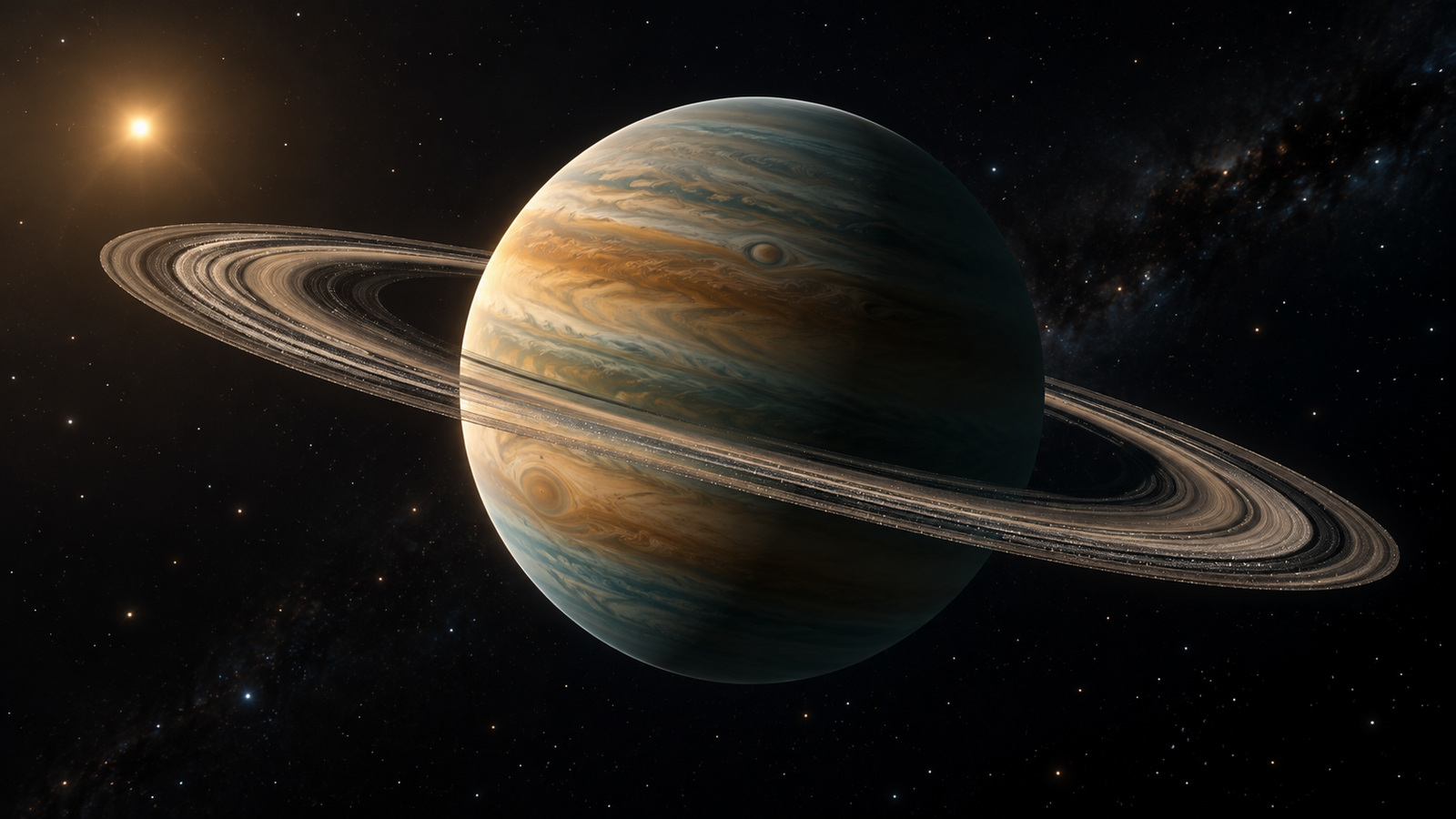
Saturn’s rings are spectacular, but the processes that arrange particles around a planet do not belong exclusively to our neighborhood. Gravity, collisions, shattered moons, and leftover material should operate around distant worlds too. Exoplanets could therefore have rings, including systems that resemble Saturn’s and others with different sizes, compositions, or lifetimes. Establishing that a particular distant planet has them is much harder. Astronomers usually measure tiny changes in starlight rather than resolve the planet itself, and several phenomena can imitate a ring’s signature. The useful distinction is between a physically reasonable expectation and an observationally secure discovery. Following that distinction turns the search for extrasolar rings into a rich investigation of planetary environments, with Saturn serving as a guide rather than a guarantee that every attractive artist’s impression depicts a real system.
A Ring Is a Population of Orbiting Pieces
A planetary ring is not a solid hoop rotating as one object. It consists of many separate particles traveling around a planet, with their orbital speeds depending on distance from the center. Some material may be dust, while larger pieces can be much more substantial. Repeated collisions tend to reduce motion perpendicular to the main orbital plane, helping a broad cloud settle into a relatively flat arrangement. That flattening makes a ring recognizable, but it does not make the structure rigid or permanent.
Saturn’s bright main rings contain abundant water ice, yet an extrasolar ring need not share that recipe. Temperature and available material matter: ice can survive in environments where it would disappear near a hot star, while rocky debris tolerates stronger heating. The appearance also depends on particle size, reflectivity, thickness, and the angle of illumination. A dark rocky ring could be physically extensive while contributing little reflected light. Conversely, a bright icy ring might look impressive without containing an enormous total mass.
Several Routes Can Supply the Material
One plausible source is the disruption of a moon. If a satellite approaches sufficiently close to its planet, differences in the planet’s gravitational pull across the satellite can overcome its ability to remain intact. The relevant boundary is called the Roche limit, although its exact location depends on densities, internal strength, and the body’s structure. Material released there can occupy neighboring orbits instead of immediately rebuilding a large moon. This offers a general physical route to rings without requiring an exact replay of Saturn’s still debated history.
Collisions provide another supply mechanism. An impact on a satellite can throw debris into orbit, and collisions between bodies may distribute fragments more broadly. Whether those fragments become a lasting ring depends on their velocities and subsequent gravitational interactions. Some escape, some strike the planet, and some reaccrete into satellites. The existence of a debris-producing event alone cannot establish the final architecture. A successful ring explanation must account for both the material’s arrival and its continued orbital organization.
A young planet may also possess a surrounding disk from its formation. Such a disk can contain gas and solids and may eventually produce moons, so it should not automatically be called a mature Saturn-like ring. Age supplies an essential distinction: a large, evolving circumplanetary disk around a young object can occupy a very different environment from a thin particulate ring around an older planet. Observational descriptions should retain that distinction even when both systems make complicated patterns in a star’s light.
The Star Sets an Outer Gravitational Boundary
A planet’s surroundings are not isolated from its host star. Astronomers use the Hill sphere as an approximate description of the region where the planet’s gravity can maintain nearby companions against stellar disturbance. Stable rings must fit comfortably within the usable part of that region, and stability varies with orbital direction and other details. A planet close to its star has less gravitational room than a similar planet farther out. Extremely broad rings are therefore harder to maintain around many close-orbiting planets than around distant ones.
The inner and outer constraints serve different purposes. The Roche limit concerns whether a body can resist disruption or material can gather into a satellite; the Hill sphere concerns the competition between the planet and the star. Neither supplies a universal fixed ring diameter. Planet mass, particle density, orbital eccentricity, and satellite perturbations all affect the outcome. A dramatic illustration showing rings many planet radii wide may be reasonable for one environment and unstable for another. The host orbit belongs in the physical explanation, even when it is absent from the picture.
Close-Orbiting Giants Face Additional Obstacles
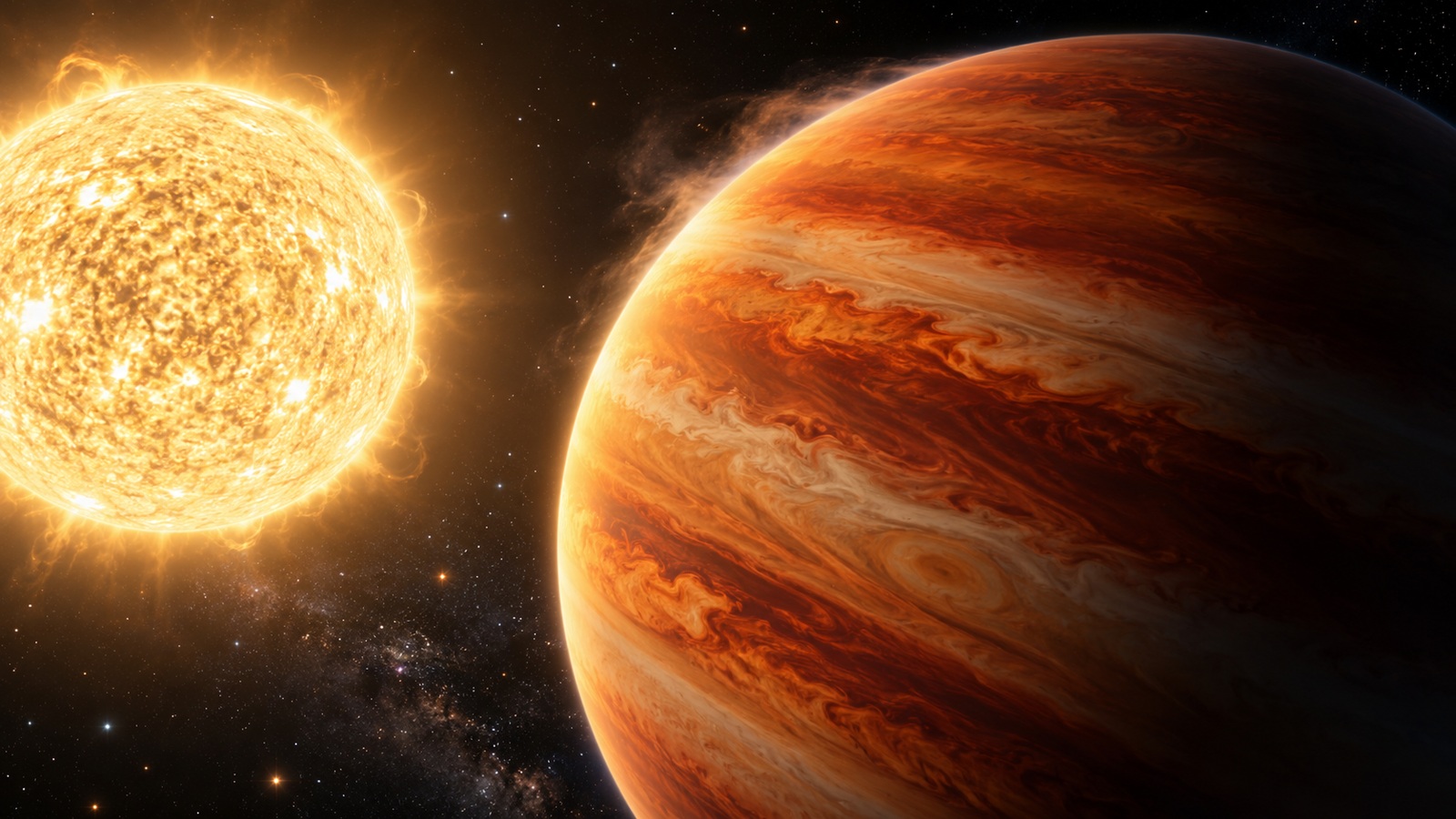
Many readily detected exoplanets orbit close to their stars, precisely where a cold icy ring faces difficult conditions. Stellar heating can remove volatile material, radiation acts on small particles, and tidal interactions can alter planetary rotation and the orientation of surrounding material. A ring’s plane also need not keep the same orientation at every distance from the planet because the planet’s equatorial bulge and the star’s influence compete. These effects do not prove that close planets can never have rings; they mean that material, geometry, and lifetime must be assessed together. A possible rocky ring around a hot giant is a different proposition from a wide icy Saturn analog.
A Transit Can Reveal More Than a Round Planet
When a planet crosses its star, it blocks a fraction of the stellar disk and produces a transit light curve. A bare, approximately spherical planet has a recognizable ingress and egress, shaped partly by the star’s brightness distribution. Rings can begin blocking light before the planetary disk enters and continue after it leaves. Depending on tilt and opacity, they may broaden the event or produce subtle deviations from an ordinary transit. The signal records projected area, so a nearly edge-on ring may be difficult to recognize even if it is physically large.
Ring interpretation also changes the meaning of an inferred planetary radius. If a fitting model assumes all the blocked light comes from a round planet, extra obscuration by rings can make the planet appear larger than it is. This is a potential explanation to test, not a reason to reclassify every unusually large planet. A good analysis asks whether the ring model improves the detailed shape, remains dynamically viable, and agrees with other measurements. Stellar spots, neighboring stars, instrument behavior, and other orbiting material can complicate the same data.
Repeated observations are especially valuable because they test whether the proposed geometry predicts future events. Different wavelengths can reveal whether the obscuration behaves like large opaque particles or fine dust, though interpretation remains model dependent. Changes in ring orientation could modify the transit shape over time, offering another possible diagnostic. None of these measurements is a direct photograph of individual particles. Together, however, they can narrow the range of structures compatible with a distant system and expose explanations that initially seemed equally convincing.
J1407 Shows Both the Appeal and the Difficulty
The young star commonly called J1407 underwent a complicated sequence of dimming events lasting 56 days around April 2007. A published ring model fitted that light curve with material around an unseen companion, often named J1407b. Its best-fitting outer radius was about 0.6 astronomical unit, or ninety million kilometers from the companion: an immense modeled structure, rather than a directly photographed ring boundary. An astronomical unit is approximately Earth’s distance from the Sun, so the proposed radius alone exceeds half that familiar separation. The observations establish the prolonged, structured dimming; the enormous ring extent follows from assumptions about motion, geometry, and opacity. That distinction preserves the event’s significance without turning its interpretation into a confirmed planet-and-ring discovery.
Follow-up work illustrates why a memorable model is not automatically a confirmed ringed planet. Research using historical photographic plates found no additional comparable eclipses and discussed difficulties for a bound-companion interpretation. Other studies examined whether such a broad ring system could remain stable. The companion’s existence, orbit, and classification should therefore retain their uncertainty in popular accounts. J1407 is a compelling candidate event and a useful scientific case study; it is unsuitable as an unquestioned example of a photographed extrasolar Saturn.
Saturn-Like Does Not Mean Saturn-Sized
The phrase Saturn-like can refer to several separate properties: a thin disk, abundant ice, sharp divisions, or an eye-catching appearance. Those properties need not occur together. A ring may be narrow and dark, broad and dusty, warped, or associated with a young moon-forming environment. A planet may also have several separated rings rather than one continuous dense disk. Comparing each property independently keeps the analogy useful. Otherwise, a familiar name can smuggle unsupported details into a system for which only an unresolved light curve exists.
Moons help shape many ring environments through gravitational resonances and repeated encounters. A gap can be consistent with a satellite’s influence, but its identification depends on the evidence and the model. Patterns can also arise through particle interactions or variations in the initial distribution. In a distant system, an appealing gap interpretation remains indirect until it survives competing explanations. The goal is not to remove imaginative possibilities from the discussion, but to give each one an evidential status proportionate to what observations actually measure.
Lifetimes create another difference between possible rings and common detectable rings. Collisions grind material, small particles respond to radiation and drag, and material can spread, fall onto the planet, or gather into moons. Replenishment may keep some structures visible, while others exist for comparatively brief stages. A survey’s detection rate therefore reflects geometry and timing as well as how often rings form. Failing to find a ring around a particular planet cannot establish that its entire history lacked one.
Direct Images Would Still Require Careful Interpretation
A future telescope capable of separating planetary light from stellar glare could search for excess brightness, polarization, or an extended shape consistent with rings. Even then, a bright surrounding structure might be dust rather than a settled particulate ring, and unresolved atmospheric properties could affect the signal. Direct imaging also favors particular separations and young luminous objects, introducing different biases from transit surveys. More detailed pictures would improve the investigation greatly, but the same scientific task would remain: connect a measured signal to a viable physical structure while checking alternatives.
What a Persuasive Discovery Would Bring Together
A strong claim would connect several kinds of evidence rather than rely on a single unusual dip. The planet or companion should have a credible identification and orbit, the obscuration should be reproduced by a well constrained ring geometry, and that geometry should survive appropriate stability tests. Follow-up observations should agree with its predictions, including future events when accessible. Reporting uncertainty is part of this assessment, especially where an orbital period is long or the signal appears only once. Practical limitations can keep an interesting candidate unresolved for years.
Exoplanet rings remain a reasonable expectation because our own system demonstrates that planets can maintain orbiting particulate material under diverse conditions. The open issue is which distant systems possess observable rings and how confidently we can identify them. Saturn supplies a starting point for that reasoning, not a universal architectural rule. By separating mature rings from young disks, dynamical plausibility from detection, and candidates from secure discoveries, readers can appreciate the excitement of the search without mistaking its most colorful possibilities for established portraits of alien worlds.