
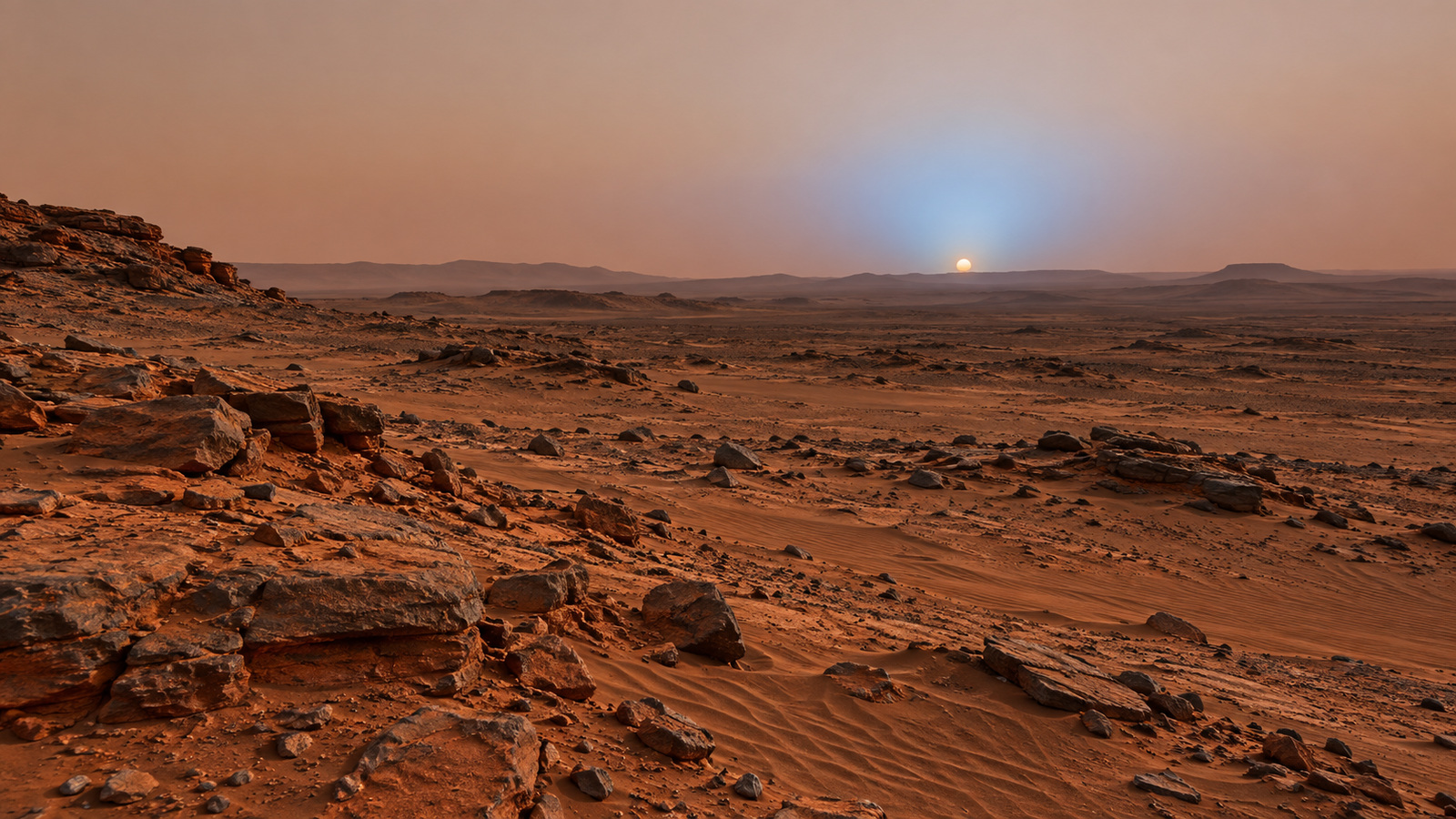
A Rusty Sky With a Blue Sunset Surprise
The question sounds simple because Mars is famous for red landscapes, but its sky does not have one permanent color. Rover photographs often show dusty tan, salmon, or reddish daylight, followed by a surprisingly blue region around the setting Sun. Those appearances arise mainly from suspended dust and the way sunlight interacts with particles of different sizes and compositions. The surface’s rusty minerals help explain the material available to the atmosphere, yet the sky is not merely reflecting a red planet underneath it. Viewing direction, dust abundance, and the length of sunlight’s path all matter. Understanding these details also explains why two authentic Mars pictures can display different colors without one being wrong. The atmosphere is a changing optical environment, not a fixed red ceiling.
Start With the Light Reaching Your Eyes
Sunlight contains a range of visible wavelengths that the eye interprets as different colors. A beam traveling through an atmosphere can be redirected, absorbed, or transmitted, and those processes alter what arrives from each direction. The sky becomes visible because some light reaches the observer after interacting with material away from the direct solar beam. Its color therefore depends on both the illuminating light and the properties of that material. A red-looking sky is a result of that combined journey, not a statement that sunlight was originally emitted as red light alone.
It is also useful to distinguish the Sun’s apparent color from the color of the surrounding sky. Looking toward the bright solar direction samples a different scattering geometry from looking high overhead or away from the Sun. On Mars, this distinction becomes particularly important around sunset, when the blue region is concentrated near the solar direction. A camera pointed elsewhere at the same time may show a much warmer-looking sky. That is a physical directional difference rather than a contradiction between simultaneous observations.
Why Earth’s Familiar Blue Is Not the Default
In a relatively clear earthly atmosphere, small gas molecules scatter shorter visible wavelengths more strongly, creating the familiar blue daytime sky. Mars also has gas molecules, but its thin atmosphere and suspended mineral dust produce a different balance of contributions. Dust particles are much larger than individual molecules, so their optical behavior cannot simply be described by the same small-particle rule. Their composition also affects absorption. Applying Earth’s clear-sky explanation unchanged to the Martian atmosphere misses the component that commonly dominates what a surface camera sees.
Dust Provides the Main Optical Ingredient
Wind lifts fine particles from Martian terrain and circulates them through the atmosphere. Iron-bearing minerals contribute to the material’s rusty appearance, but atmospheric color is shaped by scattering and absorption together. The particles need not all be identical, and their size distribution can change with the weather. Some dust remains suspended when there is no obvious nearby storm. Consequently, a calm-looking scene can still contain enough atmospheric material to influence sunlight substantially.
The suspended particles scatter light in a strongly directional manner. In ordinary daylight, their combined effect often gives the broader sky a muted reddish or brownish appearance. Near the solar direction, fine Martian dust can favor a visible blue contribution, particularly when the Sun is low. This is more precise than saying that dust always scatters only red or only blue. The answer depends on which direction is being sampled and how light has traveled through the dusty atmosphere.
Sunset Lengthens the Atmospheric Journey
When the Sun approaches the horizon, its light takes a longer path through the atmosphere before reaching a surface observer. The path encounters more dust than sunlight arriving from high overhead, changing the balance between direct transmission and scattered light. The region around the Sun can consequently develop a blue tint even while the surrounding sky remains dusty and warm. NASA’s sunrise and sunset explanation highlights the importance of fine dust in this characteristic effect. A Martian sunset is not simply an earthly sunset with all colors uniformly reversed.
The blue zone may appear as a halo or broader glow rather than a narrow ring with a sharp boundary. Its extent and contrast depend on dust conditions and viewing geometry. Landscape shadows, camera exposure, and the diminishing brightness of the Sun also change the visual impression. Photographs taken minutes apart can emphasize different features of the same event. Describing a sequence is usually more informative than assigning a single color to every Martian evening.
Particle properties also prevent an easy one-color formula. A population containing a different distribution of sizes would not produce exactly the same angular and spectral pattern. Absorption can remove some wavelengths while scattering redistributes others, and repeated interactions complicate the final signal. Researchers use physical models to connect those processes with actual observations. The rusty sky is therefore evidence about an atmospheric particle population, not just a pleasing visual hallmark of the planet.
Observer position changes this sunset experiment. A ridge can leave the Sun visible after a nearby basin’s horizon has hidden it, while observers at different elevations have different atmospheric columns overhead. The line toward a distant horizon also passes through more dust than a steep upward view under comparable conditions. A useful comparison therefore pairs frames with a similar solar height and camera direction, rather than merely selecting two reddish photographs from separate landing sites. Matching those conditions makes changes in haze or the near-solar halo easier to connect with the dust itself.
The Ground and Sky Are Related, Not Identical
Mars’s surface supplies much of its atmospheric dust, linking geological material to visible weather. That connection does not mean the sky is a mirror of whatever patch of ground happens to lie below a rover. Particles can travel far from their source, and the light reaching the camera follows a directional optical path through the atmosphere. The same ground can sit beneath different skies as dust abundance or illumination changes. A dark rock does not necessarily create a dark overhead sky, and a red plain does not dictate an equally red sunset. Material source and observed color belong to different stages of the explanation.
Imagine first looking at a sunlit red rock, then turning the camera upward into a clear patch of dusty sky. Light from the rock has interacted with a surface, whereas skylight has been redirected by particles suspended between the Sun and the camera. Related minerals can influence both signals without making them identical. Changing the viewing angle alters the atmospheric scattering geometry much more directly than it alters the rock’s composition.
A distant ridge offers a second comparison within the same landscape. Dust between the ridge and camera can weaken its contrast and add scattered light along the viewing path. A nearby rock can retain crisp dark edges while the distant ridge looks muted. The difference connects the sky’s haze with an observable loss of terrain visibility, rather than requiring the two regions to share one exact color.
Storms Change More Than the Palette
Dust storms increase the atmospheric load and can reduce the amount of sunlight reaching the surface. Small local events, regional activity, and much larger storms differ in duration and coverage. A photograph showing subdued contrast may reflect both scattered light and reduced direct illumination. Distant mountains can become difficult to distinguish as haze obscures the line of sight. These effects reveal changes in the atmosphere even when the image lacks an unmistakable wall of blowing dust.
For solar-powered spacecraft, sunlight reduction is an engineering concern as well as an optical observation. The relevant quantity is available energy over time, not whether the sky looks aesthetically darker or redder. Dust settling on hardware adds another problem distinct from particles suspended in the air. A mission’s power response therefore combines atmospheric transmission, surface deposition, and system design. The science of sky appearance connects to these practical issues without allowing color alone to predict every operational consequence.
Clouds Add Another Scattering Population
Water-ice clouds occur in the Martian atmosphere, and some high-altitude clouds involve carbon dioxide ice. These particles can produce pale features, brightness changes, or twilight displays that dust alone would not explain. Their altitude matters because a cloud may remain illuminated after the ground enters shadow. A bright evening cloud should therefore not automatically be labeled a dust plume. Context from timing, motion, temperature conditions, and other measurements helps distinguish competing interpretations.
Some clouds can show subtle colors when their particle sizes and illumination produce suitable scattering conditions. These are localized atmospheric features, not proof that Mars has acquired Earth’s global blue sky. Ice and dust may also interact because particles can contribute to cloud formation. The atmosphere is a mixture whose ingredients change with location and season. Separating those ingredients gives a richer interpretation than dividing every photograph into either red dust or clear blue air.
Weather observations benefit from repeated images rather than isolated attractive examples. A series can show how a feature moves, develops, or fades as lighting changes. Combining those views with atmospheric measurements helps constrain cloud height or dust optical depth. The aim is to identify a process consistent with several observations. A striking color alone is a starting clue rather than a complete meteorological diagnosis.
What Rover Cameras Mean by Color
A rover camera records signals through specific filters or sensor channels; it does not directly reproduce a human visual experience. Processing converts those measurements into a display that serves a purpose, such as approximating appearance or highlighting material differences. White-balanced images can adjust illumination so geological colors are easier to compare with familiar terrestrial conditions. Enhanced-color products can deliberately emphasize distinctions that would be subtler to an observer. These choices are legitimate when explained, but they answer different questions.
Calibration targets help separate a change in illumination from a change in a rock’s reflectance. Exposure introduces another practical distinction: bright sky and shaded terrain may exceed the range one frame records clearly. Increasing exposure to reveal the ground can wash out the solar region, while exposing for the sky can hide surface detail. A blue halo that retains its directional position across a well-characterized sequence is stronger evidence of atmospheric scattering than a hue judged from an isolated, strongly adjusted display. The physical pattern and the camera settings should be considered together.
Interpreting a Blue Sunset Photograph
Begin by identifying the Sun’s direction and the nearby blue area rather than assuming the entire atmosphere has turned blue. Notice how the sky changes away from that region and how terrain contrast behaves near the horizon. The image may reveal dust scattering while still containing exposure and processing choices that affect its presentation. NASA’s Opportunity sunset description connects the bluish halo with forward scattering by atmospheric dust. That explanation preserves the special geometry of the observation instead of treating blue as a new permanent Martian sky color.
A Color Story That Can Be Tested
Researchers can compare brightness at different wavelengths, directions, and times to constrain the dust producing a scene. Optical depth measures how strongly the atmosphere attenuates a beam, while angular scattering tells a different part of the story. A model that reproduces one color but fails the directional pattern is incomplete. Multiple measurements reduce the ambiguity left by a single photograph. The useful scientific question is which particle and atmospheric conditions account for the full collection of signals.
The most accurate answer to the title is therefore conditional: dust commonly gives Martian daylight a reddish or tan appearance, while its directional behavior can produce a blue solar region at sunset. Thin gas, ice clouds, storms, and image processing add further variation. None of those qualifications diminishes the planet’s distinctive appearance. They explain why Mars can remain the Red Planet while displaying evenings that surprise an observer accustomed to Earth. Its sky is a visible record of particles, sunlight, and geometry working together.


